Not on view
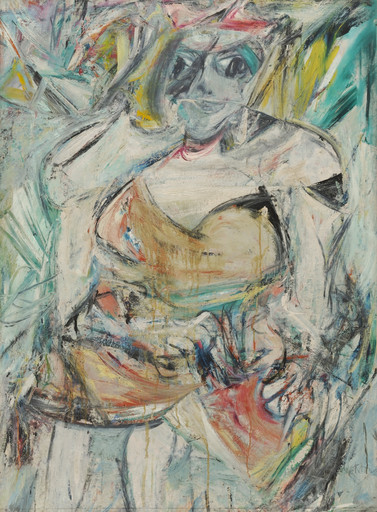
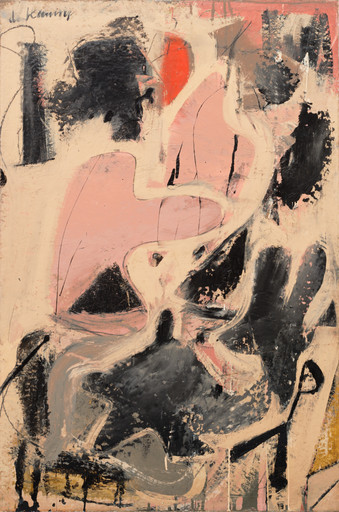
De Kooning’s mental and physical health was precarious from the late 1970s through the 1980s. Years of alcoholism were exacting their toll and, though he gave up drinking in 1981, he soon developed Alzheimer’s disease. By 1990, he stopped painting. Despite these challenges, he had fertile periods of productivity and stylistic reinvention. Breaking from his labored technique and from compositions characterized by density, he loosened and quickened his approach. This resulted in paintings like Pirate (Untitled II). Its free-flowing ribbons of color curving across patches of glowing white, yellow, pink, and green foreground de Kooning’s virtuosic hand. He used a taper’s knife (a flat-bladed tool used in drywall construction) to pull the paint into thick bands. This work was likely painted on top of an earlier discarded painting, whose original composition was sanded down to a ghost of itself. Bright and fresh, Pirate (Untitled II) belies the difficulty of the artist’s later years.
In The Studio: Postwar Abstract Painting online course, Coursera, 2017
Explore more
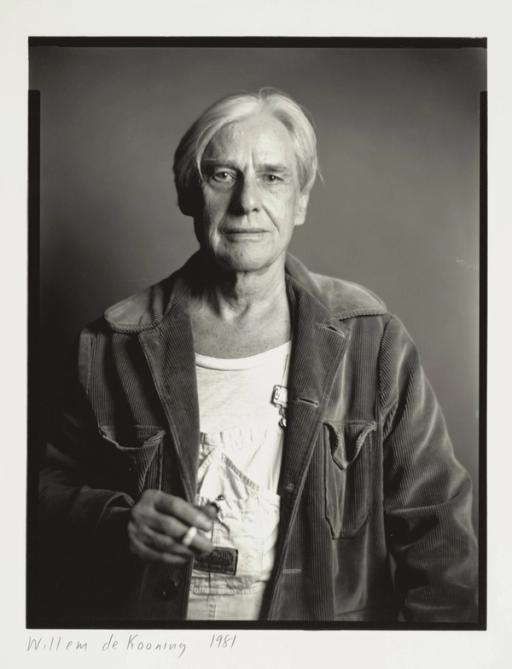
Willem de Kooning
American, born the Netherlands. 1904–1997 85 works onlineIf Jackson Pollock was the public face of the New York avant-garde , Willem de Kooning could be described as an artist’s artist, who was perceived by many of his peers as its leader.
Learn more →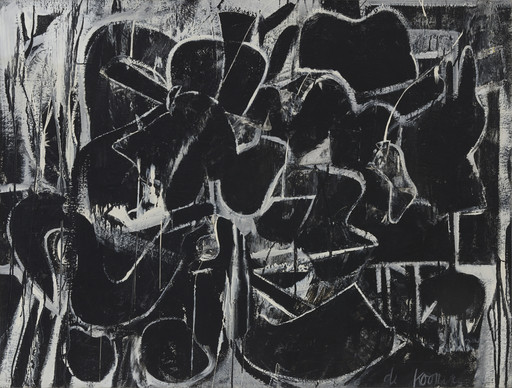
Audio
Audio from the playlist de Kooning: A Retrospective
From MoMA Design Store


Installation views
We have identified this work in the following photos from our exhibition history.
Licensing
Artwork or archival images
If you would like to reproduce an image of a work of art in MoMA's collection, or an image of a MoMA publication or archival material (including installation views, checklists, and press releases), please contact Art Resource (publication in North America) or Scala Archives (publication in all other geographic locations).
Audio and film clips
MoMA licenses archival audio and select out of copyright film clips from our film collection. At this time, MoMA produced video cannot be licensed by MoMA/Scala. All requests to license archival audio or out of copyright film clips should be addressed to Scala Archives at [email protected]. Motion picture film stills cannot be licensed by MoMA/Scala. For access to motion picture film stills for research purposes, please contact the Film Study Center at [email protected]. For more information about film loans and our Circulating Film and Video Library, please visit Circulating Film and Video Library.
Text from a publication or the archives
If you would like to reproduce text from a MoMA publication, please email [email protected]. If you would like to publish text from MoMA's archival materials, please fill out this permission form and send to [email protected].
Feedback
This record is a work in progress. If you have additional information or spotted an error, please fill out this feedback form.