With its black-and-white tones, The Charnel House was inspired by newspaper photographs showing piles of corpses in liberated Nazi concentration camps. Picasso depicted a murdered family unceremoniously tangled together under a dining table. With its varying degrees of finish—you can see traces of charcoal and sections of blank canvas—and vast network of undulating lines and geometric shapes, Picasso seems to have obscured legibility in favor of generating a rhythmic abstraction. As if questioning the ability of painting to represent war, he created a shifting, spectral vision.
2019
Explore more
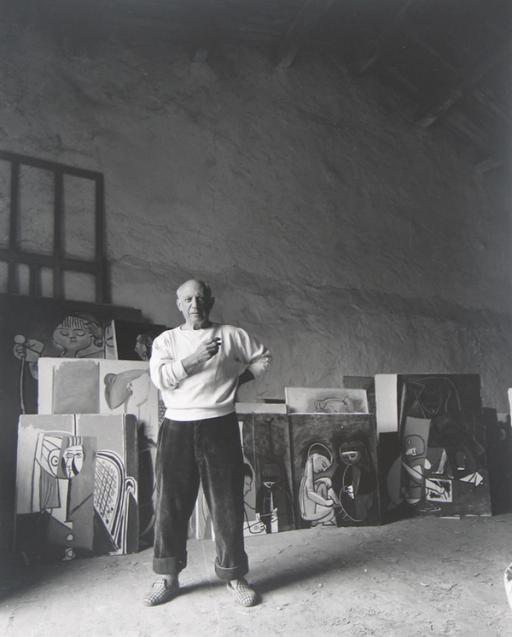
Pablo Picasso
Spanish, 1881–1973 1251 works onlineWith these words, Picasso shed light on two central principles of his artistic production over nearly 80 years: his openness to a diverse range of styles, subject matters, and mediums, and his resistance to the notion that change in art necessarily corresponds to improvement or progress.
Learn more →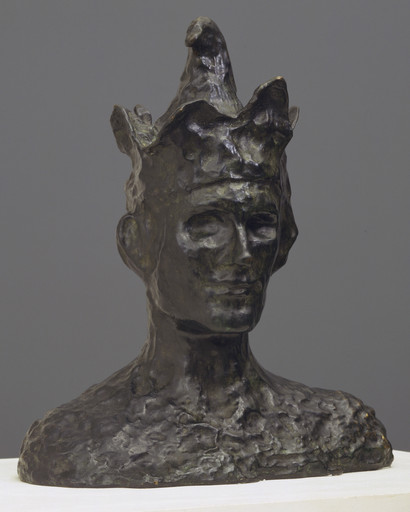
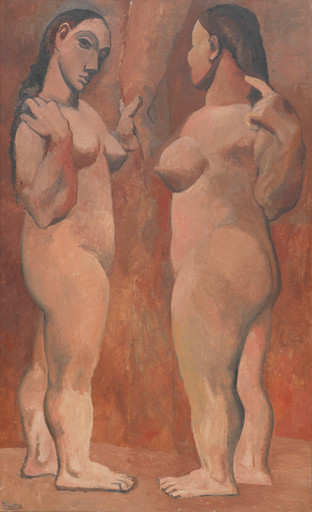
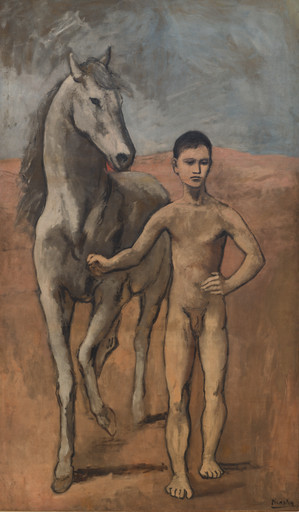
From MoMA Design Store


Installation views
We have identified this work in the following photos from our exhibition history.
Provenance Research Project
This work is included in the Provenance Research Project, which investigates the ownership history of works in MoMA's collection.
1945 - 1954, Pablo Picasso, Paris.
1954 - 1971, Walter P. Chrysler, Jr., New York and Warrenton, Virginia, purchased from the artist.
1971, The Museum of Modern Art, New York, acquired by exchange and purchased from Walter P. Chrysler, Jr.
Provenance research is a work in progress, and is frequently updated with new information. If you have any questions or information to provide about the listed works, please email [email protected] or write to:
Provenance Research Project
The Museum of Modern Art
11 West 53 Street
New York, NY 10019
Licensing
Artwork or archival images
If you would like to reproduce an image of a work of art in MoMA's collection, or an image of a MoMA publication or archival material (including installation views, checklists, and press releases), please contact Art Resource (publication in North America) or Scala Archives (publication in all other geographic locations).
Audio and film clips
MoMA licenses archival audio and select out of copyright film clips from our film collection. At this time, MoMA produced video cannot be licensed by MoMA/Scala. All requests to license archival audio or out of copyright film clips should be addressed to Scala Archives at [email protected]. Motion picture film stills cannot be licensed by MoMA/Scala. For access to motion picture film stills for research purposes, please contact the Film Study Center at [email protected]. For more information about film loans and our Circulating Film and Video Library, please visit Circulating Film and Video Library.
Text from a publication or the archives
If you would like to reproduce text from a MoMA publication, please email [email protected]. If you would like to publish text from MoMA's archival materials, please fill out this permission form and send to [email protected].
Feedback
This record is a work in progress. If you have additional information or spotted an error, please fill out this feedback form.