Oil and pencil on pillow, quilt, and sheet on wood supports
Not on view
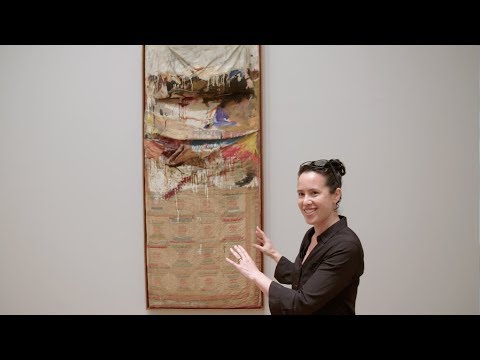
Bed is one of Robert Rauschenberg’s first combines, a term he coined to describe the works resulting from his technique of attaching found objects to a traditional canvas support. In this work, however, there is no canvas. The artist took a well-worn pillow, sheet, and quilt, scribbled on them with pencil, splashed them with paint in a style similar to Jackson Pollock’s action paintings, and hung the entire ensemble on the wall.
Rauschenberg used his own bedding (and a quilt from Dorothea Rockburne) to make Bed, because he could not afford to buy a new canvas. “It was very simply put together, because I actually had nothing to paint on,” he reflected years later. “Except it was summertime, it was hot, so I didn’t need the quilt. So the quilt was, I thought, abstracted. But it wasn’t abstracted enough, so that no matter what I did to it, it kept saying, ‘I’m a bed.’ So, finally I gave in and I gave it a pillow.”
Hung on the wall like a traditional painting, his bed becomes a sort of intimate self-portrait consistent with his assertion that “painting relates to both art and life…I try to act in that gap between the two.”
Explore more
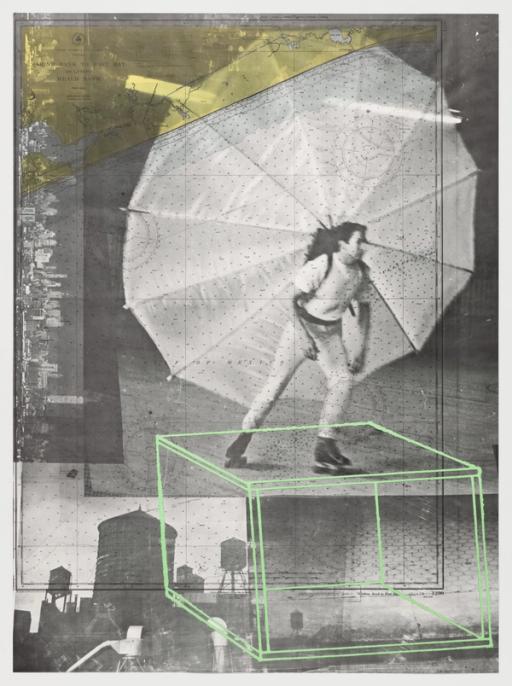
Robert Rauschenberg
American, 1925–2008 380 works onlineRobert Rauschenberg worked in a wide range of mediums including painting, sculpture, prints, photography, and performance, over the span of six decades.
Learn more →
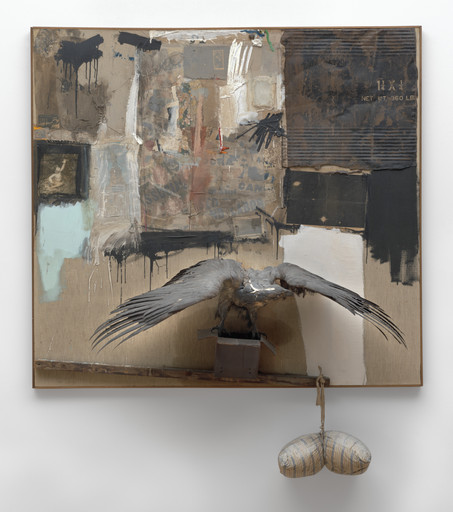
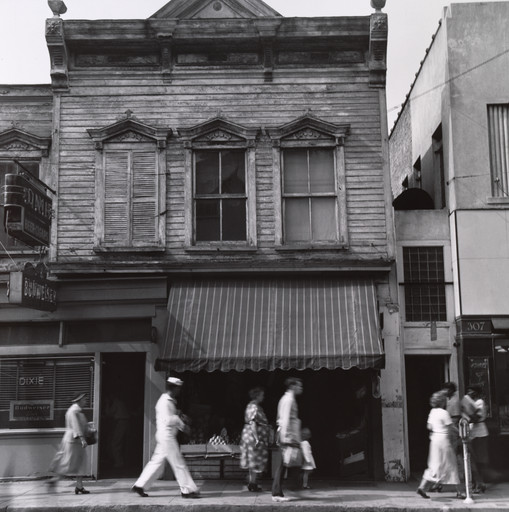
Combine
Term coined by Jasper Johns to describe a body of work by Robert Rauschenberg consisting of three-dimensional objects integrated into paintings.
Learn more →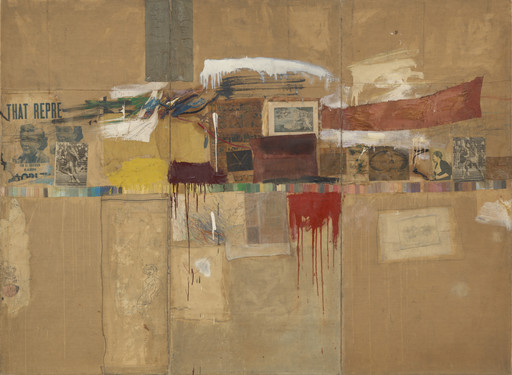

Audio
Audio from the playlist Audio Descriptions
Audio from the playlist Robert Rauschenberg: Among Friends
Audio from the playlist Kids
Audio from the playlist 1950–1980: Works from the Collection
Articles and videos
From MoMA Design Store


Installation views
We have identified this work in the following photos from our exhibition history.
Licensing
Artwork or archival images
If you would like to reproduce an image of a work of art in MoMA's collection, or an image of a MoMA publication or archival material (including installation views, checklists, and press releases), please contact Art Resource (publication in North America) or Scala Archives (publication in all other geographic locations).
Audio and film clips
MoMA licenses archival audio and select out of copyright film clips from our film collection. At this time, MoMA produced video cannot be licensed by MoMA/Scala. All requests to license archival audio or out of copyright film clips should be addressed to Scala Archives at [email protected]. Motion picture film stills cannot be licensed by MoMA/Scala. For access to motion picture film stills for research purposes, please contact the Film Study Center at [email protected]. For more information about film loans and our Circulating Film and Video Library, please visit Circulating Film and Video Library.
Text from a publication or the archives
If you would like to reproduce text from a MoMA publication, please email [email protected]. If you would like to publish text from MoMA's archival materials, please fill out this permission form and send to [email protected].
Feedback
This record is a work in progress. If you have additional information or spotted an error, please fill out this feedback form.