Not on view
Though executed entirely in oil paint, The Rope Dancer Accompanies Herself with Her Shadows grew out of Man Ray’s numerous collage experiments. The work’s original composition was inspired by the view of a tightrope dancer in a vaudeville performance. Back in his studio, Man Ray cut colored paper into shapes resembling his memory of the dancer’s acrobatic movements but, dissatisfied with what he had done, he discarded the scraps on the floor. Glancing down, he noticed that by chance they had formed an abstract pattern. Comparing the accidental pattern with shadows that a dancer might have cast, he incorporated it into his composition.
The dancer is outlined in grey and white at the top of the canvas, her legs and fluttering skirt shown in various positions simultaneously. Similarly, Man Ray depicts the tightrope six ways; each line swinging out from her feet atop the large planes of color, which represent the “shadows” cast by her figure.
Gallery label from 2020
Man Ray became dissatisfied with his original composition for this work inspired by a tightrope performance he had seen in a vaudeville show. He had originally arranged pieces of colored paper cut into the shapes of the tightrope dancer’s acrobatic forms. Glancing down at the floor, he noticed that the discarded scraps of paper from which the shapes had been cut formed an abstract pattern resulting from chance. Comparing the accidental pattern with shadows that a dancer might have cast on the floor, he incorporated it into his composition.
2020
Explore more
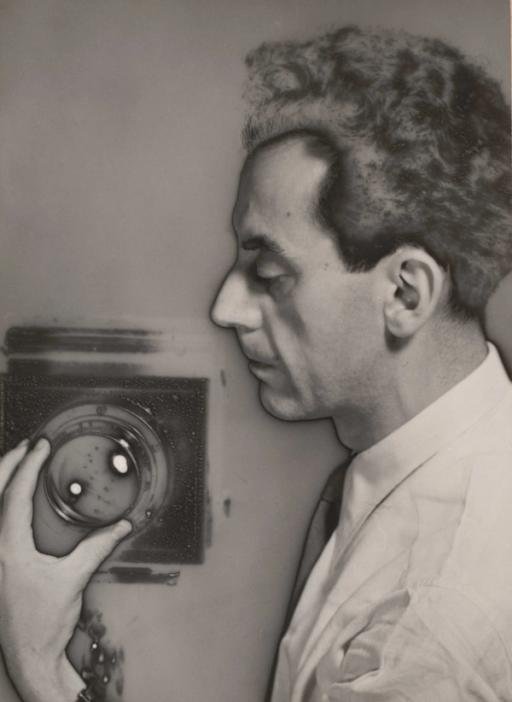
Man Ray (Emmanuel Radnitzky)
American, 1890–1976 196 works onlineSo enthused Man Ray (born Emmanuel Radnitzky) in 1922, shortly after his first experiments with camera-less photography. He remains well known for these images, commonly called photograms but which he dubbed “rayographs” in a punning combination of his own name and the word “photograph.
Learn more →




Audio
Audio from the playlist 1880–1950: Works from the Collection
From MoMA Design Store


Installation views
We have identified this work in the following photos from our exhibition history.
Provenance Research Project
This work is included in the Provenance Research Project, which investigates the ownership history of works in MoMA's collection.
1916 - 1939, Man Ray, New York, Paris and Los Angeles.
1939 - 1947, Peggy Guggenheim, Paris, New York and Venice, acquired from Man Ray.
1947 - 1954, State University of Iowa, Iowa City, Iowa, acquired as gift from Peggy Guggenheim.
1954, The Museum of Modern Art, New York, purchased and acquired in exchange from State University of Iowa.
Provenance research is a work in progress, and is frequently updated with new information. If you have any questions or information to provide about the listed works, please email [email protected] or write to:
Provenance Research Project
The Museum of Modern Art
11 West 53 Street
New York, NY 10019
Licensing
Artwork or archival images
If you would like to reproduce an image of a work of art in MoMA's collection, or an image of a MoMA publication or archival material (including installation views, checklists, and press releases), please contact Art Resource (publication in North America) or Scala Archives (publication in all other geographic locations).
Audio and film clips
MoMA licenses archival audio and select out of copyright film clips from our film collection. At this time, MoMA produced video cannot be licensed by MoMA/Scala. All requests to license archival audio or out of copyright film clips should be addressed to Scala Archives at [email protected]. Motion picture film stills cannot be licensed by MoMA/Scala. For access to motion picture film stills for research purposes, please contact the Film Study Center at [email protected]. For more information about film loans and our Circulating Film and Video Library, please visit Circulating Film and Video Library.
Text from a publication or the archives
If you would like to reproduce text from a MoMA publication, please email [email protected]. If you would like to publish text from MoMA's archival materials, please fill out this permission form and send to [email protected].
Feedback
This record is a work in progress. If you have additional information or spotted an error, please fill out this feedback form.