Casein tempera on hardboard
Not on view
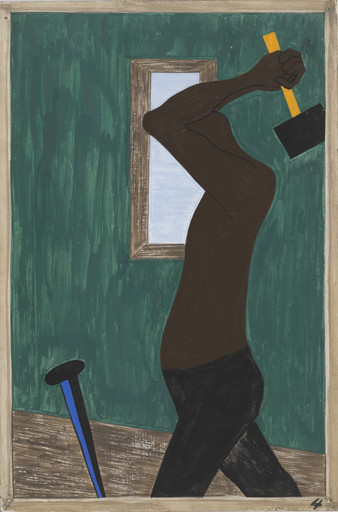
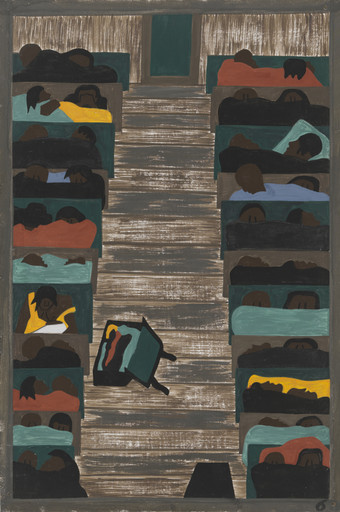
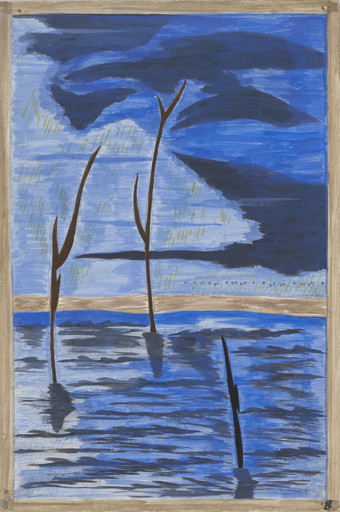
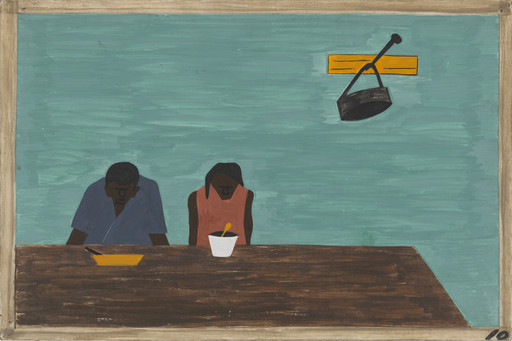
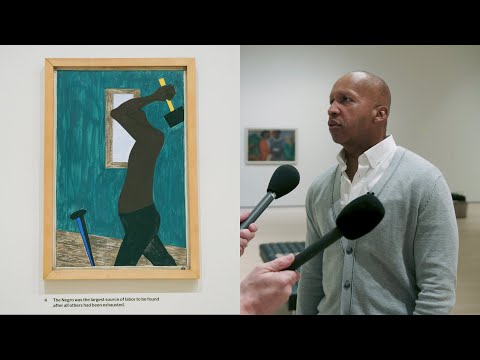
These thirty paintings constitute half of the sixty-panel Migration Series, shared between MoMA and the Phillips Collection in Washington, D.C. Lawrence took as his subject the exodus of African Americans from the rural South to Northern cities during and after World War I, when industry's demand for workers attracted them in vast numbers. As the son of migrants, Lawrence had a personal connection to the topic. He researched the subject extensively and wrote the narrative before making the paintings, taking seriously the dual roles of educator and artist.
Lawrence was influenced by the work of the Mexican muralists and earlier artists such as Goya, but he drew his stylistic inspiration primarily from the Harlem community in which he lived. The vivid pattern and color—created in tempera paint as Lawrence worked on all the panels at once—reflect an aesthetic that itself had migrated from the South.
2012.
Publication excerpt from MoMA Highlights: 375 Works from The Museum of Modern Art, New York (New York: The Museum of Modern Art, 2019)
During the first half of the twentieth century, as the expanding modern industries in America’s northern cities demanded ever more workers, great numbers of African Americans saw a chance to escape the poverty and discrimination of the rural South. Between 1916 and 1930, more than a million people moved north. Lawrence’s parents made the journey, and he grew up hearing stories about it; as a young artist living in Harlem, the heart of New York’s African American community, he recognized it as an epic theme. Originally known as The Migration of the Negro but renamed by the artist in 1993, this cycle of sixty images—each accompanied by a caption written by the artist—chronicles a great exodus and arrival.
Visually, the cycle advances through panels of incident and panels of near abstraction and emptiness. Using exaggerated perspectives, rhythmic compositions, astringent colors, and angular figures, Lawrence bent decorative forms to the task of history, making social realism compatible with abstract art. African Americans met with a mixed reception in the North; along with jobs, the vote, and education, the new life brought unhealthy living conditions, civil unrest, and other trials, all documented in Lawrence’s cycle along with his community’s heroic perseverance in facing them.
MoMA Highlights: 375 Works from The Museum of Modern Art, New York (New York: The Museum of Modern Art, 2019)
Gallery label from "Collection 1940s—2970s", 2019
In these works Lawrence focuses on the Great Migration, the exodus of African Americans from the rural South to northern and western cities beginning during World War I. The son of migrants himself, Lawrence researched extensively before starting to paint, distilling this relocation of millions into intimate vignettes. The series contains sixty panels in all, thirty of which appear here. Through an unusual decision to split the work in half, the Phillips Collection in Washington, DC, acquired the odd-numbered panels and MoMA the even-numbered ones. Using vibrant patterns, blocks of color, and pared-down, angular figures and forms, Lawrence tells a clear story of a historic event.
"Collection 1940s—2970s", 2019
Explore more
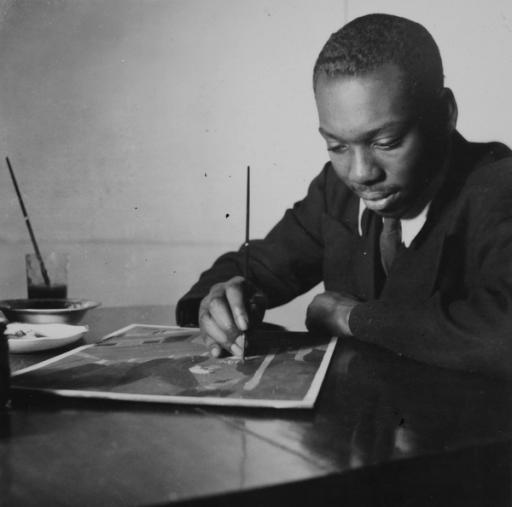
Jacob Lawrence
American, 1917–2000 41 works onlineThough he came of age before the Civil Rights Movement brought African Americans the rights they had long been denied, Lawrence forged a prominent career as an artist, chronicling the story of Black life in America through his paintings.
Learn more →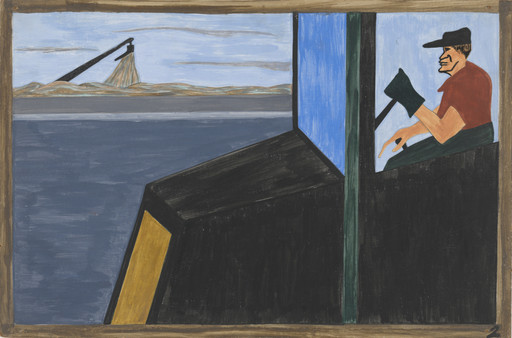
Articles and videos
From MoMA Design Store


Installation views
We have identified this work in the following photos from our exhibition history.
Licensing
Artwork or archival images
If you would like to reproduce an image of a work of art in MoMA's collection, or an image of a MoMA publication or archival material (including installation views, checklists, and press releases), please contact Art Resource (publication in North America) or Scala Archives (publication in all other geographic locations).
Audio and film clips
MoMA licenses archival audio and select out of copyright film clips from our film collection. At this time, MoMA produced video cannot be licensed by MoMA/Scala. All requests to license archival audio or out of copyright film clips should be addressed to Scala Archives at [email protected]. Motion picture film stills cannot be licensed by MoMA/Scala. For access to motion picture film stills for research purposes, please contact the Film Study Center at [email protected]. For more information about film loans and our Circulating Film and Video Library, please visit Circulating Film and Video Library.
Text from a publication or the archives
If you would like to reproduce text from a MoMA publication, please email [email protected]. If you would like to publish text from MoMA's archival materials, please fill out this permission form and send to [email protected].
Feedback
This record is a work in progress. If you have additional information or spotted an error, please fill out this feedback form.