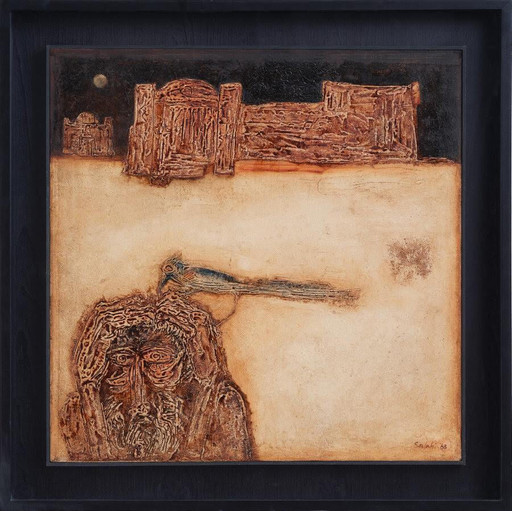
A writer, critic, politician, and foundational African modernist, El-Salahi merges a range of influences in his work, from Sudanese decorative elements and Arabic calligraphy, which he has practiced since childhood, to the Western formal traditions he studied at London’s Slade School of Fine Art in the mid-1950s. The Mosque, with its architectural minarets, suggestion of calligraphic forms in motion, and elongated figure at right, attests to these various inspirations. One of a group of paintings made following the death of his father in October 1964, this work features imagery drawn from a series of resulting dreams. Unified by a pared-down palette and depicted with a notable flatness, its representational forms merge with geometric motifs to create a pulsating visual field. “The purpose,” El-Salahi has reflected, “is to evoke the essence rather than the physical reality: this is the truth that lies beneath all my works—an invitation to meditation.”
A founder of the Sudanese modern art movement known as the Khartoum School in 1960, El-Salahi expanded his knowledge of global modernism through travel to Mexico, Brazil, and the United States throughout the 1960s. In 1964 he received a Rockefeller Foundation grant to visit New York, where he befriended artists including Romare Bearden, Richard Hunt, and Jacob Lawrence and met MoMA’s founding director, Alfred H. Barr, Jr., who acquired this work for the Museum’s collection the following year.
MoMA Highlights: 375 Works from The Museum of Modern Art, New York (New York: The Museum of Modern Art, 2019)
Gallery label from 2023
El-Salahi references a range of traditions in his work, from Sudanese decorative art to Arabic calligraphy, which he has practiced since childhood. The Mosque, with its architectural minarets, swirling forms, and stylized figure at right, attests to these influences. Notably flat and unified by a simplified palette, the painting merges representational elements with geometric motifs to create a pulsating visual field. “Through the abstracted rhythmic shapes of calligraphy,” El-Salahi reflected, “I have been led to visualize the presence of objects, the human figure and a whole world of imagery.”
2023
Explore more

From MoMA Design Store


Installation views
We have identified this work in the following photos from our exhibition history.
Licensing
Artwork or archival images
If you would like to reproduce an image of a work of art in MoMA's collection, or an image of a MoMA publication or archival material (including installation views, checklists, and press releases), please contact Art Resource (publication in North America) or Scala Archives (publication in all other geographic locations).
Audio and film clips
MoMA licenses archival audio and select out of copyright film clips from our film collection. At this time, MoMA produced video cannot be licensed by MoMA/Scala. All requests to license archival audio or out of copyright film clips should be addressed to Scala Archives at [email protected]. Motion picture film stills cannot be licensed by MoMA/Scala. For access to motion picture film stills for research purposes, please contact the Film Study Center at [email protected]. For more information about film loans and our Circulating Film and Video Library, please visit Circulating Film and Video Library.
Text from a publication or the archives
If you would like to reproduce text from a MoMA publication, please email [email protected]. If you would like to publish text from MoMA's archival materials, please fill out this permission form and send to [email protected].
Feedback
This record is a work in progress. If you have additional information or spotted an error, please fill out this feedback form.