The Voice is one of a number of paintings by European and American artists that appear to have a nearly blank surface. Newman interrupted his solid white canvas with a slightly darker white “zip,” a vertical line similar to those that comprise Cage’s 4’33”. Through The Voice, Newman was seeking a sense of the “sublime,” which he described as being at the intersection of beauty, transcendence, and the liberation from European culture in his article “The Sublime Is Now,” published in the magazine The Tiger’s Eye in 1948.
Historically, for many musicians and artists, the search for an otherworldly plane of being is a lifelong quest. Whereas Newman sought it through his paintings, which balance scale, color, and composition, Cage sought it through practicing Buddhism, playing chess with Marcel Duchamp, taking long walks, foraging mushrooms, and composing music of chance and silence.
There Will Never Be Silence: Scoring John Cage’s 4’33”, October 12, 2013–June 22, 2014.
Gallery label from 2011.
Newman was one of several Abstract Expressionists who made paintings that downplay traceable signs of the artist’s hand. In The Voice, the paint is applied so evenly that the only hint of texture comes from the weave of the canvas itself. The broad expanse of white is interrupted by an off-center “zip” of slightly darker white. The title deftly makes use of paradox, as it contradicts the silent mood of the pure white field.
2011.
Explore more
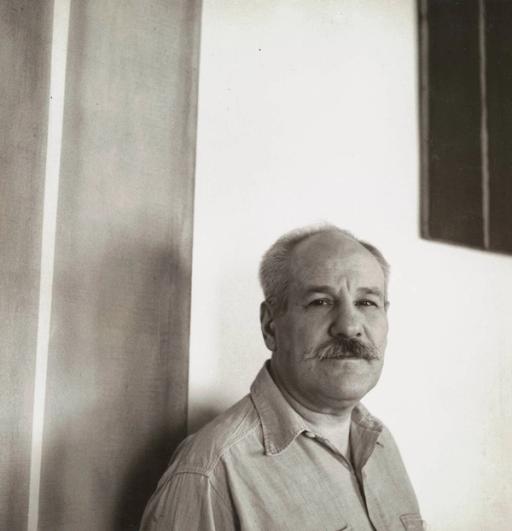
Barnett Newman
American, 1905–1970 61 works onlinePainter and theorist Barnett Newman was one of the most intellectual artists of the New York School. He was born and raised in New York, the son of Polish Jewish immigrants.
Learn more →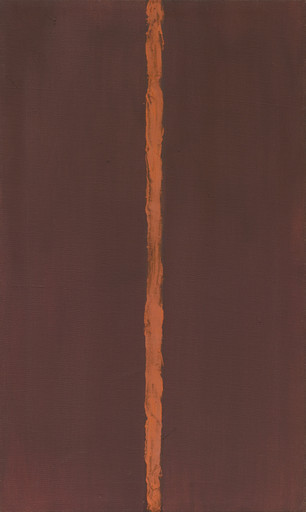
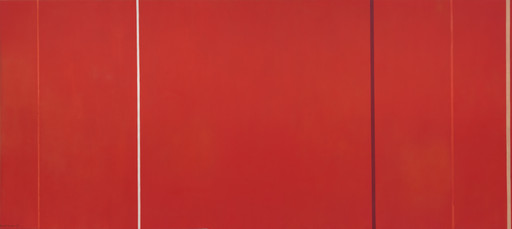
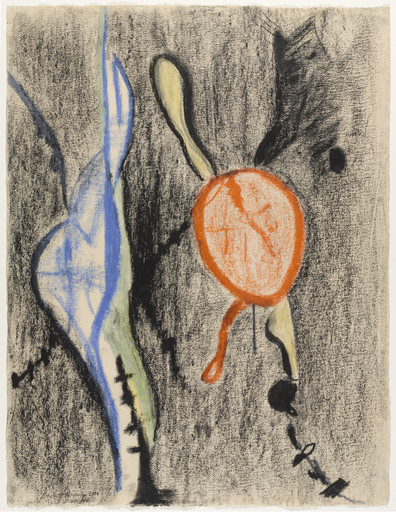

From MoMA Design Store


Installation views
We have identified this work in the following photos from our exhibition history.
Licensing
Artwork or archival images
If you would like to reproduce an image of a work of art in MoMA's collection, or an image of a MoMA publication or archival material (including installation views, checklists, and press releases), please contact Art Resource (publication in North America) or Scala Archives (publication in all other geographic locations).
Audio and film clips
MoMA licenses archival audio and select out of copyright film clips from our film collection. At this time, MoMA produced video cannot be licensed by MoMA/Scala. All requests to license archival audio or out of copyright film clips should be addressed to Scala Archives at [email protected]. Motion picture film stills cannot be licensed by MoMA/Scala. For access to motion picture film stills for research purposes, please contact the Film Study Center at [email protected]. For more information about film loans and our Circulating Film and Video Library, please visit Circulating Film and Video Library.
Text from a publication or the archives
If you would like to reproduce text from a MoMA publication, please email [email protected]. If you would like to publish text from MoMA's archival materials, please fill out this permission form and send to [email protected].
Feedback
This record is a work in progress. If you have additional information or spotted an error, please fill out this feedback form.