Oil on canvas
Not on view
Delaunay was fascinated by how the interaction of colors produces sensations of depth and movement, without reference to the natural world. In Simultaneous Contrasts that movement is the rhythm of the cosmos, for the painting's circular frame is a sign for the universe, and its flux of reds and oranges, greens and blues, is attuned to the sun and the moon, the rotation of day and night. But the star and planet, refracted by light, go undescribed in any literal way. "The breaking up of form by light creates colored planes," Delaunay said. "These colored planes are the structure of the picture, and nature is no longer a subject for description but a pretext." Indeed, he had decided to abandon "images or reality that come to corrupt the order of color."
The poet Guillaume Apollinaire christened Delaunay's style "Orphism," after Orpheus, the musician of Greek legend whose eloquence on the lyre is a mythic archetype for the power of art. The musicality of Delaunay's work lay in color, which he studied closely. In fact, he derived the phrase "Simultaneous Contrasts" from the treatise On the Law of the Simultaneous Contrast of Colors, published in 1839 by Michel-Eugène Chevreul. Absorbing Chevreul's scientific analyses, Delaunay has here gone beyond them into a mystical belief in color, its fusion into unity symbolizing the possibility for harmony in the chaos of the modern world.
The Museum of Modern Art, MoMA Highlights, New York: The Museum of Modern Art, revised 2004, originally published 1999.
Explore more

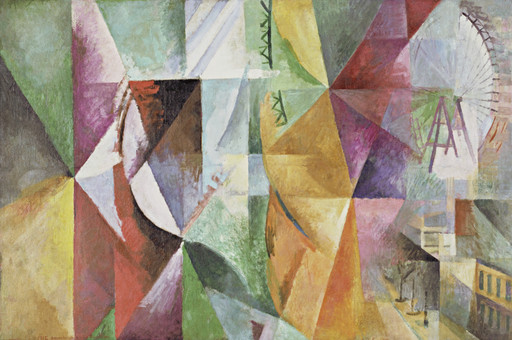
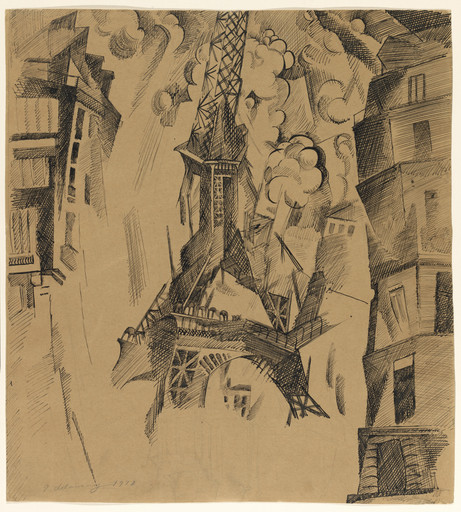
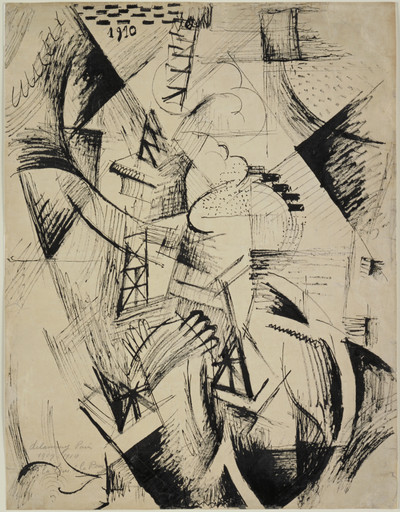

Orphism
A Cubist -influenced style of painting developed around 1912 by Robert and Sonia Delaunay and František Kupka , who turned to abstraction as a way to explore pure color and the effects of light.
Learn more →

From MoMA Design Store


Installation views
We have identified this work in the following photos from our exhibition history.
Provenance Research Project
This work is included in the Provenance Research Project, which investigates the ownership history of works in MoMA's collection.
1913 - 1940/41, Robert Delaunay, Paris.
1940/41 - 1945, Peggy Guggenheim (Art of This Century), New York, purchased from the artist.
1945, Stephan C. Lion, New York, purchased from Art of This Century gallery.
November 31, 1945 - January 7, 1954, Jacques Seligmann & Co., Inc., New York (stock no. 7355), purchased from Stephan C. Lion.
1954, The Museum of Modern Art, New York, purchased from Jacques Seligmann & Co.
Provenance research is a work in progress, and is frequently updated with new information. If you have any questions or information to provide about the listed works, please email [email protected] or write to:
Provenance Research Project
The Museum of Modern Art
11 West 53 Street
New York, NY 10019
Licensing
Artwork or archival images
If you would like to reproduce an image of a work of art in MoMA's collection, or an image of a MoMA publication or archival material (including installation views, checklists, and press releases), please contact Art Resource (publication in North America) or Scala Archives (publication in all other geographic locations).
Audio and film clips
MoMA licenses archival audio and select out of copyright film clips from our film collection. At this time, MoMA produced video cannot be licensed by MoMA/Scala. All requests to license archival audio or out of copyright film clips should be addressed to Scala Archives at [email protected]. Motion picture film stills cannot be licensed by MoMA/Scala. For access to motion picture film stills for research purposes, please contact the Film Study Center at [email protected]. For more information about film loans and our Circulating Film and Video Library, please visit Circulating Film and Video Library.
Text from a publication or the archives
If you would like to reproduce text from a MoMA publication, please email [email protected]. If you would like to publish text from MoMA's archival materials, please fill out this permission form and send to [email protected].
Feedback
This record is a work in progress. If you have additional information or spotted an error, please fill out this feedback form.