Screenprint with collage additions from a portfolio of nine screenprints and one collage
Not on view
Techniques and strategies of commercial printing are fundamental to the visual language of Roy Lichtenstein's celebrated Pop style. The Benday dots and regularized stripes he used for tone, the clarifying black outlines, the flat areas of bold primary color, and the simplification and schematization of his compositions are all elements embraced by consumer culture to create the inescapable printed imagery aimed at mass audiences.
The subject matter that first brought Lichtenstein's work to public attention was appropriated from comic strips, but his later themes owed their visual syntax to themes from "high" culture, particularly the history of modern art...like German Expressionism and Art Deco, as well as the time-honored motif of landscape in art. In every case, his sense of irony is coupled with a strikingly positive spirit.
Printmaking was integral to Lichtenstein's practice from the time he was a student, and in the early 1950s he regularly entered regional print exhibitions. But it was his Pop style that attracted the professional workshops established in the 1960s, and his work was instrumental in the renaissance of American printmaking at that time. His mechanized aesthetic was particularly in keeping with the technical expertise offered at Gemini G.E.L., and his early collaborations there were undertaken with Kenneth Tyler, a printer he continued to work with at Tyler Graphics. Donald Saff, then of Graphicstudio, was another technical wizard who urged Lichtenstein to make prints. In all he created some three hundred fifty printed images, primarily with a series format that echoed his work in painting. In addition to traditional prints, he created ephemeral projects in the spirit of Pop art, like wallpaper, gift wrap, and paper plates, and also made many benefit prints and posters for social and political causes.
Originally from TextEntryID 69575 (TextTypeID 127)
removed the second paragraph:
The subject matter that first brought Lichtenstein's work to public attention was appropriated from comic strips, but his later themes owed their visual syntax to themes from "high" culture, particularly the history of modern art. Illustrated here are examples of his interpretations of German Expressionism and Art Deco, as well as the time-honored motif of landscape in art. In every case, his sense of irony is coupled with a strikingly positive spirit.
Deborah Wye, Artists and Prints: Masterworks from The Museum of Modern Art, New York: The Museum of Modern Art, 2004, p. 168.
Explore more
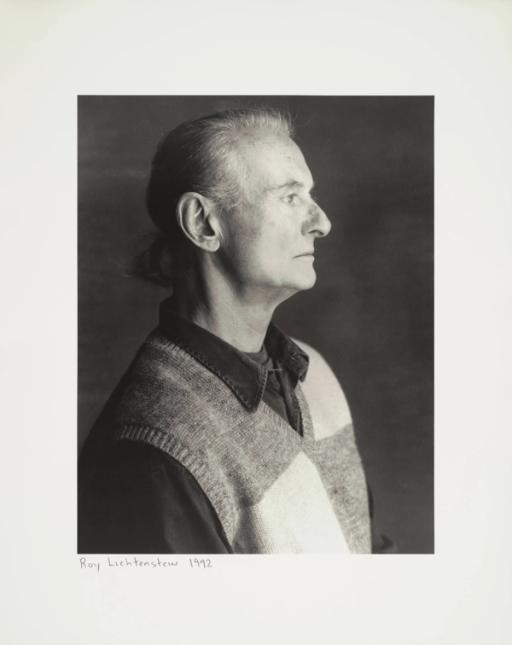
Roy Lichtenstein
American, 1923–1997 155 works onlineA key figure in the Pop art movement and beyond, Roy Lichtenstein grounded his profoundly inventive career in imitation—beginning by borrowing images from comic books and advertisements in the early 1960s, and eventually encompassing those of everyday objects, artistic styles, and art history itself.
Learn more →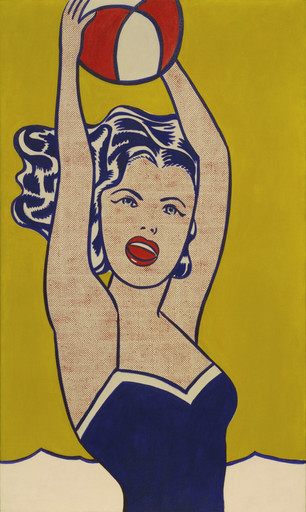
From MoMA Design Store


Installation views
We have identified this work in the following photos from our exhibition history.
Licensing
Artwork or archival images
If you would like to reproduce an image of a work of art in MoMA's collection, or an image of a MoMA publication or archival material (including installation views, checklists, and press releases), please contact Art Resource (publication in North America) or Scala Archives (publication in all other geographic locations).
Audio and film clips
MoMA licenses archival audio and select out of copyright film clips from our film collection. At this time, MoMA produced video cannot be licensed by MoMA/Scala. All requests to license archival audio or out of copyright film clips should be addressed to Scala Archives at [email protected]. Motion picture film stills cannot be licensed by MoMA/Scala. For access to motion picture film stills for research purposes, please contact the Film Study Center at [email protected]. For more information about film loans and our Circulating Film and Video Library, please visit Circulating Film and Video Library.
Text from a publication or the archives
If you would like to reproduce text from a MoMA publication, please email [email protected]. If you would like to publish text from MoMA's archival materials, please fill out this permission form and send to [email protected].
Feedback
This record is a work in progress. If you have additional information or spotted an error, please fill out this feedback form.