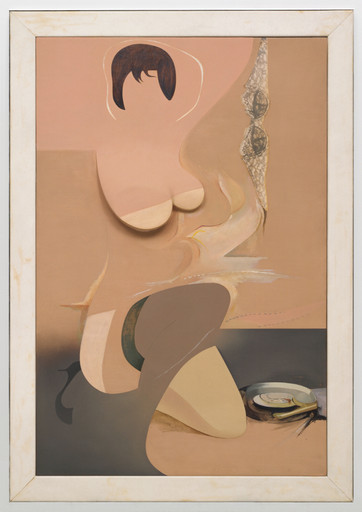
Richard Hamilton became the seminal figure in the formation of England's Pop idiom through his analytical investigations of the media's influence on our perception of reality. As an active member of London's progressive Independent Group in the early 1950s, he first studied the impact of popular culture on art and created collages incorporating advertisements from mass-circulation newspapers and magazines, a technique that served as the basis for Interior. Through a complex layering of painting and photographic techniques, he continues to examine issues of illusion and the processes of image-making. Always eager to embrace new technologies, Hamilton has experimented with computer-generated imagery since the 1980s.
Hamilton typically scrutinizes a motif through a variety of mediums, reiterating and reinterpreting from collage to painting to print, frequently combining techniques. An experimental and prolific printmaker, he has explored nearly every process except relief—from screenprint and collotype to intaglio and digital formats—since first trying etching in 1939. Although he remains preoccupied with photography and issues of reproduction, his more than two hundred prints range from mechanical manipulations of photographic images to intricate hand-drawn compositions, and he has collaborated with master printers around the world to achieve these wide-ranging effects.
Hamilton was integral in revolutionizing the screenprint medium as a tool for artistic invention in the 1960s. For My Marilyn he appropriated publicity stills of Marilyn Monroe published in a British magazine after her suicide. Respecting Monroe's own hand-drawn Xs, Hamilton vowed not to make any marks of his own, choosing instead to create painterly effects by enlarging, masking, screening, and overprinting. At the other extreme in his work is the series of elaborate intaglios illustrating James Joyce's Ulysses, based on sketches from the 1940s. The transmogrifications of Bloom parallels the novel's surrealistic chapter in which Bloom metamorphoses through genders and guises during a midnight brothel encounter.
an essay by Wendy Weitman, in Deborah Wye, Artists and Prints: Masterworks from The Museum of Modern Art, New York: The Museum of Modern Art, 2004, p. 174.
Explore more


From MoMA Design Store


Installation views
We have identified this work in the following photos from our exhibition history.
Licensing
Artwork or archival images
If you would like to reproduce an image of a work of art in MoMA's collection, or an image of a MoMA publication or archival material (including installation views, checklists, and press releases), please contact Art Resource (publication in North America) or Scala Archives (publication in all other geographic locations).
Audio and film clips
MoMA licenses archival audio and select out of copyright film clips from our film collection. At this time, MoMA produced video cannot be licensed by MoMA/Scala. All requests to license archival audio or out of copyright film clips should be addressed to Scala Archives at [email protected]. Motion picture film stills cannot be licensed by MoMA/Scala. For access to motion picture film stills for research purposes, please contact the Film Study Center at [email protected]. For more information about film loans and our Circulating Film and Video Library, please visit Circulating Film and Video Library.
Text from a publication or the archives
If you would like to reproduce text from a MoMA publication, please email [email protected]. If you would like to publish text from MoMA's archival materials, please fill out this permission form and send to [email protected].
Feedback
This record is a work in progress. If you have additional information or spotted an error, please fill out this feedback form.