Conceptual in nature, Hanne Darboven's art deals with the passage of time and implies the human desire to stop it. The main component of her practice is continuous daily writing that both articulates the measurement of days and eliminates their arbitrary separation. Systems of ordering time based on numbers, musical notations, and calendars have been her principal points of departure. These systems, along with uncensored accounts of her daily activities presented in serial formats, create a coded history in which she conflates the autobiographical with the collective.
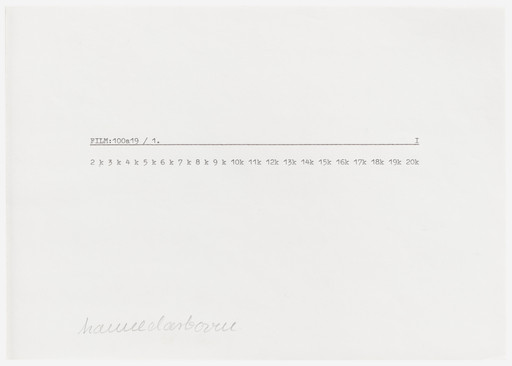
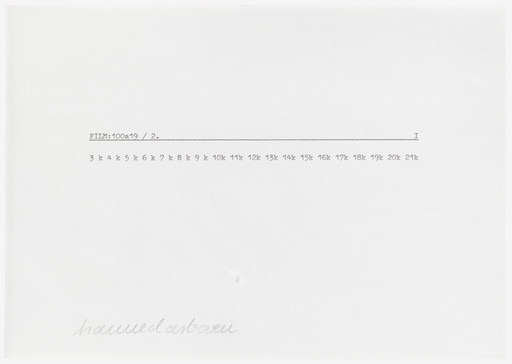
Sometimes Darboven's cursive lines simply emulate writing, but actually are devoid of syntax and content and represent only a temporal process. She often presents her work in installations of small, identically sized sheets of paper containing this writing. She has also created artist's books that combine these sheets as pages, and a small but significant body of prints, often in portfolio formats that support her serial investigations.
Photographs, some taken by the artist and others found, also appear in her work, adding new references and contexts. Harburg Sand depicts six identical images of an old postcard of a suburb of Hamburg, yet implies a sequence. The text on the first image, dated June 12, 1988, describes the artist watching television, while her mother looks at a clothing catalogue. The other images are progressively dated from June 13 to June 17. Texts begin with the words "work harburg today," and the word "today" is crossed out before the numerical indication of the date. Calculations add together digits comprising these dates. Such numerical, textual, and cursive-line juxtapositions emphasize Darboven's contradictory sense of time as both passing and stopped by her intervention.
an essay by Raimond Livasgani, in Deborah Wye, Artists and Prints: Masterworks from The Museum of Modern Art, New York: The Museum of Modern Art, 2004, p. 186.
Explore more


From MoMA Design Store


Installation views
We have identified this work in the following photos from our exhibition history.
Licensing
Artwork or archival images
If you would like to reproduce an image of a work of art in MoMA's collection, or an image of a MoMA publication or archival material (including installation views, checklists, and press releases), please contact Art Resource (publication in North America) or Scala Archives (publication in all other geographic locations).
Audio and film clips
MoMA licenses archival audio and select out of copyright film clips from our film collection. At this time, MoMA produced video cannot be licensed by MoMA/Scala. All requests to license archival audio or out of copyright film clips should be addressed to Scala Archives at [email protected]. Motion picture film stills cannot be licensed by MoMA/Scala. For access to motion picture film stills for research purposes, please contact the Film Study Center at [email protected]. For more information about film loans and our Circulating Film and Video Library, please visit Circulating Film and Video Library.
Text from a publication or the archives
If you would like to reproduce text from a MoMA publication, please email [email protected]. If you would like to publish text from MoMA's archival materials, please fill out this permission form and send to [email protected].
Feedback
This record is a work in progress. If you have additional information or spotted an error, please fill out this feedback form.