Drypoint and etching
Not on view
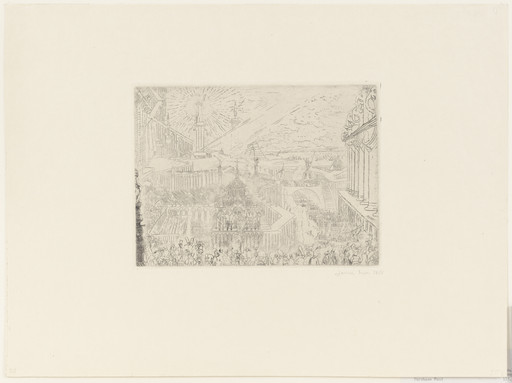
A large skeletal flying figure of Death with reptilelike feet brandishes an enormous, menacing scythe over the swarming mob of people jamming the streets below. The figures, most of whom are portrayed only by grimacing masklike faces, flee the oncoming catastrophe. In the building at the right we glimpse a nude woman toasting her companions—a hint of the debauchery, cruelty, and indifference that Ensor perceived in society. Overhead a radiating sun, centered between winged, haloed beings and frightened figures engulfed in flames, suggests heaven, hell, and the Day of Judgment.
Ensor's nightmarish, satiric visions, which reveal a preoccupation with the macabre and with death, were influenced by earlier Flemish art of the fifteenth and sixteenth centuries, specifically that of Hieronymus Bosch and Pieter Bruegel. Ensor's obsession with death and impermanence led him to printmaking. As he stated, "I dread the fragility of painting. I want to survive and I think of solid copper plates, of unalterable inks . . . of faithful printing, and I am adopting etching as a means of expression." Indeed, between 1886 and 1905 Ensor was a prolific printmaker, who executed 134 prints.
The Museum of Modern Art, MoMA Highlights, New York: The Museum of Modern Art, revised 2004, originally published 1999, p. 52.
Explore more
From MoMA Design Store


Installation views
We have identified this work in the following photos from our exhibition history.
Licensing
Artwork or archival images
If you would like to reproduce an image of a work of art in MoMA's collection, or an image of a MoMA publication or archival material (including installation views, checklists, and press releases), please contact Art Resource (publication in North America) or Scala Archives (publication in all other geographic locations).
Audio and film clips
MoMA licenses archival audio and select out of copyright film clips from our film collection. At this time, MoMA produced video cannot be licensed by MoMA/Scala. All requests to license archival audio or out of copyright film clips should be addressed to Scala Archives at [email protected]. Motion picture film stills cannot be licensed by MoMA/Scala. For access to motion picture film stills for research purposes, please contact the Film Study Center at [email protected]. For more information about film loans and our Circulating Film and Video Library, please visit Circulating Film and Video Library.
Text from a publication or the archives
If you would like to reproduce text from a MoMA publication, please email [email protected]. If you would like to publish text from MoMA's archival materials, please fill out this permission form and send to [email protected].
Feedback
This record is a work in progress. If you have additional information or spotted an error, please fill out this feedback form.