Minimalist artist Donald Judd is known primarily for his work as a sculptor, but he began his career as a painter and writer of art criticism and theory. Although his earliest paintings of landscapes and figures are in a traditional style, Judd soon began to work in an abstract mode, and shortly thereafter turned to sculpture. Between 1964 and 1966, he and other artists of his generation developed the vocabulary of Minimalism. His simple forms included boxes made of wood, metal, or industrial plastic placed directly on the floor rather than on bases or pedestals. Of particular interest to Judd was the idea of seriality, embodied in his work by progressions or repetition of standard units, and epitomized by his "stacks," groups of wall-mounted boxes forming columns of alternating solids and voids of equal size.
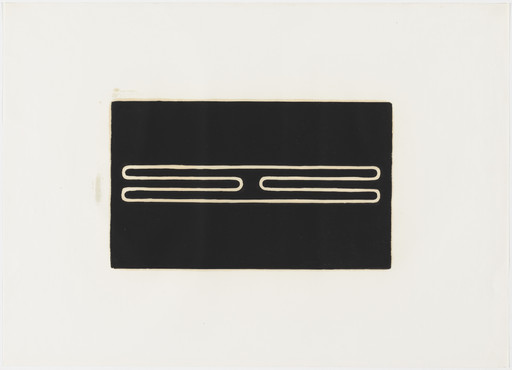
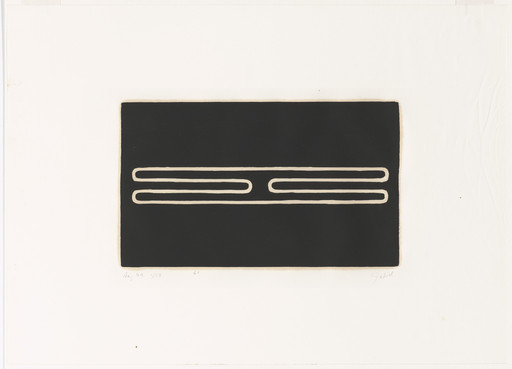
Seriality was also present in Judd's work as a printmaker, which began with figurative lithographs in 1951 and eventually grew to include approximately three hundred editions, many of them woodcuts, the most sculptural of all print mediums. In 1961 Judd began a woodcut series depicting variations on a single form, the parallelogram. Over the next eight years, the series of twenty-six prints came together in a variety of ways. Some began as wall sculptures made of unfinished lumber that Judd later decided to ink and print, essentially creating a two-dimensional manifestation of a three-dimensional sculpture. Others, including this Untitled work, were specifically designed as prints, with wood matrices carved according to Judd's design by his father, Roy C. Judd, who served as the printer for this project. After they were printed, these woodblocks were considered sculptural objects. Another series was created by printing twelve of the blocks in cerulean blue. Judd returned to the paralellogram form repeatedly, making similar serial explorations in etching and aquatint.
an essay by Sarah Suzuki, in Deborah Wye, Artists and Prints: Masterworks from The Museum of Modern Art, New York: The Museum of Modern Art, 2004, p. 198.
Explore more
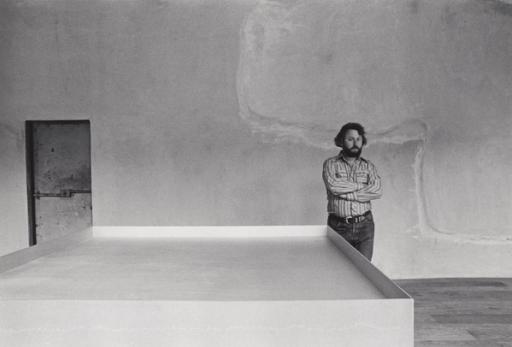
Donald Judd
American, 1928–1994 79 works onlineDonald Judd is a landmark figure in the history of postwar art. In the 1950s, he studied philosophy and art history and took classes at the Art Students League in New York.
Learn more →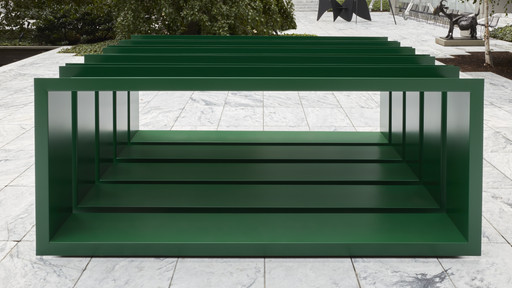
From MoMA Design Store


Installation views
We have identified this work in the following photos from our exhibition history.
Licensing
Artwork or archival images
If you would like to reproduce an image of a work of art in MoMA's collection, or an image of a MoMA publication or archival material (including installation views, checklists, and press releases), please contact Art Resource (publication in North America) or Scala Archives (publication in all other geographic locations).
Audio and film clips
MoMA licenses archival audio and select out of copyright film clips from our film collection. At this time, MoMA produced video cannot be licensed by MoMA/Scala. All requests to license archival audio or out of copyright film clips should be addressed to Scala Archives at [email protected]. Motion picture film stills cannot be licensed by MoMA/Scala. For access to motion picture film stills for research purposes, please contact the Film Study Center at [email protected]. For more information about film loans and our Circulating Film and Video Library, please visit Circulating Film and Video Library.
Text from a publication or the archives
If you would like to reproduce text from a MoMA publication, please email [email protected]. If you would like to publish text from MoMA's archival materials, please fill out this permission form and send to [email protected].
Feedback
This record is a work in progress. If you have additional information or spotted an error, please fill out this feedback form.