Ernst Ludwig Kirchner
Dancer with Raised Skirt (Tänzerin mit gehobenem Rock) from Brücke 1910
1909, published 1910
Woodcut from a portfolio of two woodcuts, one drypoint, and one woodcut cover
Not on view
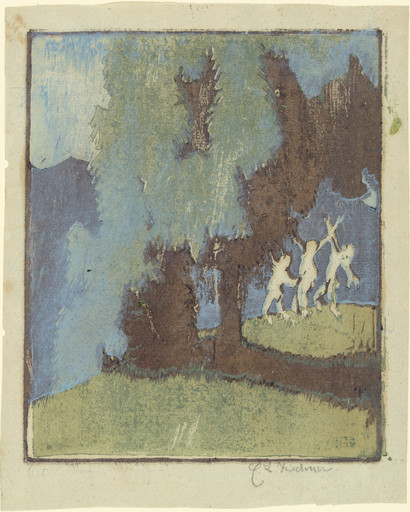
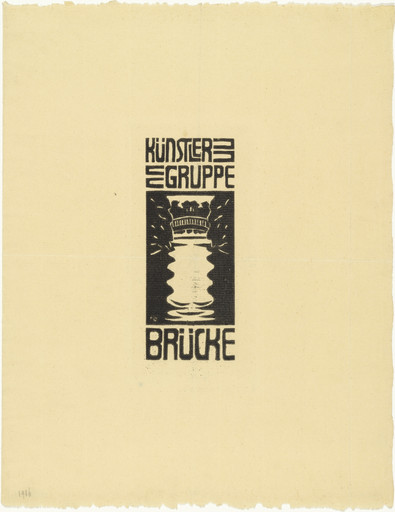
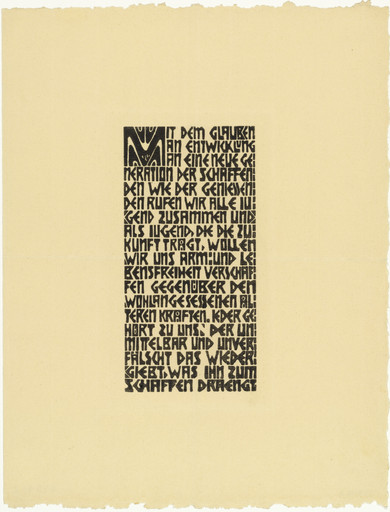
Between 1906 and 1912 the Brücke group sent an annual portfolio of prints to its "passive members"—friends and supporters who helped finance the artists' work. Through these portfolios, artists could circumvent intermediaries of the art market, such as dealers and galleries, and communicate directly with patrons. Each installment was dedicated to the work of one artist. The fifth portfolio features prints by Ernst Ludwig Kirchner, alternating between urban scenes of licentious delight and views of the idyllic Moritzburg lakes, which the Brücke artists frequently visited.
Erich Heckel's title page shows two nudes kneeling on a stage. A schematic section of geometric voids and solids represents a row of spectators, while the garish yellow paper suggests the glare of the lights. Kirchner's color woodcut, Mit Schilf werfende Badende (Bathers throwing reeds), shows nudes moving freely in nature. His black-and-white woodcut, Tänzerin mit gehobenem Rock (Dancer with raised skirt), transports this key theme of the liberated body to a Dresden cabaret. Kirchner exploits the stark contrasts and reductive possibilities encouraged by the woodcut medium, heralding the severely angular style of the group's last years. In the final drypoint, Drei Badende an den Moritzburger Seen (Three bathers at the Moritzburg lakes), Kirchner creates a scene of peace and harmony using the most limited formal means, capturing the spontaneity and freedom the artists discovered at rural retreats.
Heather Hess, German Expressionist Digital Archive Project, German Expressionism: Works from the Collection. 2011.
Publication excerpt from Deborah Wye, Artists and Prints: Masterworks from The Museum of Modern Art , New York: The Museum of Modern Art, 2004, p. 52.
It was within the artists' group Brücke (Bridge), founded in 1905, that Ernst Ludwig Kirchner formulated his views on art and established a visual language. Together with other core members—Erich Heckel, Karl Schmidt-Rottluff, Max Pechstein, and, briefly, Emil Nolde—Kirchner sought a new spirit of freedom and authenticity that rejected both the stultifying traditions of the academy and the restrictive conventions of bourgeois society. Brücke artists felt that art could respond to essential life forces with spontaneity and immediacy through such subjects as the nude in nature or figures dancing with frenzy and abandon. Sharing studios and models, teaching each other techniques, and even vacationing together, they evolved a common style that first embraced the fluidity of Fauvism and then turned to the energy and angularity of tribal art for inspiration.
Printmaking was fundamental to Brücke activities, and annual portfolios of prints were published to help the artists gain recognition and produce income. For the most part, however, members' prints were experimental in nature and made with only a few proof impressions. Kirchner continued this unstructured approach to printmaking even after the dissolution of Brücke in 1913, eventually creating some two thousand works, primarily in his own studio.
During World War I, after briefly training in the mounted artillery, Kirchner suffered a mental collapse. His depiction as an isolated figure is seen here in Evening Patrol of 1915. His series of prints of this period, entitled Schlemihl Meets His Shadow, is also considered the embodiment of his anxiety and paranoia, conditions that would continue to plague him, along with ill health, for the remainder of his life. In 1938, after being ostracized from German art circles by the Nazis, and having hundreds of his paintings removed from museums and declared "degenerate," Kirchner ended his own life.
Deborah Wye, Artists and Prints: Masterworks from The Museum of Modern Art, New York: The Museum of Modern Art, 2004, p. 52.
Explore more
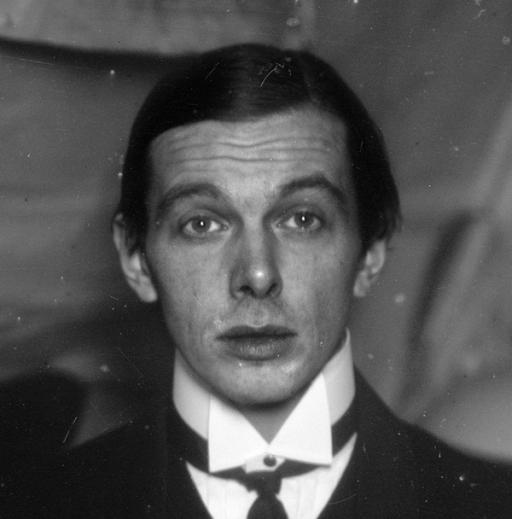
Ernst Ludwig Kirchner
German, 1880–1938 176 works onlineIn 1905, painter and printmaker Ernst Ludwig Kirchner, along with Fritz Bleyl, Erich Heckel , and Karl Schmidt-Rottluff —all untrained in the visual arts—founded the artists’ group Die Brücke , or “The Bridge,” a moment that is now considered the birth of German Expressionism.
Learn more →
From MoMA Design Store


Installation views
We have identified this work in the following photos from our exhibition history.
Licensing
Artwork or archival images
If you would like to reproduce an image of a work of art in MoMA's collection, or an image of a MoMA publication or archival material (including installation views, checklists, and press releases), please contact Art Resource (publication in North America) or Scala Archives (publication in all other geographic locations).
Audio and film clips
MoMA licenses archival audio and select out of copyright film clips from our film collection. At this time, MoMA produced video cannot be licensed by MoMA/Scala. All requests to license archival audio or out of copyright film clips should be addressed to Scala Archives at [email protected]. Motion picture film stills cannot be licensed by MoMA/Scala. For access to motion picture film stills for research purposes, please contact the Film Study Center at [email protected]. For more information about film loans and our Circulating Film and Video Library, please visit Circulating Film and Video Library.
Text from a publication or the archives
If you would like to reproduce text from a MoMA publication, please email [email protected]. If you would like to publish text from MoMA's archival materials, please fill out this permission form and send to [email protected].
Feedback
This record is a work in progress. If you have additional information or spotted an error, please fill out this feedback form.