Not on view
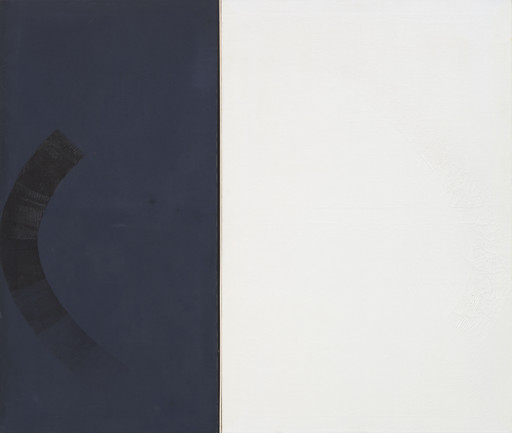
Flipper is a German term for the game of pinball, which was Palermo’s favorite pastime at his local café. The right–hand panel of this diptych features the same red, white, and blue pattern that appeared on the sides of the pinball machine he used there. In the left panel the elimination of the blue grid leaves the red squares floating unanchored on the white ground, creating formal tension in the composition.
Geo/Metric: Prints and Drawings from the Collection, June 11- August 18, 2008.
Publication excerpt from an essay by Sarah Suzuki, in Deborah Wye, Artists and Prints: Masterworks from The Museum of Modern Art , New York: The Museum of Modern Art, 2004, p. 196.
The life and art of Blinky Palermo, described as the "James Dean of the German art scene," remain enigmatic even to those who knew him well. Born Peter Schwarze, he became Peter Heisterkamp after being adopted as an infant. In 1963 he began attending art classes in Düsseldorf taught by the charismatic performance artist and sculptor Joseph Beuys, who became the artist's friend. By all accounts, Palermo spent much of his life in a constant state of crisis and despair about both his work and his identity. It was for this reason that he readily adopted the pseudonym Blinky Palermo in 1964 after a classmate noticed his resemblance to the American boxing promoter and petty gangster of the same name.
During his short career (he died at the age of thirty-four), Palermo produced a diverse body of work that seems to defy categorization, but displays affinities with Constructivist, Minimalist, and Conceptual art. He began making prints in 1966, eventually completing about forty editions. Flipper was derived from his 1965 painting, also called Flipper, the German term for the game of pinball. Inspired by Palermo's favorite game at a local café, Flipper features the same red, white, and blue pattern that appeared on the sides of that pinball machine. The right-hand panel of the diptych reproduces the composition of the painting, while the left simply removes the blue grid, an easy step in the screenprint process. The result is a shift in relationships that leaves the red squares floating, unanchored on the white ground. Originally the work was intended to be two separate prints with both bearing the artist's signature, but Palermo decided to make it a diptych once he saw the compelling tension created when the prints were hung side by side on a wall.
an essay by Sarah Suzuki, in Deborah Wye, Artists and Prints: Masterworks from The Museum of Modern Art, New York: The Museum of Modern Art, 2004, p. 196.
Explore more
Diptych
A work of art consisting of two sections or panels, usually hinged together.
Learn more →

From MoMA Design Store


Installation views
We have identified this work in the following photos from our exhibition history.
Licensing
Artwork or archival images
If you would like to reproduce an image of a work of art in MoMA's collection, or an image of a MoMA publication or archival material (including installation views, checklists, and press releases), please contact Art Resource (publication in North America) or Scala Archives (publication in all other geographic locations).
Audio and film clips
MoMA licenses archival audio and select out of copyright film clips from our film collection. At this time, MoMA produced video cannot be licensed by MoMA/Scala. All requests to license archival audio or out of copyright film clips should be addressed to Scala Archives at [email protected]. Motion picture film stills cannot be licensed by MoMA/Scala. For access to motion picture film stills for research purposes, please contact the Film Study Center at [email protected]. For more information about film loans and our Circulating Film and Video Library, please visit Circulating Film and Video Library.
Text from a publication or the archives
If you would like to reproduce text from a MoMA publication, please email [email protected]. If you would like to publish text from MoMA's archival materials, please fill out this permission form and send to [email protected].
Feedback
This record is a work in progress. If you have additional information or spotted an error, please fill out this feedback form.