Etching and drypoint
Not on view
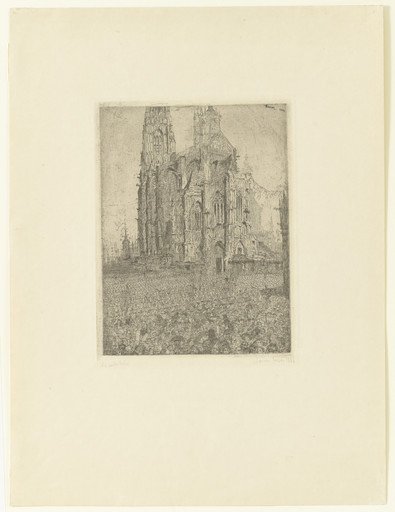
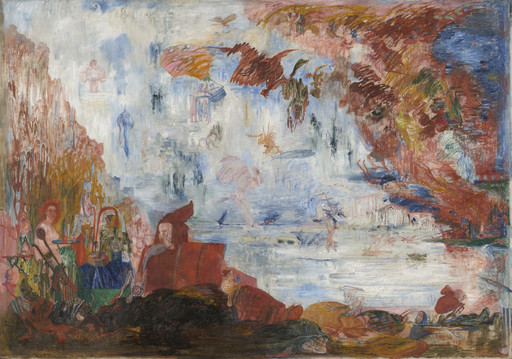
An eccentric visionary, James Ensor created images that defy categorization. After two frustrating years at the Royal Academy of Fine Arts in Brussels, he returned to his hometown of Ostend and set up a studio in the attic of his family's home and souvenir shop. There he continued his education, studying Old Masters such as Breugel and Bosch, copying etchings by Rembrandt and Goya, and making sketches depicting his family's disquieting domestic life. Although Ensor was a member of the Belgian avant-garde group Les Vingt (The Twenty) between 1883 and 1893, he had a pained and tumultuous relationship with his fellow artists and critics.
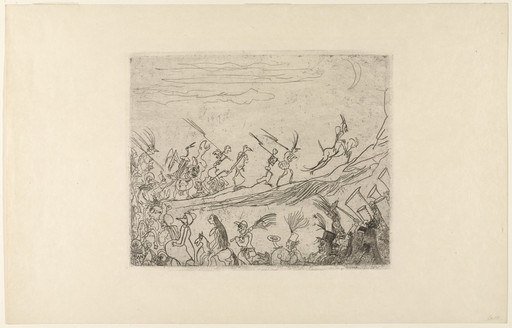
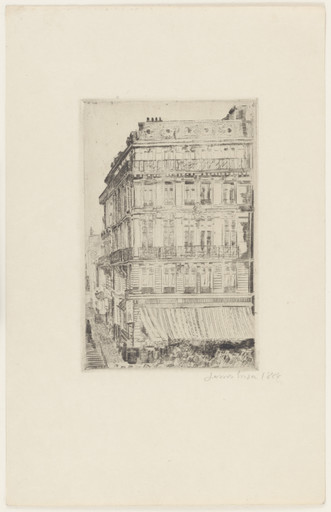
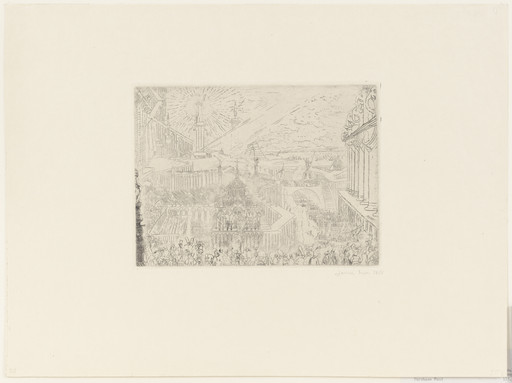
In addition to painting, Ensor made some one hundred forty prints over the course of his career, most of which were etchings completed in an intense burst of activity at the turn of the century. His obsession with death, and his desire to defy it through his art, contributed to his embrace of etching. He wrote, "I want to survive and I think of solid copperplates, of unalterable inks . . . of faithful printing, and I am adopting etching as a means of expression."
Current political events, literary themes, the life of Christ, and the popular spectacle of the annual carnivals in Belgium were among Ensor's favorite subjects. Deeply concerned with political and social injustice, he ridiculed the Church, the military, and the bourgeoisie. The Entrance of Christ into Brussels updates the story of Christ, giving it contemporary relevance by depicting the masses holding banners, political signs, and advertisements. The Assassination is based on Edgar Allan Poe's gothic tale The Facts in the Case of M. Valdemar of 1845, which tells the gruesome story of a hypnotist trying to arrest the process of death by hypnotizing a dying man.
an essay by Harper Montgomery and Sarah Suzuki, in Deborah Wye, Artists and Prints: Masterworks from The Museum of Modern Art, New York: The Museum of Modern Art, 2004, p. 49.
Explore more
From MoMA Design Store


Installation views
We have identified this work in the following photos from our exhibition history.
Licensing
Artwork or archival images
If you would like to reproduce an image of a work of art in MoMA's collection, or an image of a MoMA publication or archival material (including installation views, checklists, and press releases), please contact Art Resource (publication in North America) or Scala Archives (publication in all other geographic locations).
Audio and film clips
MoMA licenses archival audio and select out of copyright film clips from our film collection. At this time, MoMA produced video cannot be licensed by MoMA/Scala. All requests to license archival audio or out of copyright film clips should be addressed to Scala Archives at [email protected]. Motion picture film stills cannot be licensed by MoMA/Scala. For access to motion picture film stills for research purposes, please contact the Film Study Center at [email protected]. For more information about film loans and our Circulating Film and Video Library, please visit Circulating Film and Video Library.
Text from a publication or the archives
If you would like to reproduce text from a MoMA publication, please email [email protected]. If you would like to publish text from MoMA's archival materials, please fill out this permission form and send to [email protected].
Feedback
This record is a work in progress. If you have additional information or spotted an error, please fill out this feedback form.