After gouging the woodblock to create the figure of his model, Fränzi, Heckel then sawed it into pieces, inked the components separately in red and black, and finally reassembled them like a jigsaw before printing. Heckel’s flat, angular rendering of Fränzi’s adolescent body and her exaggerated masklike features were influenced by his interest in African sculpture.
German Expressionism: The Graphic Impulse, March 27–July 11, 2011.
Publication excerpt from an essay by Starr Figura, in Deborah Wye, Artists and Prints: Masterworks from The Museum of Modern Art , New York: The Museum of Modern Art, 2004, p. 56.
A former architecture student, Erich Heckel founded the artists' group Brücke (Bridge) in Dresden in 1905, together with Fritz Bleyl, Karl Schmidt-Rottluff, and Ernst Ludwig Kirchner. The bold coloring and sharp angularity of his portraits, nudes, bathers, and cabaret performers helped define the German Expressionist aesthetic in painting and printmaking.
During his lifetime, Heckel completed more than one thousand prints, the vast majority between 1905 and 1923. He made hundreds of etchings and lithographs, but is most acclaimed for his woodcuts, which display a radical flatness and simplification of form. He created Fränzi Reclining by sawing the woodblock into pieces, inking each part separately, and then reassembling them for printing, a jigsaw-puzzle technique derived from Edvard Munch, the Norwegian painter whose highly experimental approach to printmaking was emulated by Brücke artists.
Heckel's model, twelve-year-old Fränzi, was a favorite of the Brücke members; they responded to her awkward poses, so typical of adolescence and so unlike those of conventional models. The exaggerated masklike features of her face were inspired in part by the artist's study of African sculptures at the Dresden Ethnological Museum.
After moving from Dresden to Berlin in 1911, along with other Brücke artists, Heckel turned increasingly to themes of melancholy and isolation. By 1913 the Brücke group had disbanded, and in 1915 Heckel went off to war. Portrait of a Man, a gaunt self-portrait created in the difficult months just after the war ended, manifests a psychic weariness that may be interpreted as broadly symbolic of the German people at that time. Technically, it demonstrates Heckel's ongoing eagerness to experiment with printmaking processes. The colored areas were applied to the wood with a brush rather than with the more common ink roller. The thick brushstrokes create a painterly surface that contrasts with the deliberate flatness in his earlier work.
an essay by Starr Figura, in Deborah Wye, Artists and Prints: Masterworks from The Museum of Modern Art, New York: The Museum of Modern Art, 2004, p. 56.
Publication excerpt from The Museum of Modern Art, MoMA Highlights , New York: The Museum of Modern Art, revised 2004, originally published 1999, p. 58.
Fränzi, shown here at the age of twelve, posed frequently for Heckel and other German Expressionists, who were drawn to the natural, yet awkward, positions that she assumed because they were so unlike the artificial stances of professional models. The woodcut medium was a perfect vehicle to express thick, angular outlines for her figure, with its distorted arm and jagged fingers, and exaggerated masklike features for her face. This bold new imagery found its source in African sculptures that Heckel had studied in the Dresden Ethnological Museum.
Heckel also took a cue from Edvard Munch, the Norwegian painter much admired by Brücke artists, and employed one of his unusual printing techniques. Like Munch, he sawed the woodblock into pieces, cutting out the three red background areas, inking the components separately, and then reassembling them like a jigsaw puzzle before printing.
Cataloged in Text Editor by title in German: Franzi liegend
The Museum of Modern Art, MoMA Highlights, New York: The Museum of Modern Art, revised 2004, originally published 1999, p. 58.
Explore more
Die Brücke (The Bridge)
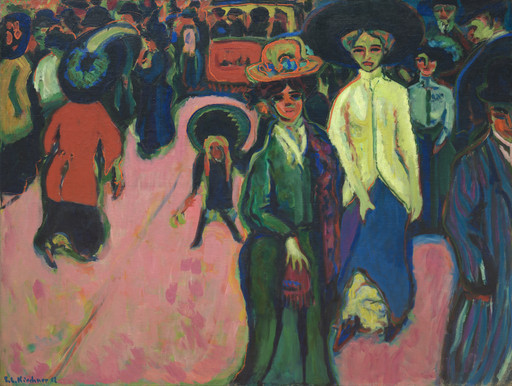
The artists’ group Die Brücke was established in 1905, a moment that is recognized as the birth of Expressionism. The affiliated artists often turned to simplified or distorted forms and unusually strong, unnatural colors to jolt the viewer and provoke an emotional response.
Learn more →
![Max Pechstein. Dancer (Pair of Dancers) ( Tänzerin [Tänzerpaar] )](https://www.moma.org/media/W1siZiIsIjExNDgxMyJdLFsicCIsImNvbnZlcnQiLCItcXVhbGl0eSA5MCAtcmVzaXplIDUxMng1MTJcdTAwM2UiXV0.jpg?sha=a5aef98bdbcef9b6)

Audio
Audio from the playlist German Expressionism: The Graphic Impulse
From MoMA Design Store


Installation views
We have identified this work in the following photos from our exhibition history.
Provenance Research Project
This work is included in the Provenance Research Project, which investigates the ownership history of works in MoMA's collection.
Ilse Gerson and Otto Gerson, New York; to The Museum of Modern Art, New York, 1958
Provenance research is a work in progress, and is frequently updated with new information. If you have any questions or information to provide about the listed works, please email [email protected] or write to:
Provenance Research Project
The Museum of Modern Art
11 West 53 Street
New York, NY 10019
Licensing
Artwork or archival images
If you would like to reproduce an image of a work of art in MoMA's collection, or an image of a MoMA publication or archival material (including installation views, checklists, and press releases), please contact Art Resource (publication in North America) or Scala Archives (publication in all other geographic locations).
Audio and film clips
MoMA licenses archival audio and select out of copyright film clips from our film collection. At this time, MoMA produced video cannot be licensed by MoMA/Scala. All requests to license archival audio or out of copyright film clips should be addressed to Scala Archives at [email protected]. Motion picture film stills cannot be licensed by MoMA/Scala. For access to motion picture film stills for research purposes, please contact the Film Study Center at [email protected]. For more information about film loans and our Circulating Film and Video Library, please visit Circulating Film and Video Library.
Text from a publication or the archives
If you would like to reproduce text from a MoMA publication, please email [email protected]. If you would like to publish text from MoMA's archival materials, please fill out this permission form and send to [email protected].
Feedback
This record is a work in progress. If you have additional information or spotted an error, please fill out this feedback form.