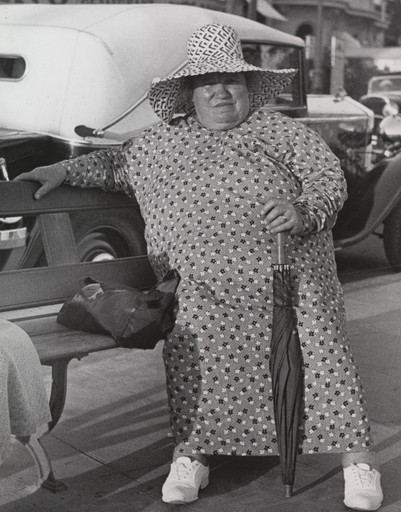
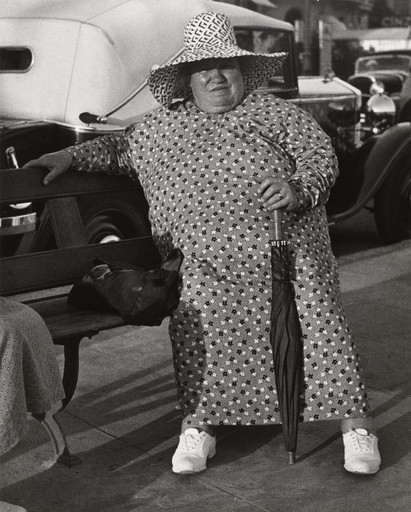
Spread out diagonally and filling the entire frame, Model’s subject poses like a pinup model, seizing the viewer’s attention. Equipped with a Rolleiflex, one of a newer generation of handheld, portable cameras that revolutionized how photographers captured the dynamic flux of modern urban life, Model candidly portrayed the idiosyncrasies of the people she encountered. Her work is distinguished by its emphasis on everyday situations and its raw, unapologetic gaze at its human subjects. Like other American street photographers of her time, including Walker Evans, Helen Levitt, and Ben Shahn, she was attracted to New York’s working-class immigrant neighborhoods, such as Manhattan’s Lower East Side and Coney Island in Brooklyn.
Model came into prominence in the 1940s after immigrating to New York from France, where she had lived for a few years after leaving her native Austria. Alexey Brodovitch, the visionary art director of Harper’s Bazaar, gave Model her first American magazine assignment, and the resulting, now-iconic images of beachgoers at Coney Island—including a variant of this image—were first published in July 1941. Through her photography and her decades of teaching at The New School in Manhattan, she was a powerful influence on a younger, postwar group of photographers, including Diane Arbus, Larry Fink, and Rosalind Fox Solomon, who also took the human figure as their subject.
MoMA Highlights: 375 Works from The Museum of Modern Art, New York (New York: The Museum of Modern Art, 2019)
Explore more


From MoMA Design Store


Installation views
We have identified this work in the following photos from our exhibition history.
Licensing
Artwork or archival images
If you would like to reproduce an image of a work of art in MoMA's collection, or an image of a MoMA publication or archival material (including installation views, checklists, and press releases), please contact Art Resource (publication in North America) or Scala Archives (publication in all other geographic locations).
Audio and film clips
MoMA licenses archival audio and select out of copyright film clips from our film collection. At this time, MoMA produced video cannot be licensed by MoMA/Scala. All requests to license archival audio or out of copyright film clips should be addressed to Scala Archives at [email protected]. Motion picture film stills cannot be licensed by MoMA/Scala. For access to motion picture film stills for research purposes, please contact the Film Study Center at [email protected]. For more information about film loans and our Circulating Film and Video Library, please visit Circulating Film and Video Library.
Text from a publication or the archives
If you would like to reproduce text from a MoMA publication, please email [email protected]. If you would like to publish text from MoMA's archival materials, please fill out this permission form and send to [email protected].
Feedback
This record is a work in progress. If you have additional information or spotted an error, please fill out this feedback form.