Inspired by an exhibition of work by the pioneering street photographer Henri Cartier-Bresson the previous year, in 1936 Levitt bought a used Leica and began to take photographs in New York. Her lifelong love of film, photography, dance, and literature informed how she portrayed the world. In this picture, three children pause on a building stoop. A boy and a girl, who is oddly dressed in long trousers, stand in balletic poses, the masks they wear rendering their faces alien. The third child—socks sagging at her ankles and the hem of her dress peeking out from beneath her overcoat—tries to secure her mask over her ears. One of her eyes is barely visible through the aperture, but nonetheless she stares directly at Levitt.
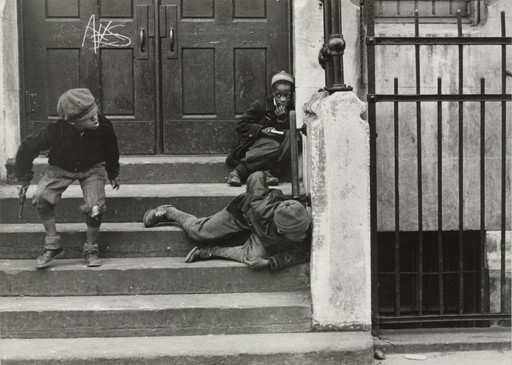
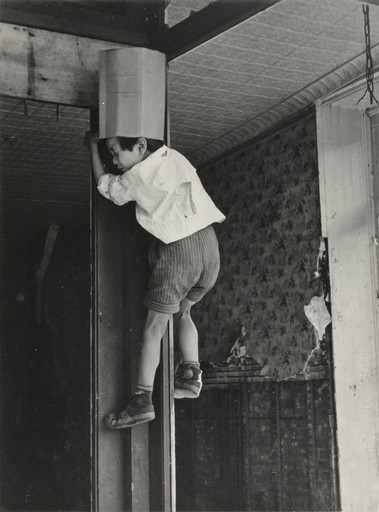
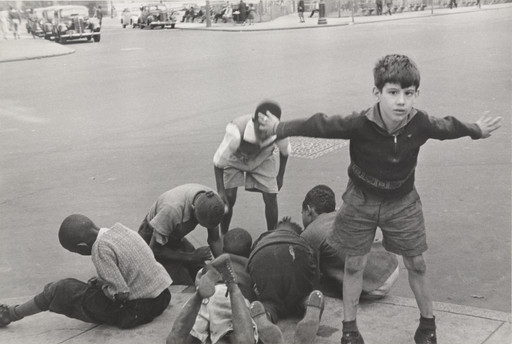
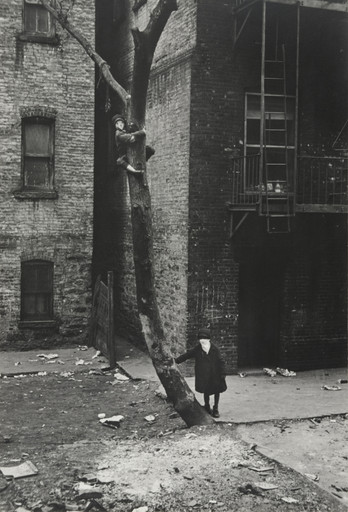
Levitt’s images from the late 1930s and early ’40s are central to the history of street photography. Observing public spaces as if they were stage sets, Levitt unobtrusively photographed personal dramas and mundane moments, often capturing surreal juxtapositions of people, places, and things. She was particularly fascinated by the imaginative play and athletic movements of children. Unlike the many Depression-era photographers who had an explicitly social documentary agenda, Levitt did not intend her work to be read as political commentary but aimed, rather, to capture the poetics of everyday life.
MoMA Highlights: 375 Works from The Museum of Modern Art, New York (New York: The Museum of Modern Art, 2019)
Explore more
From MoMA Design Store


Installation views
We have identified this work in the following photos from our exhibition history.
Licensing
Artwork or archival images
If you would like to reproduce an image of a work of art in MoMA's collection, or an image of a MoMA publication or archival material (including installation views, checklists, and press releases), please contact Art Resource (publication in North America) or Scala Archives (publication in all other geographic locations).
Audio and film clips
MoMA licenses archival audio and select out of copyright film clips from our film collection. At this time, MoMA produced video cannot be licensed by MoMA/Scala. All requests to license archival audio or out of copyright film clips should be addressed to Scala Archives at [email protected]. Motion picture film stills cannot be licensed by MoMA/Scala. For access to motion picture film stills for research purposes, please contact the Film Study Center at [email protected]. For more information about film loans and our Circulating Film and Video Library, please visit Circulating Film and Video Library.
Text from a publication or the archives
If you would like to reproduce text from a MoMA publication, please email [email protected]. If you would like to publish text from MoMA's archival materials, please fill out this permission form and send to [email protected].
Feedback
This record is a work in progress. If you have additional information or spotted an error, please fill out this feedback form.