Gelatin silver print, printed 1957
Not on view
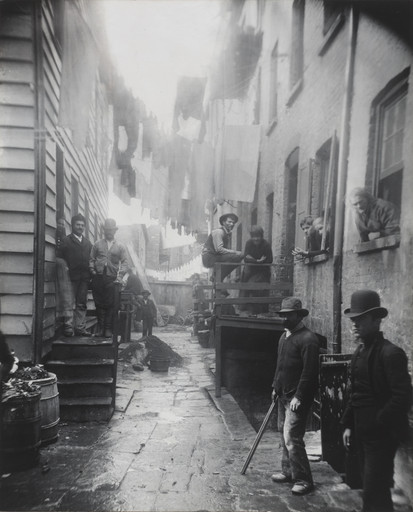
Journalist, photographer, and social activist Jacob Riis produced photographs and writings documenting poverty in New York City in the late 19th century, making the lives and living conditions of the working poor as widely visible as possible. In 1878, he became a police reporter for the New York Tribune and was assigned to the area known as Mulberry Bend in Lower Manhattan, where the city’s worst slums and tenements were concentrated. He began documenting the deplorable living conditions there, producing photographs like Lodgers in Bayard Street Tenement, Five Cents a Spot. In this image, he captures tenement dwellers in a candid moment, highlighting their overcrowded, dirty, and dangerously dilapidated surroundings. Riis would visit the tenements at night, whose darkness was compounded by the fact that many of the rooms in these buildings lacked windows. He compensated for this by using the newly invented magnesium flash, which produced a ball of blinding light that both illuminated these spaces and surprised his subjects.
Riis presented his images in magic lantern slide lectures and published them alongside essays and eventually in his successful 1890 book, How the Other Half Lives: Studies Among the Tenements of New York. Though his methods and motivations were not free of controversy, his photographs are widely credited with helping to bring attention and improvements to the degrading conditions in the tenements. His candid, raw style influenced later generations of documentary photographers, including Dorothea Lange and Walker Evans.
Gallery label from 2021
In the late nineteenth century, many immigrants in New York City lived in crowded tenement apartments that lacked the modern conveniences of the bourgeois home, such as artificial lighting. For this reason, when social reformer and police reporter Jacob Riis set out to photograph these working-class inhabitants, he brought his own flash apparatus: a frying pan filled with flammable magnesium. Although his intention—to stir the conscience of the upper classes with his documents of urban poverty—was progressive, his methods were intrusive. Riis often entered homes without permission, opening his camera shutter and blinding unsuspecting sitters with an explosion of light. His illustrated book How the Other Half Lives (1890), which includes this photograph and many others, led to laws making tenements safer and more habitable.
2021
Explore more

From MoMA Design Store


Installation views
We have identified this work in the following photos from our exhibition history.
Licensing
Artwork or archival images
If you would like to reproduce an image of a work of art in MoMA's collection, or an image of a MoMA publication or archival material (including installation views, checklists, and press releases), please contact Art Resource (publication in North America) or Scala Archives (publication in all other geographic locations).
Audio and film clips
MoMA licenses archival audio and select out of copyright film clips from our film collection. At this time, MoMA produced video cannot be licensed by MoMA/Scala. All requests to license archival audio or out of copyright film clips should be addressed to Scala Archives at [email protected]. Motion picture film stills cannot be licensed by MoMA/Scala. For access to motion picture film stills for research purposes, please contact the Film Study Center at [email protected]. For more information about film loans and our Circulating Film and Video Library, please visit Circulating Film and Video Library.
Text from a publication or the archives
If you would like to reproduce text from a MoMA publication, please email [email protected]. If you would like to publish text from MoMA's archival materials, please fill out this permission form and send to [email protected].
Feedback
This record is a work in progress. If you have additional information or spotted an error, please fill out this feedback form.