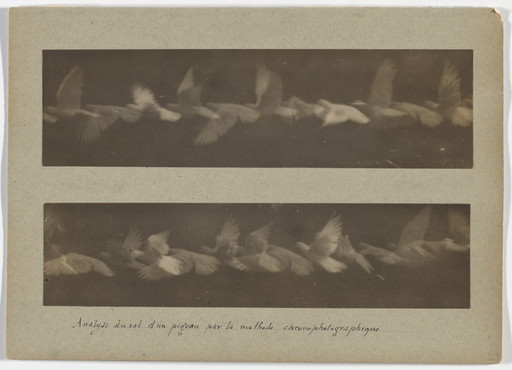
Marey, a physiologist, had been studying motion for two decades when the work of the American photographer Eadweard Muybridge led him to try photography in 1881. Unlike Muybridge, who used a battery of cameras to make a sequence of separate frames (like the frames in a movie), Marey recorded the successive phases of motion on single plate. Thus, his studies at once analyze motion and present a virtual image of its course.
Photography has radically enhanced our ability to study the world around us (and the skies beyond) by making visible what once had been too distant, too small, too fast, or otherwise too difficult to see. Many such pictures were made in the service of science, but their impact often has been much broader than their original scientific function. The influence of Marey's pictures on the Futurist painters, such as Giacomo Balla and Gino Severini, who sought to evoke dynamic motion in their work, is only the most familiar example.
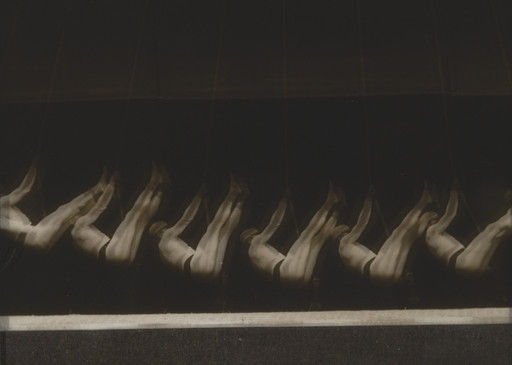
Demenÿ worked as Marey's assistant from 1881 to 1893 and then applied Marey's method to the physical training program of the French army. This picture, whose successive exposures were timed to match the strides of the runner, may have been made by him.
The Museum of Modern Art, MoMA Highlights, New York: The Museum of Modern Art, revised 2004, originally published 1999, p. 25.
Explore more

From MoMA Design Store


Installation views
We have identified this work in the following photos from our exhibition history.
Licensing
Artwork or archival images
If you would like to reproduce an image of a work of art in MoMA's collection, or an image of a MoMA publication or archival material (including installation views, checklists, and press releases), please contact Art Resource (publication in North America) or Scala Archives (publication in all other geographic locations).
Audio and film clips
MoMA licenses archival audio and select out of copyright film clips from our film collection. At this time, MoMA produced video cannot be licensed by MoMA/Scala. All requests to license archival audio or out of copyright film clips should be addressed to Scala Archives at [email protected]. Motion picture film stills cannot be licensed by MoMA/Scala. For access to motion picture film stills for research purposes, please contact the Film Study Center at [email protected]. For more information about film loans and our Circulating Film and Video Library, please visit Circulating Film and Video Library.
Text from a publication or the archives
If you would like to reproduce text from a MoMA publication, please email [email protected]. If you would like to publish text from MoMA's archival materials, please fill out this permission form and send to [email protected].
Feedback
This record is a work in progress. If you have additional information or spotted an error, please fill out this feedback form.