Louis I. Kahn
Traffic Study project , Philadelphia, PA (Plan of proposed traffic-movement pattern)
1952
Not on view
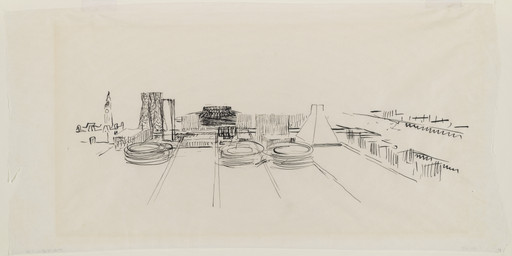
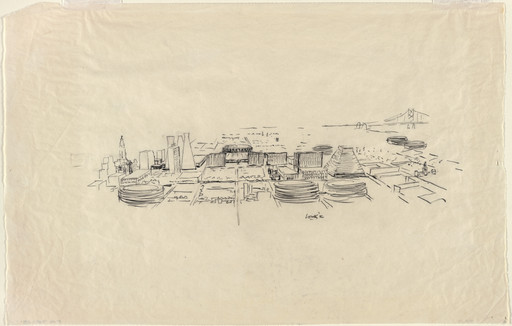
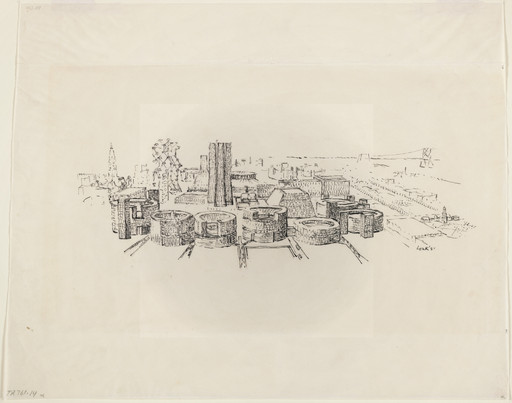
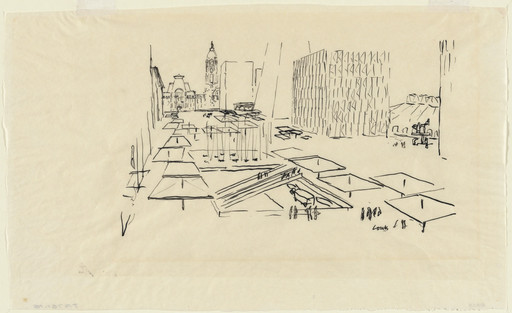
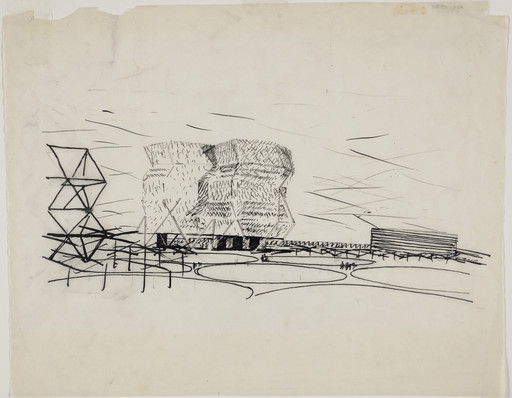
"What spaces, what activities, what buildings form the creative center of human communication?" This probing philosophical question, posed in 1955 by the American architect Louis I. Kahn, underlies the extraordinarily powerful buildings and projects for which he is known, as well as these two studies of Philadelphia's city center. In the 1950s Kahn had relatively little real work. Philadelphia, where he lived nearly all his life, was launching a decade of immense redevelopment, and Kahn was at the forefront. His numerous studies, many of them made independently without a commission, focused on the historic center city. These visionary drawings are significant not as blueprints for Philadelphia's redevelopment but because they reveal forms and ideas fulfilled in Kahn's later masterpieces.
The Traffic Study is a carefully ordered conceptual plan in which Kahn proposed a new traffic pattern. In an effort to untangle traffic congestion and to mitigate the haphazard proliferation of parking lots that plagued postwar American cities, Kahn reordered the streets according to a functional hierarchy. Like an idiosyncratic musical score, the drawing's abstract notational system corresponds to different tempos of traffic, such as the stop-and-go movement of trucks and buses (dotted lines), the fast flow of vehicles around the periphery (arrows), and the stasis of cars in parking garages (spirals). To explain his movement study, Kahn invoked a historical analogy: for him, the girdle of expressways and parking towers circling the city center metaphorically recalled the walls and towers that protected the medieval cities of Europe. Kahn's specific comparison was to the largely medieval town of Carcassonne, in the South of France: just as Carcassonne was a city built for defense, Kahn envisioned the modern city center having to defend itself against the automobile.
an essay by Peter Reed, in Matilda McQuaid, ed., Envisioning Architecture: Drawings from The Museum of Modern Art, New York: The Museum of Modern Art, 2002, p. 112.
Explore more


From MoMA Design Store


Installation views
We have identified this work in the following photos from our exhibition history.
Licensing
Artwork or archival images
If you would like to reproduce an image of a work of art in MoMA's collection, or an image of a MoMA publication or archival material (including installation views, checklists, and press releases), please contact Art Resource (publication in North America) or Scala Archives (publication in all other geographic locations).
Audio and film clips
MoMA licenses archival audio and select out of copyright film clips from our film collection. At this time, MoMA produced video cannot be licensed by MoMA/Scala. All requests to license archival audio or out of copyright film clips should be addressed to Scala Archives at [email protected]. Motion picture film stills cannot be licensed by MoMA/Scala. For access to motion picture film stills for research purposes, please contact the Film Study Center at [email protected]. For more information about film loans and our Circulating Film and Video Library, please visit Circulating Film and Video Library.
Text from a publication or the archives
If you would like to reproduce text from a MoMA publication, please email [email protected]. If you would like to publish text from MoMA's archival materials, please fill out this permission form and send to [email protected].
Feedback
This record is a work in progress. If you have additional information or spotted an error, please fill out this feedback form.