Cut-and-pasted printed and painted paper, charcoal, chalk, and pencil on gessoed canvas
Not on view
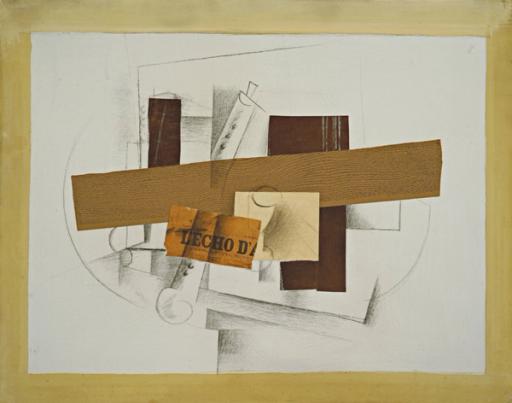
Still Life with Tenora is a consummate example of Braque's papier collé (literally, pasted paper) style. The bold geometric fragments of contrasting types of paper interlaced with the figurative motifs drawn in charcoal evoke the structure of a fugue, in which two distinct melodies intertwine in a rich, sonorous composition, each acting as a foil to the other's reality.
The invention of the papier collé in 1912 by Braque and Pablo Picasso introduced a revolution in Western painting, whose repercussions are still being felt today. By pasting fragments of paper (newspaper, wallpaper, and wood-grained paper) onto their still-life compositions, they introduced real materials and textures into an art hitherto based on illusionistic renderings.
The significance of this breakthrough cannot be overestimated because through this technique these artists declared the autonomy of the painted or drawn image, and radically severed it from any attempt at representation. The fragments attached to the picture's surface rarely followed the contours or silhouettes of the drawn motifs (glasses, bottles, or musical instruments), but, paradoxically, contradicted them. Thus, they countered the conventional devices of modeling and depth perspective, and drew attention to the absolute flatness of the two-dimensional plane.
The Museum of Modern Art, MoMA Highlights, New York: The Museum of Modern Art, revised 2004, originally published 1999.
Explore more
Georges Braque
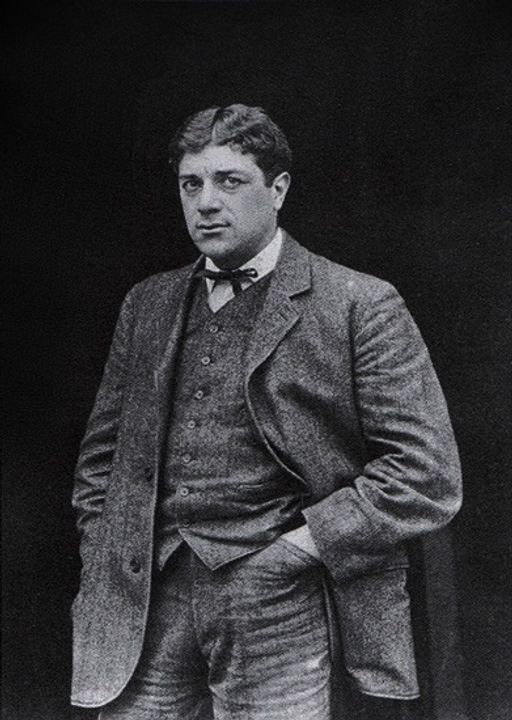
French, 1882–1963 68 works onlineGuitars, violins, clarinets, mandolins. These are some of the musical instruments that appear in the paintings , drawings , and prints by artist Georges Braque, best known for his role in inventing Cubism with Pablo Picasso in the early 20th century.
Learn more →

Cubism
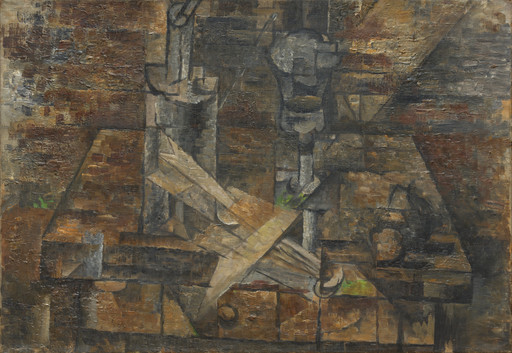
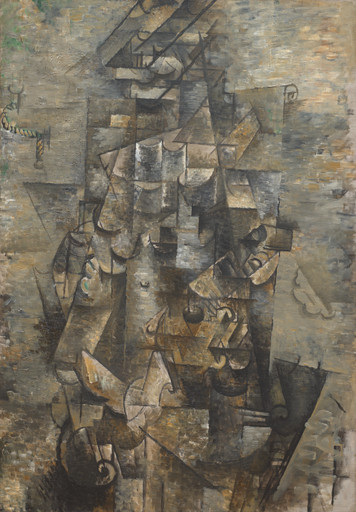
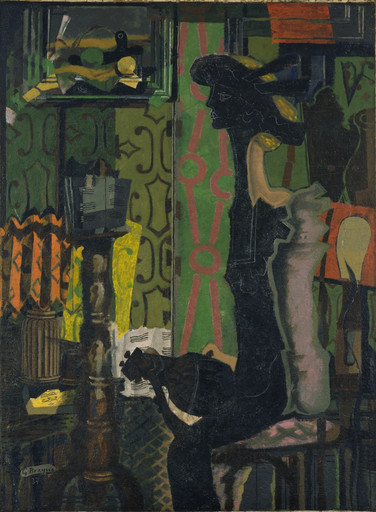
An artistic style invented in Paris during the first decade of the 20th century, Cubism was soon adopted by an international network of artists who sought to create a new art for a new century.
Learn more →


From MoMA Design Store


Installation views
We have identified this work in the following photos from our exhibition history.
Provenance Research Project
This work is included in the Provenance Research Project, which investigates the ownership history of works in MoMA's collection.
1913/14 - December 12, 1914, Galerie Kahnweiler (photo no. 1171), Paris, acquired from the artist.
December 12, 1914 - May 7-8, 1923, Kahnweiler collection and gallery stock, sequestered during World War I by the French government as enemy property and sold through Hôtel Drouot to unidentified buyer (4th sale of Kahnweiler collection, May 7-8, 1923, lot 14), Paris.
By 1924, Léonce Rosenberg (Galerie L’Effort moderne), Paris.
[1925] - 1951, Amédée Ozenfant, Paris and New York.
1951 - 1979, Nelson A. Rockefeller, New York, purchased from Amédée Ozenfant.
1979, The Museum of Modern Art, New York, acquired by bequest from Nelson A. Rockefeller.
Provenance research is a work in progress, and is frequently updated with new information. If you have any questions or information to provide about the listed works, please email [email protected] or write to:
Provenance Research Project
The Museum of Modern Art
11 West 53 Street
New York, NY 10019
Licensing
Artwork or archival images
If you would like to reproduce an image of a work of art in MoMA's collection, or an image of a MoMA publication or archival material (including installation views, checklists, and press releases), please contact Art Resource (publication in North America) or Scala Archives (publication in all other geographic locations).
Audio and film clips
MoMA licenses archival audio and select out of copyright film clips from our film collection. At this time, MoMA produced video cannot be licensed by MoMA/Scala. All requests to license archival audio or out of copyright film clips should be addressed to Scala Archives at [email protected]. Motion picture film stills cannot be licensed by MoMA/Scala. For access to motion picture film stills for research purposes, please contact the Film Study Center at [email protected]. For more information about film loans and our Circulating Film and Video Library, please visit Circulating Film and Video Library.
Text from a publication or the archives
If you would like to reproduce text from a MoMA publication, please email [email protected]. If you would like to publish text from MoMA's archival materials, please fill out this permission form and send to [email protected].
Feedback
This record is a work in progress. If you have additional information or spotted an error, please fill out this feedback form.