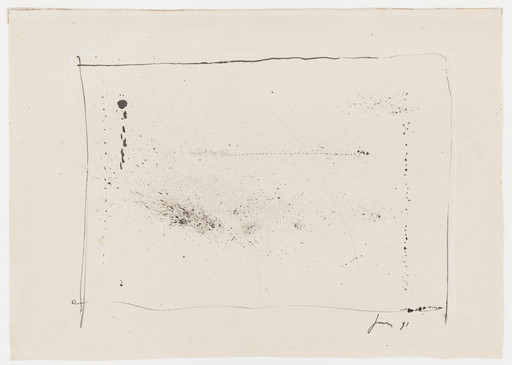
Ink and pencil on paper on canvas
Not on view
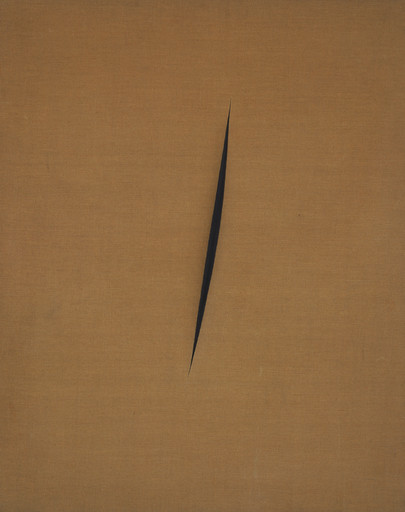
Inspired by Futurism, Fontana sought to escape the “prison” of the flat picture surface to explore movement, time, and space. In 1949 he first developed his Spatial Concepts, puncturing and piercing the surfaces of sheets of paper to reach behind and beyond the illusionistic plane into what he called “a free space.” In the late 1950s Fontana began to slash linear cuts into stretched canvases; shedding its materiality, line became coextensive with infinite space.
On Line: Drawing Through the Twentieth Century, November 21, 2010-February 7, 2011.
Publication excerpt from MoMA Highlights: 375 Works from The Museum of Modern Art, New York (New York: The Museum of Modern Art, 2019)
The strongest visual device in Spatial Concept is a wide, irregular oval of rough holes, their broken rims poking outward as if some force in the hidden darkness behind the picture plane were struggling to break through. Scratches of black ink, most of them short and bristle-like, scatter in flurries across the surface; the lighter lines and whorls are abrasions scored in the thick paper, ridged scars that compensate for their relative faintness with their violence. The works in Fontana’s Spatial Concepts series—the first of which dates from 1949—have a physical concreteness that is in tune with the anti-idealist mood prevalent in Europe after World War II.
Fontana felt that advances in science demanded parallel innovations in art, which, he declared, should reach out into its surroundings—it should exist not in two dimensions but in space. Sculpture, being three-dimensional, did this necessarily, as did the kind of environmental installation that Fontana explored early on and which has since become its own genre of art. Painting, though, demanded radical surgery: the rupturing of the picture’s flatness. Canvas or paper is the literal foundation for a picture, the stage on which all of its events must play themselves out. To puncture this plane is a daring, even shocking act for a painter. Spatial Concept clearly conveys the considerable psychological nerve Fontana’s gesture required.
MoMA Highlights: 375 Works from The Museum of Modern Art, New York (New York: The Museum of Modern Art, 2019)
Explore more
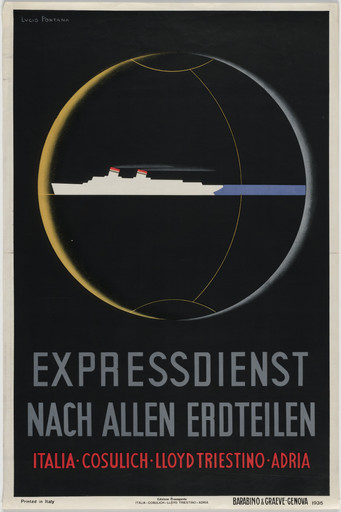
![Lucio Fontana. Services Express Pour le Monde Entier (Poster advertising the four United Italian shipping lines [Italia Flotte Riunite, Consulich S.T.N., Lloyd Triestino and Adria])](https://www.moma.org/media/W1siZiIsIjIxMTY5NiJdLFsicCIsImNvbnZlcnQiLCItcXVhbGl0eSA5MCAtcmVzaXplIDUxMng1MTJcdTAwM2UiXV0.jpg?sha=52a766b6da1f2cd3)



From MoMA Design Store


Installation views
We have identified this work in the following photos from our exhibition history.
Licensing
Artwork or archival images
If you would like to reproduce an image of a work of art in MoMA's collection, or an image of a MoMA publication or archival material (including installation views, checklists, and press releases), please contact Art Resource (publication in North America) or Scala Archives (publication in all other geographic locations).
Audio and film clips
MoMA licenses archival audio and select out of copyright film clips from our film collection. At this time, MoMA produced video cannot be licensed by MoMA/Scala. All requests to license archival audio or out of copyright film clips should be addressed to Scala Archives at [email protected]. Motion picture film stills cannot be licensed by MoMA/Scala. For access to motion picture film stills for research purposes, please contact the Film Study Center at [email protected]. For more information about film loans and our Circulating Film and Video Library, please visit Circulating Film and Video Library.
Text from a publication or the archives
If you would like to reproduce text from a MoMA publication, please email [email protected]. If you would like to publish text from MoMA's archival materials, please fill out this permission form and send to [email protected].
Feedback
This record is a work in progress. If you have additional information or spotted an error, please fill out this feedback form.