Stainless steel and synthetic rubber
Not on view
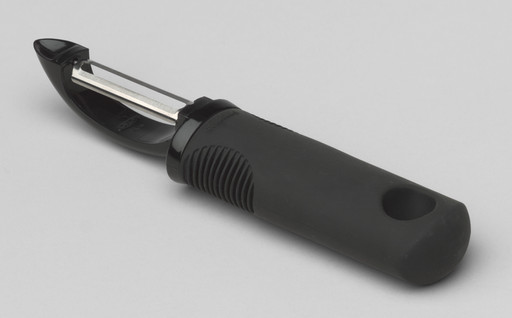
Sometimes an object designed to improve one person’s life can also improve those of countless others. After entrepreneur Sam Farber noticed his wife, Betsey, struggling with a peeler because of her arthritis, he approached Smart Design to develop a line of kitchen utensils that would be easy to wield, regardless of the strength, size, or anatomy of one’s hand. They designed an oval-shaped handle formed out of thermoplastic elastomer—a soft synthetic rubber—with gill-like incisions to facilitate grip. The handle has since been paired with knives, can openers, peelers, and other products for OXO, the company Farber went on to found. By designing tools that are usable not just by arthritis sufferers but everybody, Good Grips exemplifies the concept of universal design.
Pirouette: Turning Points in Design, January 26, 2025–November 15, 2025
Gallery label from Born out of Necessity , March 2, 2012–January 28, 2013
After retiring from Copco (the American kitchenware company he founded) in 1988, Sam Farber decided to use his entrepreneurial experience to help people with physical disabilities and impairments. He asked the New York-based firm Smart Design to develop a line of kitchen utensils whose principal focus was the grip, its quality and efficiency. Oval in shape and formed out of thermoplastic elastomer—a synthetic rubber that can be molded in detail by injection—with gill-like incisions for a firm grip, the handle they developed has been outfitted with knife blades, can openers, potato peelers, and more. A better-fitting handle born out of necessity was the spark for a design philosophy that extended to other kitchen items, from measuring cups to oven mitts. The line, which was initially devised for a few, has become widely favored for its beauty, comfort, and intelligence—a great example of universal design.
Born out of Necessity, March 2, 2012–January 28, 2013
Explore more




From MoMA Design Store


Installation views
We have identified this work in the following photos from our exhibition history.
Licensing
Artwork or archival images
If you would like to reproduce an image of a work of art in MoMA's collection, or an image of a MoMA publication or archival material (including installation views, checklists, and press releases), please contact Art Resource (publication in North America) or Scala Archives (publication in all other geographic locations).
Audio and film clips
MoMA licenses archival audio and select out of copyright film clips from our film collection. At this time, MoMA produced video cannot be licensed by MoMA/Scala. All requests to license archival audio or out of copyright film clips should be addressed to Scala Archives at [email protected]. Motion picture film stills cannot be licensed by MoMA/Scala. For access to motion picture film stills for research purposes, please contact the Film Study Center at [email protected]. For more information about film loans and our Circulating Film and Video Library, please visit Circulating Film and Video Library.
Text from a publication or the archives
If you would like to reproduce text from a MoMA publication, please email [email protected]. If you would like to publish text from MoMA's archival materials, please fill out this permission form and send to [email protected].
Feedback
This record is a work in progress. If you have additional information or spotted an error, please fill out this feedback form.