Plastic, glass and electronics
Not on view
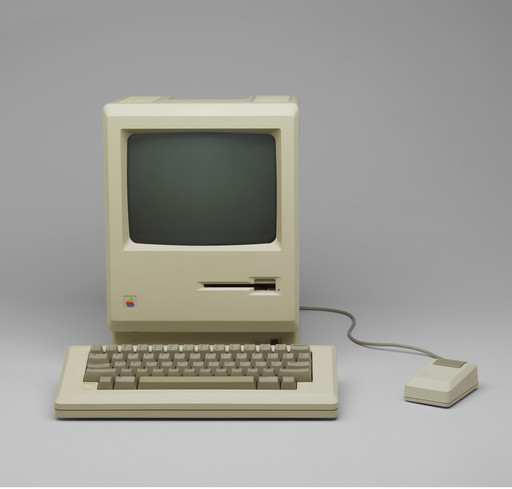
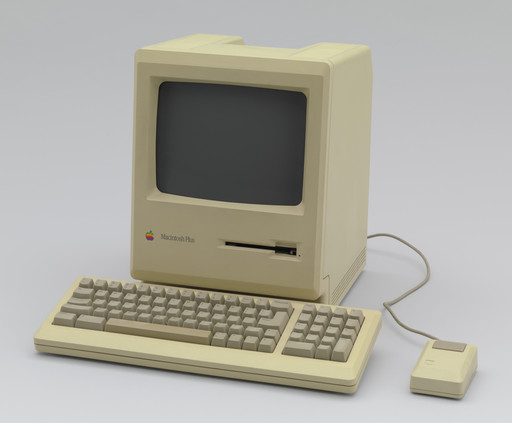
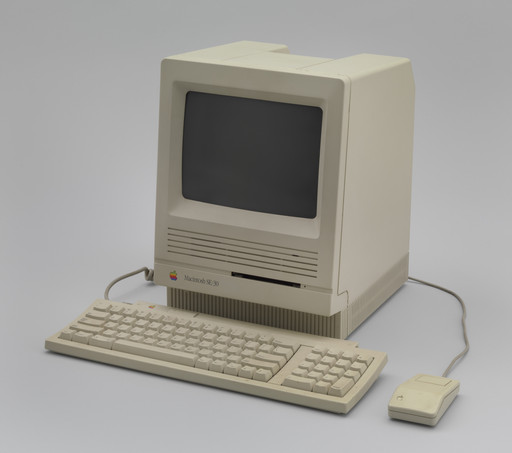
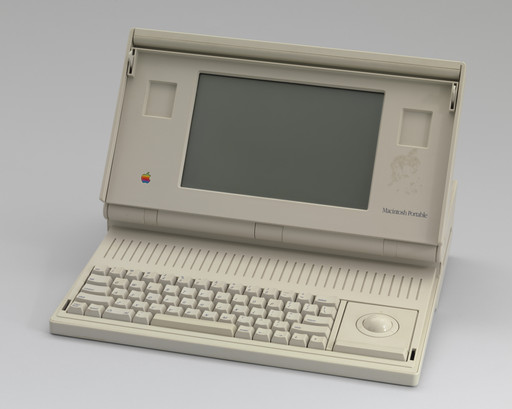
In 1982, Steve Jobs, founder of Apple Computer, Inc., was seeking "the best design in the world" for his company, which had skyrocketed from nothing to a $581 million market value in only six years. When Hartmut Esslinger, the idealistic founder of frogdesign, expressed his view that "computer accessibility is a problem of democracy," Jobs recognized a kindred spirit. He called on Esslinger to design an expressive visual code that could produce a wide range of coherent design variations. The result was a design program that led, for instance, to the horizontal lines that mask the vents in this Macintosh home computer. Esslinger maintained that "in computers, design isn’t decoration, it’s the essence."
Jobs left the company in the late 1980s but returned in 1997 and resumed his search for great design. He found it with Jonathan Ive, an Apple designer since 1992, whom he promoted to senior vice president of industrial design. With his collaborators Ive has designed beautiful objects, including the Cube, the iMac, and the iBook, endowed with communicative skills and mesmerizing details. "Our goal is to take a great technology and make it very accessible, make it appropriately meaningful to a lot of people," Ive has declared. "We try to remove the barriers . . . that have traditionally forced people to try and fit the machine, rather than the machine fitting them."
The Museum of Modern Art, MoMA Highlights since 1980, New York: The Museum of Modern Art, 2007, p. 70.
Explore more
Coding/programming
Coding is the method by which computer programmers, or coders, transmit instructions to computers. Coding transforms human language into the binary language of computers (in which there are only two possible states, off and on, commonly symbolized by 0 and 1).
Learn more →




From MoMA Design Store


Installation views
We have identified this work in the following photos from our exhibition history.
Licensing
Artwork or archival images
If you would like to reproduce an image of a work of art in MoMA's collection, or an image of a MoMA publication or archival material (including installation views, checklists, and press releases), please contact Art Resource (publication in North America) or Scala Archives (publication in all other geographic locations).
Audio and film clips
MoMA licenses archival audio and select out of copyright film clips from our film collection. At this time, MoMA produced video cannot be licensed by MoMA/Scala. All requests to license archival audio or out of copyright film clips should be addressed to Scala Archives at [email protected]. Motion picture film stills cannot be licensed by MoMA/Scala. For access to motion picture film stills for research purposes, please contact the Film Study Center at [email protected]. For more information about film loans and our Circulating Film and Video Library, please visit Circulating Film and Video Library.
Text from a publication or the archives
If you would like to reproduce text from a MoMA publication, please email [email protected]. If you would like to publish text from MoMA's archival materials, please fill out this permission form and send to [email protected].
Feedback
This record is a work in progress. If you have additional information or spotted an error, please fill out this feedback form.