Acrylic on paper pinned to canvas
Not on view
Kelley made a career of reading the “lower” regions of American culture—comic strips, suburbia, punk music, consumerism—through the psychoanalytic concepts of repression, regression, and transference. The resulting drawings, sculptures, and installations are often evocative, disturbing, and deeply funny.
The project Plato’s Cave, Rothko’s Chapel, Lincoln’s Profile comprises performances, music, installations, and drawings; its title refers to the well-known allegory of the cave in Plato’s Republic, putting it in association with the Texas chapel designed by the Abstract Expressionist painter Mark Rothko, and President Abraham Lincoln’s familiar facial profile, which is featured on the US penny. Kelley crossed Plato’s parable of appearance and reality with questions of lightness and darkness, interiority and exteriority, representation and simulation, the ideal and the contingent.
Exploring, part of this larger project, shows the inside of a cave, dense with suggestively shaped stalagmites and stalactites; to explore this space, we are told, we must first stoop and then crawl like a worm. In its conflation of interior exploration and regression, the drawing ponders the opposition between the desire to know and the impulse to refuse knowledge, which Kelley acknowledged as the crux of his art: “I saw that certain themes came back again and again in my work. There’s sort of an ur-group of information that I was suppressing . . . standardized kinds of repressed things in the culture—embarrassing things, like sexual dysfunction and the scatological.”
MoMA Highlights: 375 Works from The Museum of Modern Art, New York (New York: The Museum of Modern Art, 2019)
Publication excerpt from The Museum of Modern Art, MoMA Highlights since 1980 , New York: The Museum of Modern Art, 2007, p. 59.
Of all the artists who have emerged over the past fifteen years from the now-legendary California Conceptualist movement, Kelley has had the most profound impact on American art—with his scatological performance pieces, prolific writing, and large-scale installations featuring the abject souvenirs of middle-class adolescence (from dirty stuffed animals to crocheted couch throws). In Kelley's multimedia work, high and low are combined to create a kind of détente between the academic and the everyday. In this world old toys and groups of drawings executed in the style of mid-1950s comic books are marshaled together to examine the most intricate metaphysical problems.
This large drawing is from a group of ten works that explore a perennial artistic conundrum: truth versus illusion. Having rendered the interior of a cave in a style that recalls comic illustration and film, Kelley asks the viewer to enter into his illusion: in its original installation, the drawing, which drips with curiously scatological stalactites and stalagmites, was hung close to the floor, directly above and partially blocking a small entryway. Viewers were forced to crouch down and slide beneath it, strengthening the work's comparison of art viewing to cave exploration and making manifest the words that appear in the drawing itself: "When spelunking, sometimes you have to stoop . . . Sometimes you have to go on all fours . . . Sometimes even crawl. . . . Crawl worm!!"
The Museum of Modern Art, MoMA Highlights since 1980, New York: The Museum of Modern Art, 2007, p. 59.
Explore more
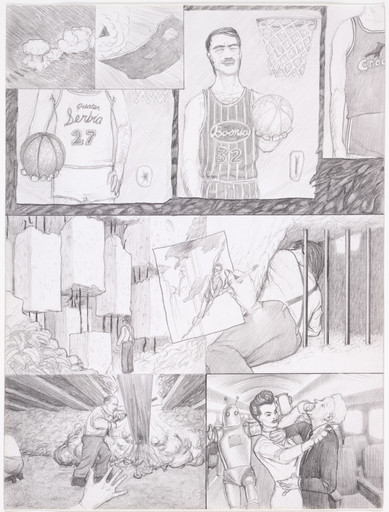
Comic
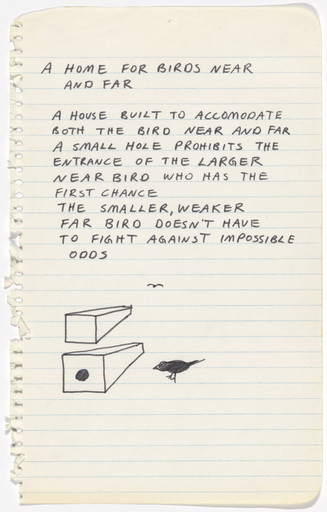
A sequence of images that may or may not also contain words. This sequence is made up of several images, or self-contained sections, called “panels.
Learn more →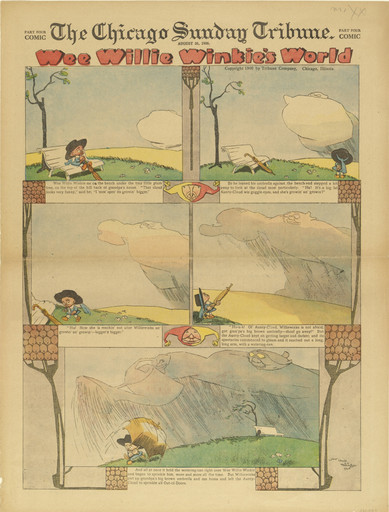



From MoMA Design Store


Installation views
We have identified this work in the following photos from our exhibition history.
Licensing
Artwork or archival images
If you would like to reproduce an image of a work of art in MoMA's collection, or an image of a MoMA publication or archival material (including installation views, checklists, and press releases), please contact Art Resource (publication in North America) or Scala Archives (publication in all other geographic locations).
Audio and film clips
MoMA licenses archival audio and select out of copyright film clips from our film collection. At this time, MoMA produced video cannot be licensed by MoMA/Scala. All requests to license archival audio or out of copyright film clips should be addressed to Scala Archives at [email protected]. Motion picture film stills cannot be licensed by MoMA/Scala. For access to motion picture film stills for research purposes, please contact the Film Study Center at [email protected]. For more information about film loans and our Circulating Film and Video Library, please visit Circulating Film and Video Library.
Text from a publication or the archives
If you would like to reproduce text from a MoMA publication, please email [email protected]. If you would like to publish text from MoMA's archival materials, please fill out this permission form and send to [email protected].
Feedback
This record is a work in progress. If you have additional information or spotted an error, please fill out this feedback form.