Not on view
For Tomb Dienes combined her two signature practices, ink rubbing and the use of found objects. Influenced by the Surrealist process of frottage, Dienes first made rubbings of natural objects and household items during a residency in upstate New York in 1953. She quickly deployed this technique outside the studio, creating haunting imprints of colonial tombstones in New England cemeteries. After taping a large piece of paper onto the headstone, she used a roller to apply ink to the sheet to transfer the decoration; the uneven impression captures the idiosyncrasies of the surface and her interaction with the stone.
Dienes viewed her rubbings as more than documents of her environment: “My use of rollers and natural surfaces . . . is a kind of jumping off place for my imagination.” Tomb embodies her inspired amplification of the technique: after Dienes completed the rubbing, she stapled a weather-worn fabric American flag over it and encased the design within two sheets of torn mat board, heightening the sense of decay already palpable in the imprint. In juxtaposing a tombstone with a symbol of American patriotism and democracy, Dienes radically upended the traditional meaning of both icons, inviting numerous new interpretations. Among other possibilities, the work may describe the Hungarian-born artist’s relationship with her adopted country or respond, more specifically, to threats to American democracy at the time, from the Korean War to McCarthyism.
MoMA Highlights: 375 Works from The Museum of Modern Art, New York (New York: The Museum of Modern Art, 2019)
Explore more
Sari Dienes
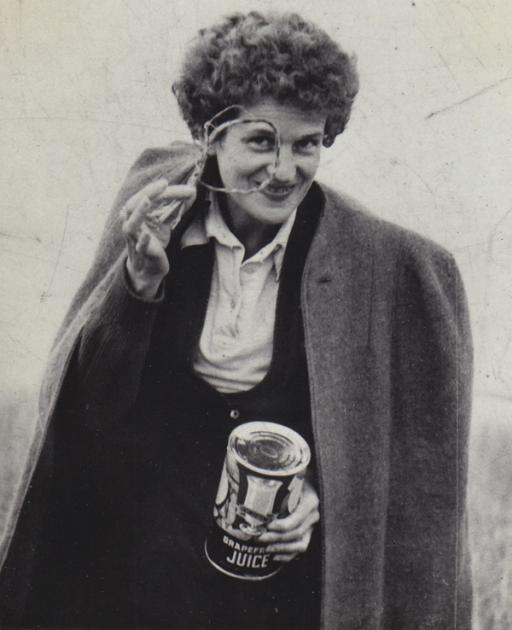
American, born Hungary. 1898–1992 11 works onlineA photograph of Sari Dienes published in the November 15, 1954, issue of Life magazine shows a demure, well-coiffed woman strolling through quaint old graveyards to make “tombstone tracery” rubbings from old stone monuments.
Learn more →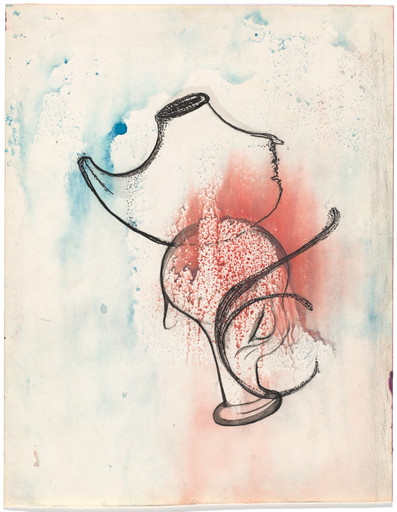
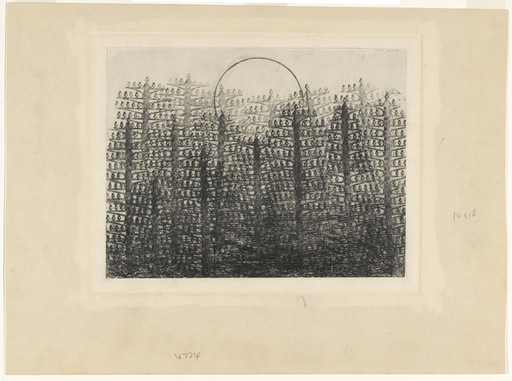
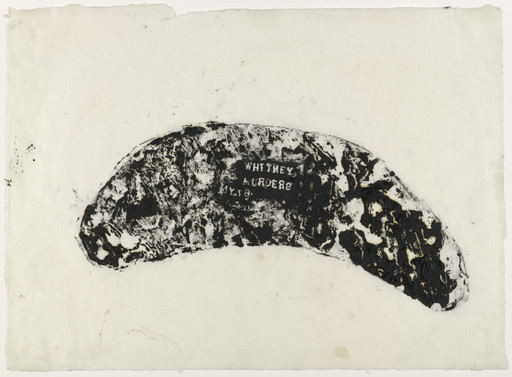
Frottage
A technique that involves rubbing pencil, graphite, chalk, crayon, or another medium onto a sheet of paper that has been placed on top of a textured object or surface.
Learn more →![Christian Rohlfs. Large Heads (2 Heads I) [Grosse Köpfe (2 Köpfe I)]](https://www.moma.org/media/W1siZiIsIjExNzA0NiJdLFsicCIsImNvbnZlcnQiLCItcXVhbGl0eSA5MCAtcmVzaXplIDUxMng1MTJcdTAwM2UiXV0.jpg?sha=8299cb91ee901684)




From MoMA Design Store


Installation views
We have identified this work in the following photos from our exhibition history.
Licensing
Artwork or archival images
If you would like to reproduce an image of a work of art in MoMA's collection, or an image of a MoMA publication or archival material (including installation views, checklists, and press releases), please contact Art Resource (publication in North America) or Scala Archives (publication in all other geographic locations).
Audio and film clips
MoMA licenses archival audio and select out of copyright film clips from our film collection. At this time, MoMA produced video cannot be licensed by MoMA/Scala. All requests to license archival audio or out of copyright film clips should be addressed to Scala Archives at [email protected]. Motion picture film stills cannot be licensed by MoMA/Scala. For access to motion picture film stills for research purposes, please contact the Film Study Center at [email protected]. For more information about film loans and our Circulating Film and Video Library, please visit Circulating Film and Video Library.
Text from a publication or the archives
If you would like to reproduce text from a MoMA publication, please email [email protected]. If you would like to publish text from MoMA's archival materials, please fill out this permission form and send to [email protected].
Feedback
This record is a work in progress. If you have additional information or spotted an error, please fill out this feedback form.