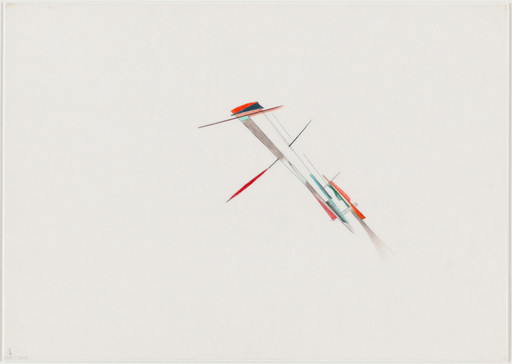
Colored pencil on tracing paper
Not on view
The drawing is a lens that reveals otherwise imperceptible aspects; it's a method for understanding how things can change and evolve and serve, not for crystallizing a form in a definitive way but to demonstrate the possibilities of what it can become.
—Zaha Hadid
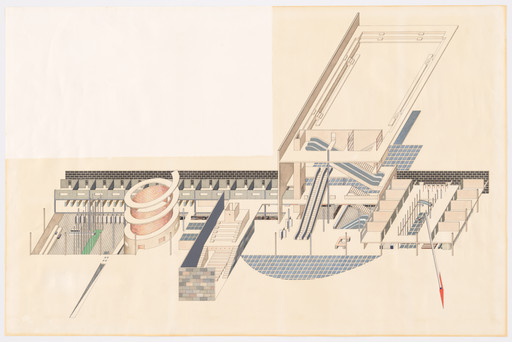
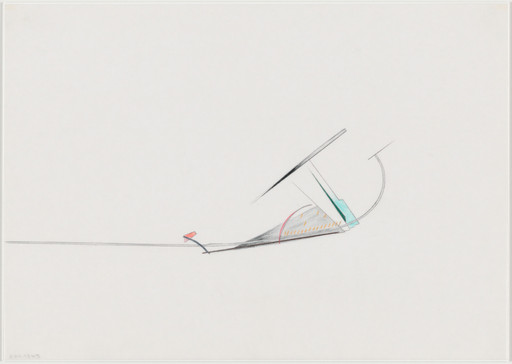
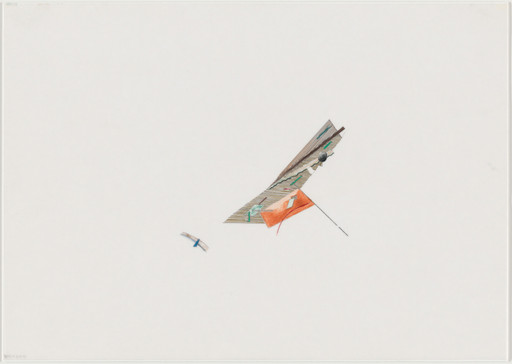
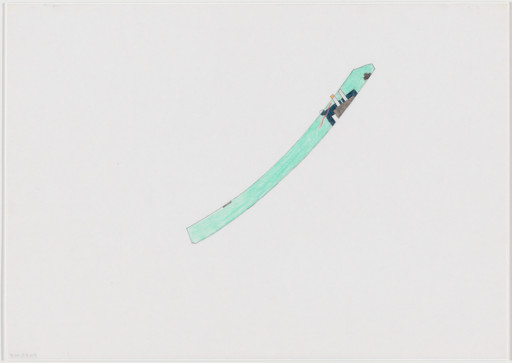
At once a representation of a proposal and an investigation into architecture, Zaha Hadid's drawings for the Parc de la Villette, Paris, present drawing as a way of thinking. These drawings—six from a series of twenty—form a series of overlays that mimic Hadid's conception for the project: stacked planes of uninterrupted space that hover over the landscape. They were produced for a competion sponsored by the French government in 1982, and eventually won by Bernard Tschumi in March 1983, that entailed designing a park for the twenty-first century. The park was to be located in a terraine vague, a 125-acre site that had once housed a group of slaughterhouses in the northeast corner of Paris, between the outer fringes of the city and the peripheral highway that borders it to the north. Hadid proposed a series of elevated mobile gardens, which were to move in random or controlled orbits and change with the seasons—a virtual galaxy of kiosks, picnic areas, restaurants, and gardens. One might experience this park the way one sees an architectural section—as a vertical slice through the landscape, where one would encounter unforeseen and infinite juxtapositions of space. Nature in this sense became an artificial construct, and the landscape, rather than a picturesque paysage, a laboratory of discovery.
These elements of surprise are the point of both Hadid's project and her drawings. Just as the mechanized movement of the gardens becomes a kind of calligraphy on the ground, Hadid's precise mark-making becomes a form of research into the possibilities of architecture. Her preferred method of black and white drawing explores elemental constructs, and when she does use color, rather than being decorative, it reveals the mood and quality of the space.
Hadid is perhaps best known as a theoretical architect; the Vitra Fire Station, Weil am Rhein, completed in 1993, was her first built work, and the Terminus Nord, a transportation center in Strasbourg, is scheduled to be completed early in 2002. Her affinity with the Russian Constructivists and Suprematists of the 1920s lies less with formal drawing conventions than in an attitude of experimentation without need for conclusion, and in an expression of hope for new forms of architecture that go beyond what we know.
an essay by Tina di Carlo, in Matilda McQuaid, ed., Envisioning Architecture: Drawings from The Museum of Modern Art, New York: The Museum of Modern Art, 2002, p. 212.
Explore more

From MoMA Design Store


Installation views
We have identified this work in the following photos from our exhibition history.
Licensing
Artwork or archival images
If you would like to reproduce an image of a work of art in MoMA's collection, or an image of a MoMA publication or archival material (including installation views, checklists, and press releases), please contact Art Resource (publication in North America) or Scala Archives (publication in all other geographic locations).
Audio and film clips
MoMA licenses archival audio and select out of copyright film clips from our film collection. At this time, MoMA produced video cannot be licensed by MoMA/Scala. All requests to license archival audio or out of copyright film clips should be addressed to Scala Archives at [email protected]. Motion picture film stills cannot be licensed by MoMA/Scala. For access to motion picture film stills for research purposes, please contact the Film Study Center at [email protected]. For more information about film loans and our Circulating Film and Video Library, please visit Circulating Film and Video Library.
Text from a publication or the archives
If you would like to reproduce text from a MoMA publication, please email [email protected]. If you would like to publish text from MoMA's archival materials, please fill out this permission form and send to [email protected].
Feedback
This record is a work in progress. If you have additional information or spotted an error, please fill out this feedback form.