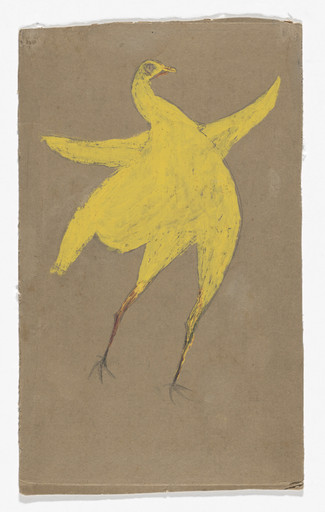
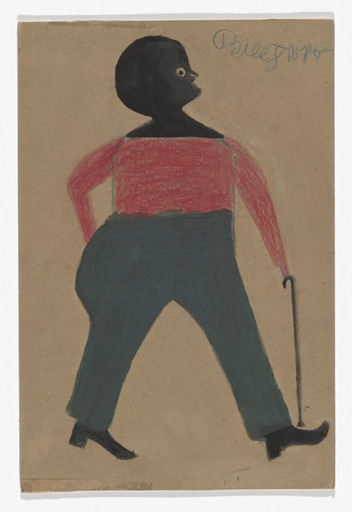
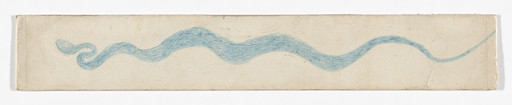
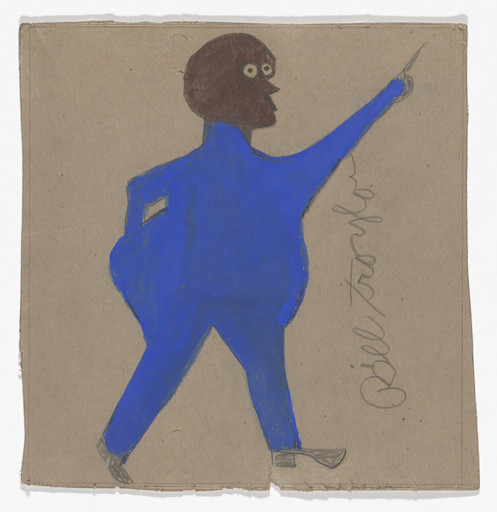
The articulated silhouette and fluid monochrome wash of Arched Drinker embody the idiosyncratic poetic vision and unselfconscious technique of this self-taught artist. Traylor's single figures, or more complex scenes in which he weaves figures, architecture, and other motifs into intricate patterns, show an acute observation, a visionary imagination, and a deftness of execution that are altogether astounding. Whereas some of Traylor's motifs may appear somewhat folkloric, others translate into an exuberant expression and sophisticated invention comparable to the more studied naïveté found in the works of Paul Klee or Jean Dubuffet, for example. These mainstream artists and others have long been inspired by the freshness and authenticity of expression of artists such as Traylor.
Born into slavery in Benton, Alabama, Traylor practiced his art only during a three-year period, after the age of eighty-five. His initial mediums were watercolor and pencil, later expanded to include charcoal and poster paint; his supports were pieces of discarded cardboard. Traylor's subject matter was the street life of downtown Montgomery, observed from his makeshift sidewalk studio (a crate and a table), where he produced between 1,200 and 1,500 whimsical drawings.
The Museum of Modern Art, MoMA Highlights, New York: The Museum of Modern Art, revised 2004, originally published 1999, p. 158.
Explore more


From MoMA Design Store


Installation views
We have identified this work in the following photos from our exhibition history.
Licensing
Artwork or archival images
If you would like to reproduce an image of a work of art in MoMA's collection, or an image of a MoMA publication or archival material (including installation views, checklists, and press releases), please contact Art Resource (publication in North America) or Scala Archives (publication in all other geographic locations).
Audio and film clips
MoMA licenses archival audio and select out of copyright film clips from our film collection. At this time, MoMA produced video cannot be licensed by MoMA/Scala. All requests to license archival audio or out of copyright film clips should be addressed to Scala Archives at [email protected]. Motion picture film stills cannot be licensed by MoMA/Scala. For access to motion picture film stills for research purposes, please contact the Film Study Center at [email protected]. For more information about film loans and our Circulating Film and Video Library, please visit Circulating Film and Video Library.
Text from a publication or the archives
If you would like to reproduce text from a MoMA publication, please email [email protected]. If you would like to publish text from MoMA's archival materials, please fill out this permission form and send to [email protected].
Feedback
This record is a work in progress. If you have additional information or spotted an error, please fill out this feedback form.