Geometric abstraction flourished from the 1930s through the 1970s in the art centers of Latin America, notably Buenos Aires, São Paulo, and Rio de Janeiro. Oiticica, who was based in Rio de Janeiro, experimented with geometric abstraction in the late 1950s. Works in the Metaesquemas series are composed of squares and rectangles, usually against a pale background, reflecting the influence of Kazimir Malevich and Piet Mondrian. Arranged in a gridlike structure but without complete regularity, his shapes seem to rhythmically shift and float slightly off the surface of the paper.
Geo/Metric: Prints and Drawings from the Collection, June 11–August 18, 2008.
Publication excerpt from MoMA Highlights: 375 Works from The Museum of Modern Art, New York (New York: The Museum of Modern Art, 2019)
This gouache drawing presents a group of black rectangles tilting rhythmically toward each other in a mirrored disposition: an imaginary axis runs vertically through the center of the work, dividing the composition into nearly symmetrical halves.
Oiticica was only twenty years old when he began working on his Metaesquemas series, which would eventually comprise more than 350 compositions. The Metaesquemas (Meta-Schemes) were pivotal in the young artist’s career, marking the shift from two-dimensional to three-dimensional space that he would pursue in his practice in subsequent years. He later described this series as exercises in the “obsessive dissection of space” aimed at destabilizing the spatial conventions of Concrete painting, a rationalist movement that promoted geometric abstraction and had dominated art-making in Brazil since the early 1950s. Indeed, the dynamic compositions in Oiticica’s Metaesquemas introduced an unprecedented range of whimsicality, upending the primacy and stability of the grid. The vibrating picture planes also subtly anticipated Oiticica’s ambition to transform viewers into active participants, a strategy that was formalized shortly thereafter in the 1959 manifesto of the Neo-Concrete movement, which counted Oiticica as one of its main proponents.
MoMA Highlights: 375 Works from The Museum of Modern Art, New York (New York: The Museum of Modern Art, 2019)
Explore more


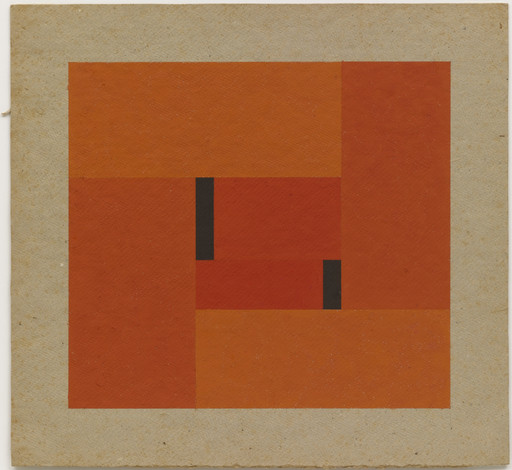

Geometric abstraction
A form of abstract art that combines geometric, “hard-edge,” or linear forms. When geometric shapes are arranged in nonrepresentational space (i.e.
Learn more →


From MoMA Design Store


Installation views
We have identified this work in the following photos from our exhibition history.
Provenance
The artist.
? - 1997, Projeto Hélio Oiticica, Rio de Janeiro.
1997, The Museum of Modern Art, New York, purchased from Projeto Hélio Oiticica.
Exhibition history
MoMA Exh. #1774: "A Decade of Collecting: Recent Acquisitions in Modern Drawing", June 5 - September 9, 1997
El Museo del Barrio, New York, "MoMA at El Museo: Latin American and Caribbean Art from the Collection of The Museum of Modern Art", March 4 - July 25, 2004
MoMA Exh. #1938: "Drawing from the Modern, 1945 - 1975", Third Floor, March 25 - August 29, 2005
MoMA Exh. #2022: "New Perspectives in Latin American Art, 1930-2006: Selections from a Decade of Acquisitions," November 21, 2007-February 25, 2008
MoMA Exh. #2041: "Geo/Metric: Prints and Drawings from the Collection," Second floor special exhibition galleries, June 11 - August 18, 2008.
MoMA Exh. MOMAATNGV: National Gallery of Victoria, Melbourne, Australia, "MoMA at NGV: 130 Years of Modern and Contemporary Art from The Museum of Modern Art, New York," June 9, 2018 - October 7, 2018
MoMA Exh. #2424, "Sur moderno: Journeys of Abstraction―The Patricia Phelps de Cisneros Gift", 3rd Floor, East Gallery, [The Robert B. Menschel Galleries], October 21, 2019 - October 2, 2020
MoMA Exh. #2578: "2024-25: 4th Floor Collection" Gallery 421 (Visible Ideas), November 1, 2024 - February 11, 2025
Licensing
Artwork or archival images
If you would like to reproduce an image of a work of art in MoMA's collection, or an image of a MoMA publication or archival material (including installation views, checklists, and press releases), please contact Art Resource (publication in North America) or Scala Archives (publication in all other geographic locations).
Audio and film clips
MoMA licenses archival audio and select out of copyright film clips from our film collection. At this time, MoMA produced video cannot be licensed by MoMA/Scala. All requests to license archival audio or out of copyright film clips should be addressed to Scala Archives at [email protected]. Motion picture film stills cannot be licensed by MoMA/Scala. For access to motion picture film stills for research purposes, please contact the Film Study Center at [email protected]. For more information about film loans and our Circulating Film and Video Library, please visit Circulating Film and Video Library.
Text from a publication or the archives
If you would like to reproduce text from a MoMA publication, please email [email protected]. If you would like to publish text from MoMA's archival materials, please fill out this permission form and send to [email protected].
Feedback
This record is a work in progress. If you have additional information or spotted an error, please fill out this feedback form.