Not on view
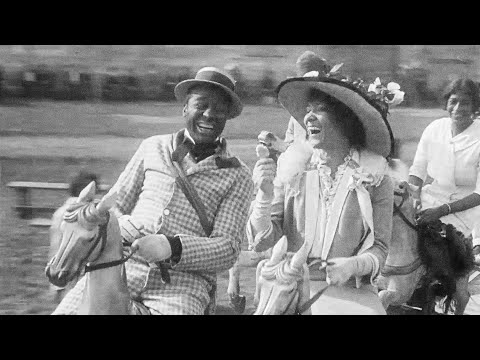
In fall 1913, a pioneering cast of black performers and an interracial crew, including directors Hunter and Middleton and the veteran comedian and Ziegfeld Follies stage star Bert Williams, gathered in the Bronx to make a motion picture. After well over an hour of film had been shot, the project was abandoned by its white producers, who packed the footage away in unmarked cans, leaving no written record of its existence. Twenty-five years later, in 1938, MoMA film curator Iris Barry rescued a cache of nine hundred negatives from the vaults of the bankrupt Biograph film studio, by chance securing the survival of the 1913 footage as well as still images and moving-image fragments documenting the cast and crew on set.
The earliest surviving feature-length film with an all-black cast, Lime Kiln Club Field Day follows the efforts of Williams’s character to win the hand of a local beauty (Odessa Warren Grey). Its highlights include a high-energy African American dance routine that still feels contemporary and a display of onscreen affection between the lead actors, at a time when such scenes were considered unacceptable for white audiences. Its singular imagery attests, a century later, to the achievements of this little-known company of performers. A long-lost landmark of film history, it is evidence that attempts were made at interracial collaboration in American film much earlier in the century than was previously known.
MoMA Highlights: 375 Works from The Museum of Modern Art, New York (New York: The Museum of Modern Art, 2019)
Gallery label from 2019
In 1913, the cast of the Harlem-based theatrical production Darktown Follies joined Caribbean-American stage star Bert Williams at the Biograph film studio in the Bronx to appear in a motion picture that reflected a more progressive image of black social life than had previously been seen on screen. Among the dances shot for the film was the cakewalk, a theatrical phenomenon in the late nineteenth and early twentieth centuries, and a feature in a number of early race-themed films. Celebrated as authentically African-American, the dance had roots in the minstrel walk-around, plantation ring-shout, and African circle dance, and possessed a vitality and potential for improvisation that stood in contrast to the formality of imported European forms of dance.
2019
Explore more

From MoMA Design Store


Installation views
We have identified this work in the following photos from our exhibition history.
Licensing
Artwork or archival images
If you would like to reproduce an image of a work of art in MoMA's collection, or an image of a MoMA publication or archival material (including installation views, checklists, and press releases), please contact Art Resource (publication in North America) or Scala Archives (publication in all other geographic locations).
Audio and film clips
MoMA licenses archival audio and select out of copyright film clips from our film collection. At this time, MoMA produced video cannot be licensed by MoMA/Scala. All requests to license archival audio or out of copyright film clips should be addressed to Scala Archives at [email protected]. Motion picture film stills cannot be licensed by MoMA/Scala. For access to motion picture film stills for research purposes, please contact the Film Study Center at [email protected]. For more information about film loans and our Circulating Film and Video Library, please visit Circulating Film and Video Library.
Text from a publication or the archives
If you would like to reproduce text from a MoMA publication, please email [email protected]. If you would like to publish text from MoMA's archival materials, please fill out this permission form and send to [email protected].
Feedback
This record is a work in progress. If you have additional information or spotted an error, please fill out this feedback form.