Ink and graphite on paper
Not on view
Although this drawing of Frank Lloyd Wright's Unity Temple is inscribed with the building's completion date, 1908, the rendering itself was made years later, around 1929–30. This fact is significant because the drawing's style and the circumstances of its production relate directly to the aging architect's reputation and waning career, which, in 1930, when Wright was in his early sixties, were being challenged by a younger generation associated with the emerging modern movement that would come to be known as the International Style. That year, delivering the Kahn Lectures on Modern Architecture at Princeton University, Wright critiqued aspects of the new architecture. A small exhibition of his work that accompanied the lectures featured many of his projects from the century's first decade—including Unity Temple, an influential building that boldly broke with traditions of ecclesiastical architecture in form, materials, and symbolism. In an effort to recast Wright's work in a more modern guise, his young assistants Heinrich Klumb and Takehiko Okami prepared new drawings for the show in a bold new manner.
In this rendering Unity Temple is reduced to starkly contrasting, relatively unornamented black and white planes, and is completely detached from its context in the landscape. The drawing focuses our attention on the cubic massing of the monolithic reinforced-concrete building, the vertical and horizontal planar surfaces, and the corner piers containing the stairs, evident in the plan below. The style is a marked departure from Wright's more typical renderings, which are romantic and colorful, expressively depicting the building, its details, and the surrounding landscape. By effectively co-opting the drawing style of a younger generation of architects associated with the modern movement, Wright consciously positioned himself as a forerunner of the so-called International Style.
an essay by Peter Reed, in Matilda McQuaid, ed., Envisioning Architecture: Drawings from The Museum of Modern Art, New York: The Museum of Modern Art, 2002, p. 42.
Explore more
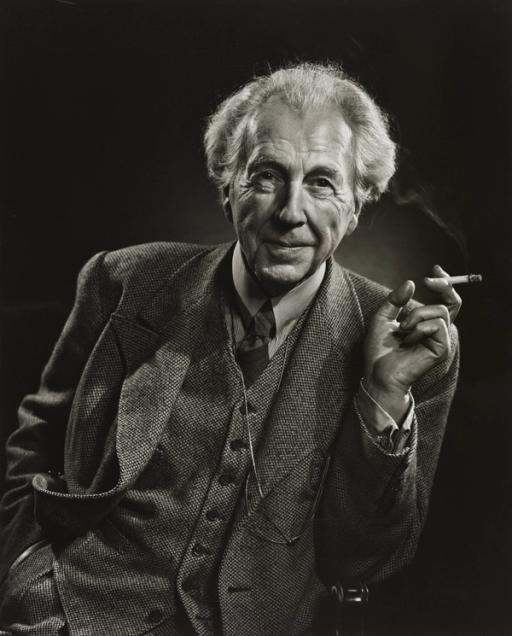
Frank Lloyd Wright
American, 1867–1959 124 works onlineA pragmatist, technical innovator, and independent thinker, Frank Lloyd Wright designed cities and buildings and their interior furnishings across a prolific 72-year career, reflecting his vision of an ideal American society.
Learn more →

From MoMA Design Store


Installation views
We have identified this work in the following photos from our exhibition history.
Licensing
Artwork or archival images
If you would like to reproduce an image of a work of art in MoMA's collection, or an image of a MoMA publication or archival material (including installation views, checklists, and press releases), please contact Art Resource (publication in North America) or Scala Archives (publication in all other geographic locations).
Audio and film clips
MoMA licenses archival audio and select out of copyright film clips from our film collection. At this time, MoMA produced video cannot be licensed by MoMA/Scala. All requests to license archival audio or out of copyright film clips should be addressed to Scala Archives at [email protected]. Motion picture film stills cannot be licensed by MoMA/Scala. For access to motion picture film stills for research purposes, please contact the Film Study Center at [email protected]. For more information about film loans and our Circulating Film and Video Library, please visit Circulating Film and Video Library.
Text from a publication or the archives
If you would like to reproduce text from a MoMA publication, please email [email protected]. If you would like to publish text from MoMA's archival materials, please fill out this permission form and send to [email protected].
Feedback
This record is a work in progress. If you have additional information or spotted an error, please fill out this feedback form.