Thom Mayne, Andrew Zago
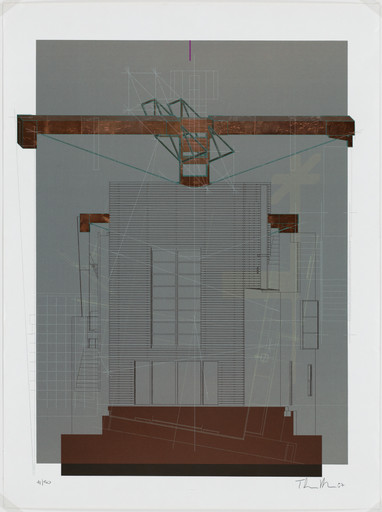
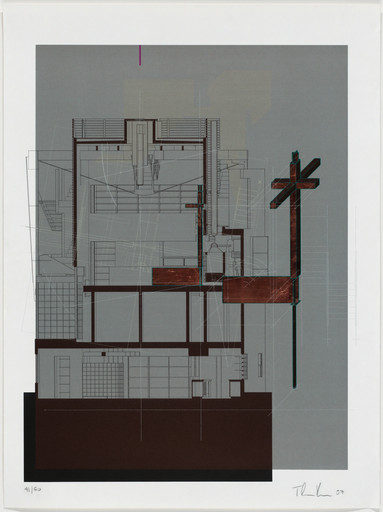
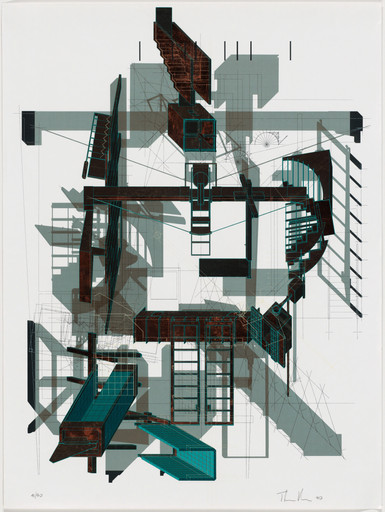
Sixth Street House project, Santa Monica, California, Sixth Street: Figure 6
1987
Serigraph with metal foil on paper
Not on view
Mayne's design for his own home began with the insertion of eleven disused mechanical objects into the existing structure of a conventional frame house. These alien fragments are positioned to activate and redefine the regular spaces of the original house, and Mayne creates subtle connections between them. Each piece is reprogrammed as a functional element—a stair or fireplace, for example—and remains in the altered space as an artifact of the design process.
In order to represent the complex configuration of elements within the house's interior effectively, Mayne and Zago developed two graphic innovations. First, all sections and elevations are taken at an oblique angle to the primary axes of the building, slicing across the house diagonally to expose new relationships not prescribed by the rectilinear geometry of the existing structure. Second, two representations are included on each drawing—a plan, section, or elevation of the house and an isometric study of one of the eleven inserted objects. Each detailed study of an object is positioned on the page relative to its location in the house, to expose the spatial ramifications. The drawing becomes a palimpsest in which layers of information unfold, creating a spatial experience on the page.
The Museum of Modern Art, MoMA Highlights since 1980, New York: The Museum of Modern Art, p. 120.
Gallery label from 9 + 1 Ways of Being Political: 50 Years of Political Stances in Architecture and Urban Design , September 12, 2012–March 25, 2013.
Mayne’s drawings for Sixth Street House invoke architectural conventions only to surpass their limitations. By collapsing plan, elevation, and detail through juxtapositions of scale, oblique angles, projection, and rotation, Mayne challenges the historical view of drawing as a passive medium at the service of architecture. The design involves the insertion of eleven found machinery parts into the shell of a preexisting bungalow. Reworked as functional elements—staircase, fireplace, shower—these innovative elements embody an imagined prehistory or archeology of the site. The complex operations characteristic of this and other early works by Mayne resonate with deconstruction’s philosophical goals, destabilizing normative procedures and producing new interpretations of cultural objects. As Mayne has said, his decontextualization of these different parts affirms “the presence of an artistic intervention” just as it “distorts scale, subverts typological expectations, and asserts functional neologisms.” Ultimately, they create an awareness of architecture’s potential to shift our perception of reality—opening up the possibility for transformation.
9 + 1 Ways of Being Political: 50 Years of Political Stances in Architecture and Urban Design, September 12, 2012–March 25, 2013.
Explore more

From MoMA Design Store


Installation views
We have identified this work in the following photos from our exhibition history.
Licensing
Artwork or archival images
If you would like to reproduce an image of a work of art in MoMA's collection, or an image of a MoMA publication or archival material (including installation views, checklists, and press releases), please contact Art Resource (publication in North America) or Scala Archives (publication in all other geographic locations).
Audio and film clips
MoMA licenses archival audio and select out of copyright film clips from our film collection. At this time, MoMA produced video cannot be licensed by MoMA/Scala. All requests to license archival audio or out of copyright film clips should be addressed to Scala Archives at [email protected]. Motion picture film stills cannot be licensed by MoMA/Scala. For access to motion picture film stills for research purposes, please contact the Film Study Center at [email protected]. For more information about film loans and our Circulating Film and Video Library, please visit Circulating Film and Video Library.
Text from a publication or the archives
If you would like to reproduce text from a MoMA publication, please email [email protected]. If you would like to publish text from MoMA's archival materials, please fill out this permission form and send to [email protected].
Feedback
This record is a work in progress. If you have additional information or spotted an error, please fill out this feedback form.