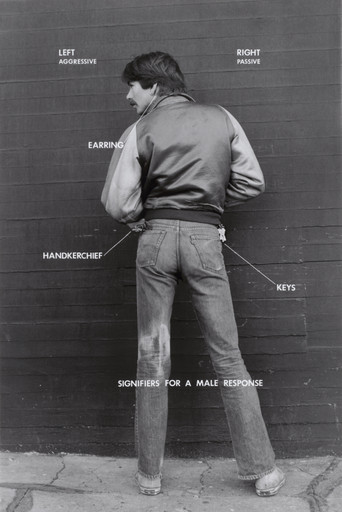
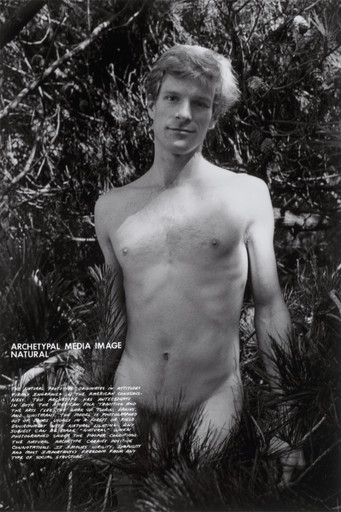
Fischer’s Gay Semiotics applied the study of signs to gay culture in San Francisco’s the Castro and Haight-Ashbury neighborhoods. Fischer, a close colleague of Thomas and Phillips, described the series as a “lexicon of attraction” in which he categorized various styles and media stereotypes with ironic annotations. The category “Street Fashion,” for example, identifies specific brands and forms of styling in gay communities, while the category “Archetypal Media Images” breaks down the clothes and characteristics of cultural archetypes such as “western” and “urbane.”
419: Photography and Language, 2025
Gallery label from Inbox: Hal Fischer , 2018
In 1975, Hal Fischer moved to San Francisco, where his work was soon featured in the exhibition Photography and Language. Although the artists included were not part of a formal movement, they were interested in combining photographs with text in a way that expanded, reinterpreted, or contradicted the imagery. Contributors to the exhibition catalogue analyzed the work using principles of semiotics, the study of how meaning is created and communicated through signs, each consisting of a form (a signifier) and what it represents (the signified).
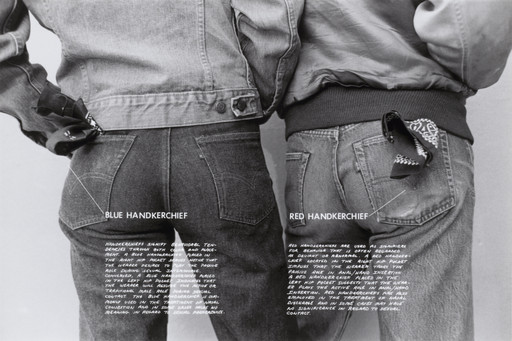
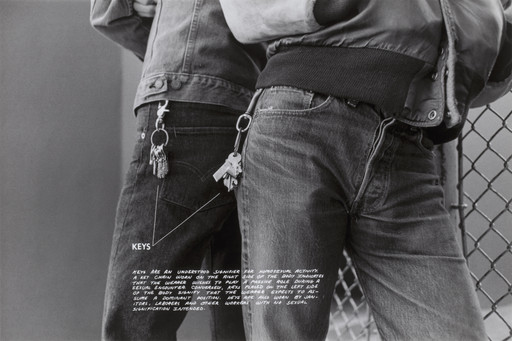
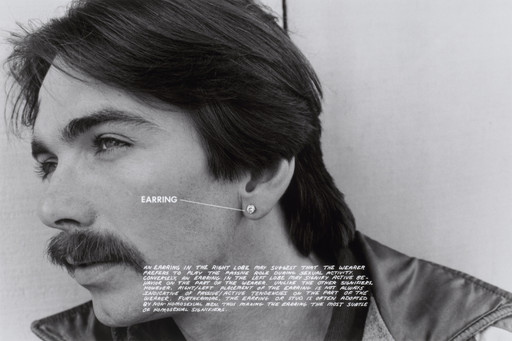
Fischer’s 1977 series Gay Semiotics, brought these theories to bear on gay culture in San Francisco’s Castro and Haight-Ashbury districts. A “lexicon of attraction,” as the artist has called it, this work classifies styles and types while acknowledging their ambiguity. For instance, images of men with handkerchiefs in their pockets feature text that explains the possible meanings of these items according to the “hanky codes” that gay men used to convey sexual preferences, but which also points out that the men could be carrying them for blowing their noses. Other images in the series consider gay fashion, media stereotypes, and BDSM culture.
Inbox: Hal Fischer, 2018
Explore more
From MoMA Design Store


Licensing
Artwork or archival images
If you would like to reproduce an image of a work of art in MoMA's collection, or an image of a MoMA publication or archival material (including installation views, checklists, and press releases), please contact Art Resource (publication in North America) or Scala Archives (publication in all other geographic locations).
Audio and film clips
MoMA licenses archival audio and select out of copyright film clips from our film collection. At this time, MoMA produced video cannot be licensed by MoMA/Scala. All requests to license archival audio or out of copyright film clips should be addressed to Scala Archives at [email protected]. Motion picture film stills cannot be licensed by MoMA/Scala. For access to motion picture film stills for research purposes, please contact the Film Study Center at [email protected]. For more information about film loans and our Circulating Film and Video Library, please visit Circulating Film and Video Library.
Text from a publication or the archives
If you would like to reproduce text from a MoMA publication, please email [email protected]. If you would like to publish text from MoMA's archival materials, please fill out this permission form and send to [email protected].
Feedback
This record is a work in progress. If you have additional information or spotted an error, please fill out this feedback form.