Oil on canvas
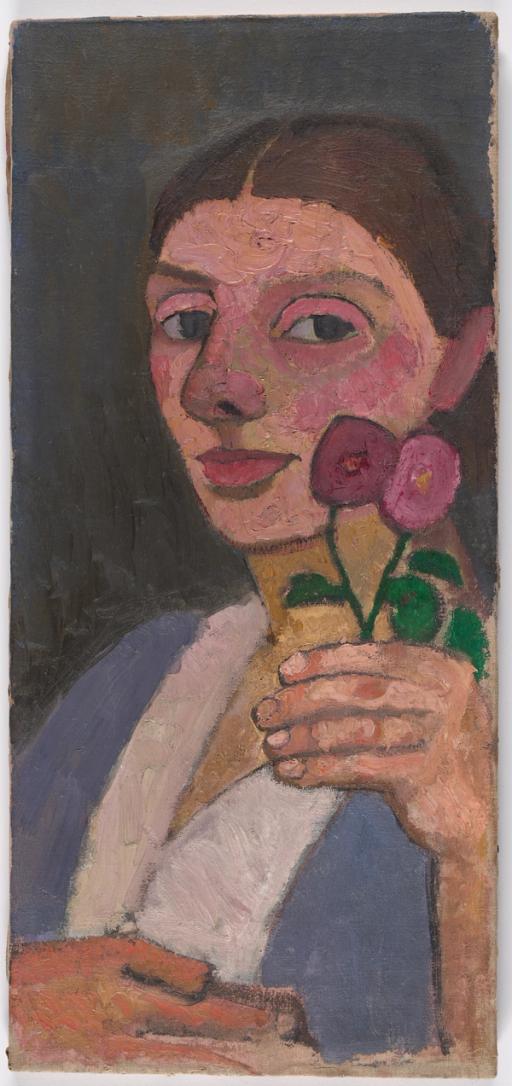
In this emblematic self-portrait, a pregnant Paula Modersohn–Becker stares out at the viewer with a steady gaze. She holds two flowers, symbols of fertility, in her left hand. Her right hand rests on her swelling belly.
Modersohn-Becker began painting in 1893, when she was 16 years old. In her short career, and despite considerable barriers to women artists, she became a pioneering figure of the 20th-century German avant-garde. She produced landscapes, still lifes, and domestic scenes, but it was portraits of women and girls that most fully occupied her artistic imagination. She also made self-portraits, in countless variations. At a time when women were expected to be wives and mothers first, she worked professionally as an artist, painting herself and other women in a way that upended traditional standards of femininity and avoided idealization and conventional beauty.
By 1906, Modersohn-Becker had begun painting life-sized nudes. She rejected the overtly eroticized nudes of artists like Pablo Picasso and Henri Matisse as she sought to reinvent the representation of women in Western art history. Her most radical step was in taking herself as a subject, likely becoming the first modern woman artist to have painted nude self-portraits, and, as in Self-Portrait with Two Flowers in Her Raised Left Hand, to have painted herself pregnant. This would be one of her last paintings. The same year she completed it, she died of complications just 20 days after giving birth to a daughter. She was 31 years old.
Gallery label from 2017
In this emblematic self-portrait, a pregnant Modersohn–Becker stares out at the viewer with a steady, compelling gaze. One hand is raised, holding two stylized flowers, while the other is positioned over her swelling belly. Modersohn–Becker, a pioneering figure of the 20th–century German avant–garde, is believed to be the first woman to paint herself while pregnant; this painting is one of only a few such portrayals. She gave birth to a daughter on November 2, 1907, and died of complications on November 21, at age 31. The painting's audacious palette, stark composition, and psychological depth reflect Modersohn–Becker's position as a pivotal link between Fauvism and German Expressionism.
2017
Gallery label from 2019
In this self-portrait, the pregnant artist looks out at us with a steady, self-possessed gaze. She rests one hand protectively on her swelling belly, and raises the other to hold two flowers—symbols of fertility. Modersohn-Becker is believed to have been the first woman to paint herself while pregnant. She was also one of the first German artists to experiment with the audacious color and simplified forms of modernism and to pursue the emotional charge such distortions might provoke. “Personal feeling,” she wrote, “is the main thing.” This was among the last paintings the artist made; she died of complications from childbirth later the same year.
2019
Publication excerpt from MoMA Highlights: 375 Works from The Museum of Modern Art, New York (New York: The Museum of Modern Art, 2019)
In this emblematic self-portrait, the pregnant artist stares at viewers with a steady, compelling gaze. One hand is raised, holding two stylized flowers, while the other rests over her swelling belly. Born in Dresden, Modersohn-Becker studied in Berlin from 1896 to 1898, then moved to Worpswede, an artists’ community north of Bremen. There she met her husband, the artist Otto Modersohn, as well as the poet Rainer Maria Rilke, who became a close companion. Worpswede’s artists were known for their commitment to nature and to positive depictions of the local villagers, but Modersohn-Becker soon grew restless. Between 1900 and her death, in 1907, she made four trips to Paris, studying ancient sculpture and Egyptian mummy portraits at the Louvre and visiting other museums and galleries, all of which profoundly impacted her last great period of work. Best known for penetrating self-portraits, characterized by psychological introspection as well as material and stylistic experimentation, Modersohn-Becker is also thought to be the first woman to paint female nudes.
In this artwork, painted the year of her death, her masklike visage, combined with the areas of thick paint on her brow and right eyelid, the literal carving of a flower into her cheek (likely done with the end of a brush), and the vivid, expressionistic palette, all mark Modersohn-Becker as a pioneering contemporary of Henri Matisse and Pablo Picasso.
MoMA Highlights: 375 Works from The Museum of Modern Art, New York (New York: The Museum of Modern Art, 2019)
Explore more
Paula Modersohn-Becker
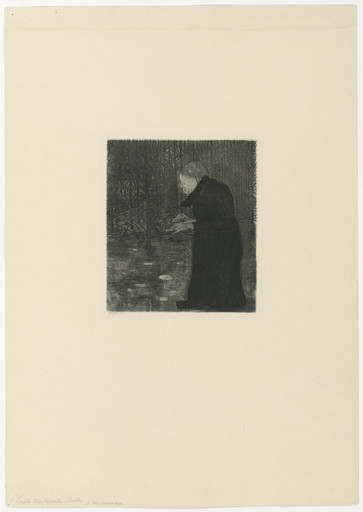
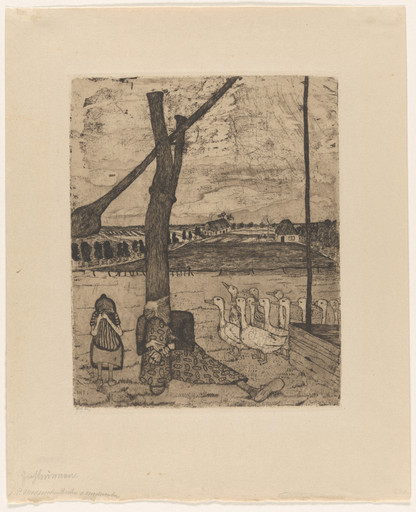
German, 1876–1907 10 works onlinePaula Modersohn-Becker made landscapes, still lifes, and domestic scenes, but it was portraits of women and girls that most fully occupied her artistic imagination.
Learn more →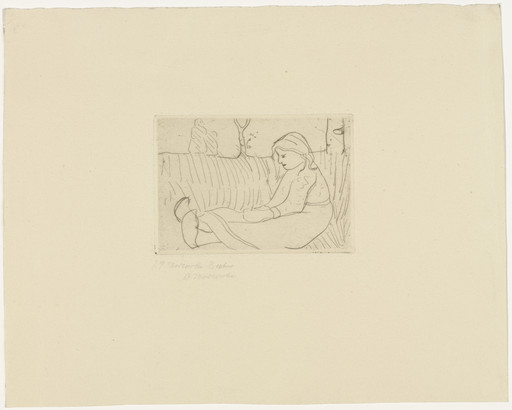


Portrait
A representation of a particular individual, usually intended to capture their likeness or personality.
Learn more →
Audio
Audio from the playlist Collection 1880s–1940s
From MoMA Design Store


Installation views
We have identified this work in the following photos from our exhibition history.
Provenance Research Project
This work is included in the Provenance Research Project, which investigates the ownership history of works in MoMA's collection.
1907, Paula Modersohn-Becker, Worpswede, Germany.
[1907 - before 1917, Estate of Paula Modersohn-Becker, Worpswede, Germany]
1917 - at least 1919, Karl Jakob Hirsch (1892-1952), Worpswede, Paris, and Berlin.
[1919, Graphisches Kabinett J. B. Neumann (Jsrael Ber Neumann, 1887-1961), Berlin]
By 1928 (probably by 1921) - at least July 16, 1941 (possibly until 1950), Hugo Simon (1880-1950), Berlin, Paris, and Brazil, possibly purchased from/through Graphisches Kabinett J. B. Neumann.
[1950 - 1952, Gertrud Simon, Brazil, probably inherited from her husband Hugo Simon]
1952 - 1966, Paul Speck (1896-1966), Zürich, probably acquired through Galerie Ernst Beyeler.
1966 - 1976, Else Speck, Zürich, inherited from her husband Paul Speck.
1976 - 2013, Julia Diethelm, Zürich, inherited from her mother Else Speck.
2013 - 2017, Heirs of Julia Diethelm, Zürich, inherited from Julia Diethelm.
2017, The Museum of Modern Art and The Neue Galerie, New York, jointly purchased from heirs of Julia Diethelm through Kunsthandel Wolfgang Werner, Bremen/Berlin.
Provenance research is a work in progress, and is frequently updated with new information. If you have any questions or information to provide about the listed works, please email [email protected] or write to:
Provenance Research Project
The Museum of Modern Art
11 West 53 Street
New York, NY 10019
Licensing
Artwork or archival images
If you would like to reproduce an image of a work of art in MoMA's collection, or an image of a MoMA publication or archival material (including installation views, checklists, and press releases), please contact Art Resource (publication in North America) or Scala Archives (publication in all other geographic locations).
Audio and film clips
MoMA licenses archival audio and select out of copyright film clips from our film collection. At this time, MoMA produced video cannot be licensed by MoMA/Scala. All requests to license archival audio or out of copyright film clips should be addressed to Scala Archives at [email protected]. Motion picture film stills cannot be licensed by MoMA/Scala. For access to motion picture film stills for research purposes, please contact the Film Study Center at [email protected]. For more information about film loans and our Circulating Film and Video Library, please visit Circulating Film and Video Library.
Text from a publication or the archives
If you would like to reproduce text from a MoMA publication, please email [email protected]. If you would like to publish text from MoMA's archival materials, please fill out this permission form and send to [email protected].
Feedback
This record is a work in progress. If you have additional information or spotted an error, please fill out this feedback form.