Gelatin silver photograph
Not on view
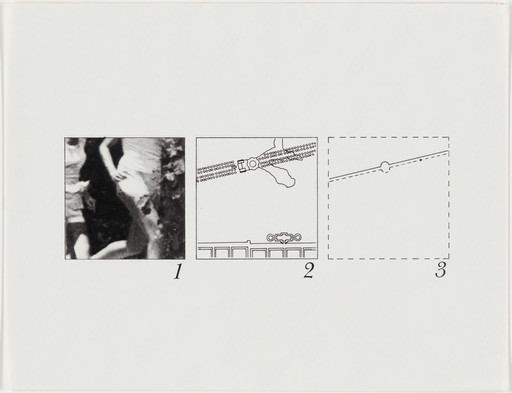
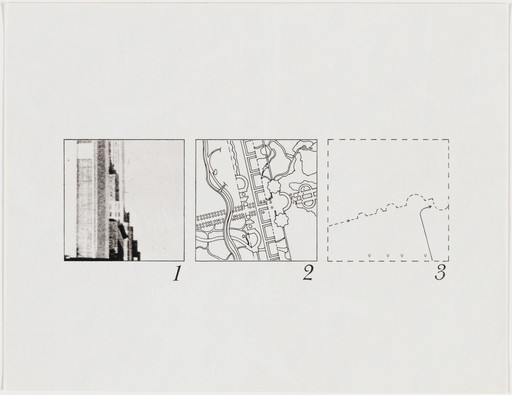
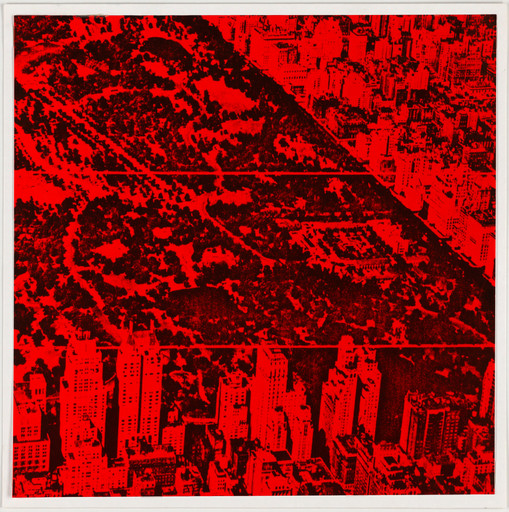
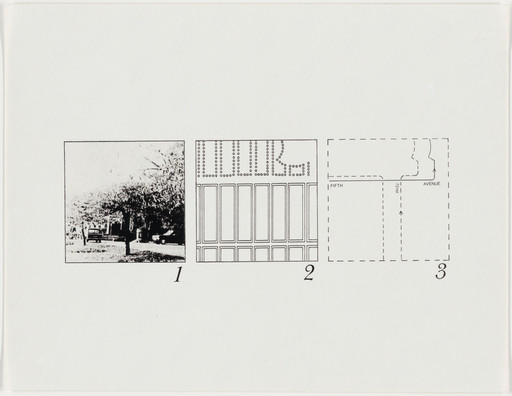
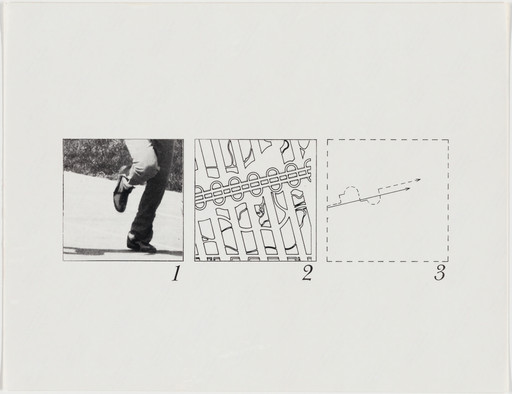
The Manhattan Transcripts are theoretical propositions executed through drawing. Made between 1976 and 1981 for consecutive exhibitions, the four episodes transcribe imagined events in real New York locales: The Park uncovers a murder in Central Park; The Street (Border Crossing) chronicles the movement of a person drifting through violent and sexual events on Forty-second Street; The Tower (The Fall) depicts a vertiginous fall from a Manhattan skyscraper; and The Block illustrates five unlikely events occurring in separate courtyards within a city block. Tschumi’s Transcripts propose that, beyond its traditional conventions of representation, architecture resides in the superimposition of space, movement, and events. The event, in particular, is the figurative origin of architecture itself, through which Tschumi proposes an architecture of difference and opposition rather than synthesis and totality. Narrative techniques—be they pictorial or cinematic—evoke the ability of fiction to produce an alternative form of critique.
9 + 1 Ways of Being Political: 50 Years of Political Stances in Architecture and Urban Design, September 12, 2012–March 25, 2013.
Publication excerpt from an essay by Tina di Carlo, in Matilda McQuaid, ed., Envisioning Architecture: Drawings from The Museum of Modern Art , New York: The Museum of Modern Art, 2002, p. 204.
The tripartite mode of notation [used in The Manhattan Transcripts] . . . proceeded from a need to question the modes of representation generally used by architects: plans, sections, axonometrics, perspectives. However precise and generative they may have been, each implies a logical reduction of architectural thought to what can be shown. . . . They are caught in a sort of prison-house of architectural language, where the limits of my language are the limits of my world. Any attempt to go beyond such limits, to offer another reading of architecture, demanded the questioning of these conventions. —Bernard Tschumi
Bernard Tschumi's Manhattan Transcripts is a theoretical proposition executed through drawing. Made between 1976 and 1981 for consecutive exhibitions, its four episodes transcribe imagined events in real New York locales: Episode 1: The Park uncovers a murder in Central Park; Episode 2: The Street (Border Crossing) chronicles the movement of a person drifting through violent and sexual events on 42nd Street; Episode 3: The Tower (The Fall) depicts a vertiginous fall from a Manhattan skyscraper; and Episode 4: The Block illustrates five unlikely events occurring in separate courtyards within a city block.
Influenced by the writings of Georges Bataille, Jacques Derrida, and Michel Foucault, and by Guy Debord's notions of dérive (urban drifting) and détournement (the deflection or rerouting of events and images to subversive effect), Tschumi's Transcripts propose that architecture resides in the superimposition of three disjunctures: space (the fabrication of physical spaces); movement (the movement of bodies in space); and event (program, function, or use). Each of these fields correlates to a graphic device employed, in varying degrees of collapse, in the work's four episodes: architectural-drawing conventions (plans, sections, perspectives, and axonometrics) outline space; a modified form of dance notation diagrams the movement of different protagonists; and photographs direct or witness events. While Episode 1 isolates each device in discrete frames, Episode 4 integrates the architectural drawing with movement notation. The event has become the origin of the architectural image, and the figurative origin of architecture itself. Using film techniques such as the jump cut and the tracking shot to go beyond architectural conventions of representation, Tschumi proposes an architecture of difference and opposition rather than of synthesis and totality. Meaning, no longer fixed, is produced through the subjective sequencing of isolated frames and of disjunctive, multitudinous events.
an essay by Tina di Carlo, in Matilda McQuaid, ed., Envisioning Architecture: Drawings from The Museum of Modern Art, New York: The Museum of Modern Art, 2002, p. 204.
Explore more

From MoMA Design Store


Installation views
We have identified this work in the following photos from our exhibition history.
Licensing
Artwork or archival images
If you would like to reproduce an image of a work of art in MoMA's collection, or an image of a MoMA publication or archival material (including installation views, checklists, and press releases), please contact Art Resource (publication in North America) or Scala Archives (publication in all other geographic locations).
Audio and film clips
MoMA licenses archival audio and select out of copyright film clips from our film collection. At this time, MoMA produced video cannot be licensed by MoMA/Scala. All requests to license archival audio or out of copyright film clips should be addressed to Scala Archives at [email protected]. Motion picture film stills cannot be licensed by MoMA/Scala. For access to motion picture film stills for research purposes, please contact the Film Study Center at [email protected]. For more information about film loans and our Circulating Film and Video Library, please visit Circulating Film and Video Library.
Text from a publication or the archives
If you would like to reproduce text from a MoMA publication, please email [email protected]. If you would like to publish text from MoMA's archival materials, please fill out this permission form and send to [email protected].
Feedback
This record is a work in progress. If you have additional information or spotted an error, please fill out this feedback form.