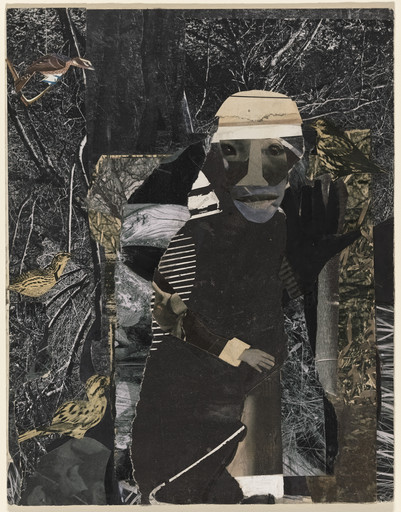
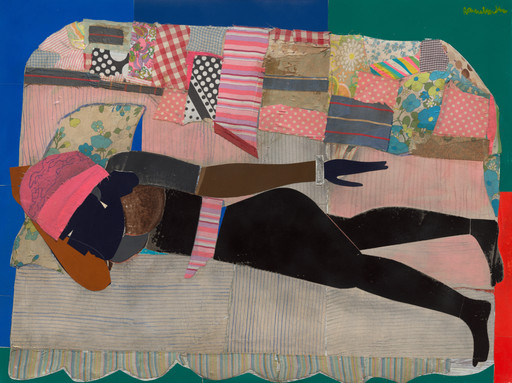
Bearden's approach to art making centered on fragmentation and recombination; he created richly textured collages depicting scenes of African American life using painted paper, photographs from magazines, newspaper, pieces of cloth, and other materials. His process was inspired by the improvisational and rhythmic elements of jazz; “In many ways it’s like putting a symphony together, or a piece of music,” he explained. In addition to collages, he made watercolors, photomontages, and prints. Train Whistle Blue No. 1 began as a collage that Bearden then photocopied in black and white and enlarged using a photostat machine. This innovative technique, which flattened the layers of his collage into a graphic image reminiscent of a film still, established Bearden as a leading contemporary artist.
Studio Visit: Selected Gifts from Agnes Gund, 2018
Gallery label from 2022
In 1964, after three decades of living and working in Harlem, Bearden took up collage, cutting and combining found images and photographs to achieve new combinations defined by their fragmentation, texture, and layered depth. He used this approach to capture the complex facets of Black experience in the United States, often depicting scenes from everyday life in the rural South, which many African Americans left to move to northern cities during the Great Migration (1916–70), and scenes from Harlem. Throughout his career, Bearden reworked his own images in different mediums, including this collage, which is shown alongside a later photo reproduction.
2022
Explore more
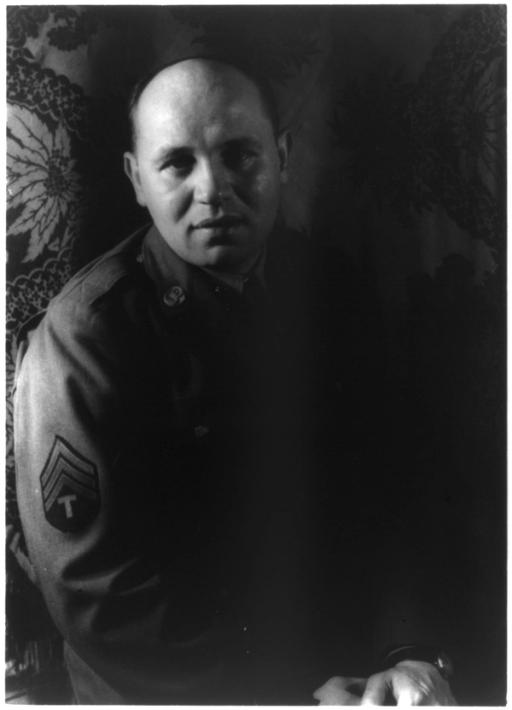
Romare Bearden
American, 1911–1988 25 works onlineRomare Bearden was 53 years old in 1964, the year he made his first series of collages. By that point in his life, he had already had several careers.
Learn more →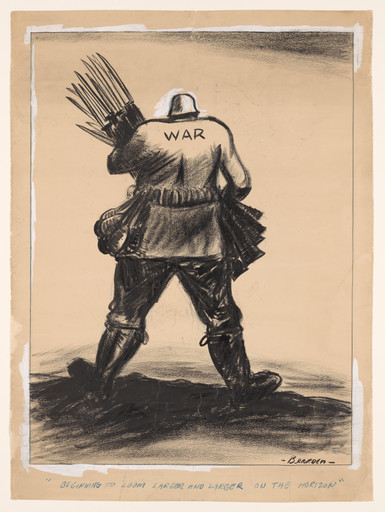


Photomontage
A collage work that includes cut or torn and pasted photographs or photographic reproductions.
Learn more →
From MoMA Design Store


Installation views
We have identified this work in the following photos from our exhibition history.
Licensing
Artwork or archival images
If you would like to reproduce an image of a work of art in MoMA's collection, or an image of a MoMA publication or archival material (including installation views, checklists, and press releases), please contact Art Resource (publication in North America) or Scala Archives (publication in all other geographic locations).
Audio and film clips
MoMA licenses archival audio and select out of copyright film clips from our film collection. At this time, MoMA produced video cannot be licensed by MoMA/Scala. All requests to license archival audio or out of copyright film clips should be addressed to Scala Archives at [email protected]. Motion picture film stills cannot be licensed by MoMA/Scala. For access to motion picture film stills for research purposes, please contact the Film Study Center at [email protected]. For more information about film loans and our Circulating Film and Video Library, please visit Circulating Film and Video Library.
Text from a publication or the archives
If you would like to reproduce text from a MoMA publication, please email [email protected]. If you would like to publish text from MoMA's archival materials, please fill out this permission form and send to [email protected].
Feedback
This record is a work in progress. If you have additional information or spotted an error, please fill out this feedback form.