Not on view
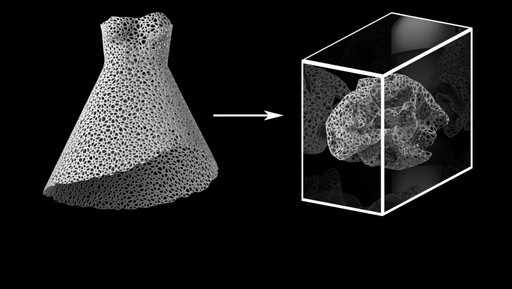
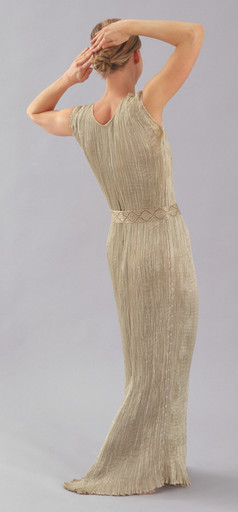
Nervous System, a.k.a. Rosenkrantz and Louis-Rosenberg, use organic forms and patterns as blueprints for digitally printed objects. Their 4D-printing system, which creates flexible, responsive objects, is named for kinematics, the branch of classical mechanics known as the geometry of motion. This dress consists of more than three thousand unique parts combined into a single complex assemblage. The garment’s surface is digitally tessellated into triangular shapes, the tessellation is folded and compressed, and the dress is formed from nylon powder fused into a solid material; the tiles emerge from the printer already hinged together to fit a scan of the client’s body.
Life Cycles: The Materials of Contemporary Design, 2023
Gallery label from This Is for Everyone: Design Experiments for the Common Good , February 14, 2015–January 31, 2016.
Working at the intersection of math, science, and technology, designers Jessica Rosenkrantz and Jesse Louis-Rosenberg study patterns inherent to organic forms, using them as blueprints for man-made printed materials. Kinematics is a branch of classical mechanics that investigates the motion of points and objects, a term adopted by the designers for their 4-D printing system. The dress consists of over three thousand unique parts that have been combined into one complete, complex assemblage in a 3-D printer.
To produce the dress, the client’s body is imaged through a 3-D scan, onto which the garment surface is then digitally tessellated into triangular shapes that hinge together (the smaller the triangles, the more flexible and likely to drape the fabric will be). The tessellation is compressed to fit the volume of (the 3-D printer and the form is generated using a selective laser sinter process that binds nylon powder into concrete forms. This method allows garments to be customized based on clients’ individual body shapes and aesthetic desires.
This Is for Everyone: Design Experiments for the Common Good, February 14, 2015–January 31, 2016.
Explore more
Design
This term is most commonly associated with graphics, furniture, lighting, and products, but also encompasses a wide variety of related practices, including the design of exhibitions, environments, digital interfaces, film title sequences, crafted objects, textiles, clothing, and corporate identity systems.
Learn more →





Audio
Audio from the playlist This Is for Everyone: Design Experiments for the Common Good
Audio from the playlist Items: Is Fashion Modern?
Audio from the playlist Life Cycles: The Materials of Contemporary Design
From MoMA Design Store


Installation views
We have identified this work in the following photos from our exhibition history.
Licensing
Artwork or archival images
If you would like to reproduce an image of a work of art in MoMA's collection, or an image of a MoMA publication or archival material (including installation views, checklists, and press releases), please contact Art Resource (publication in North America) or Scala Archives (publication in all other geographic locations).
Audio and film clips
MoMA licenses archival audio and select out of copyright film clips from our film collection. At this time, MoMA produced video cannot be licensed by MoMA/Scala. All requests to license archival audio or out of copyright film clips should be addressed to Scala Archives at [email protected]. Motion picture film stills cannot be licensed by MoMA/Scala. For access to motion picture film stills for research purposes, please contact the Film Study Center at [email protected]. For more information about film loans and our Circulating Film and Video Library, please visit Circulating Film and Video Library.
Text from a publication or the archives
If you would like to reproduce text from a MoMA publication, please email [email protected]. If you would like to publish text from MoMA's archival materials, please fill out this permission form and send to [email protected].
Feedback
This record is a work in progress. If you have additional information or spotted an error, please fill out this feedback form.