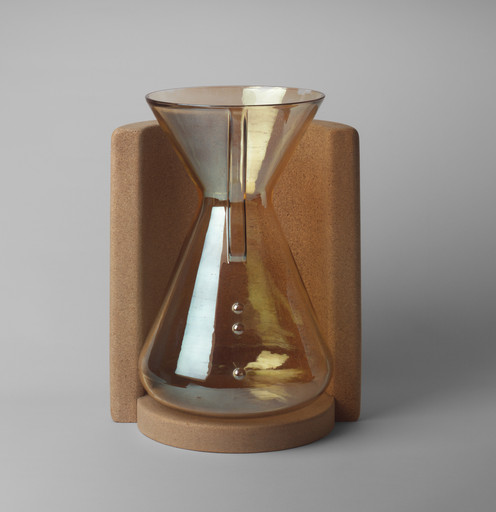
The Chemex Coffee Maker is the most successful design by Schlumbohm, an inventor and chemist who immigrated to the United States in 1935. In developing its form he was inspired by the modern spirit of the interwar period and particularly by the Bauhaus school of design in Germany. He explained, “A table must be a table; a chair must be a chair; a bed must be a bed. When, in 1938, the personal desire for coffee came up, my aspect simply was: A coffeemaker must make coffee, and then I applied my knowledge of physics and chemistry.” Schlumbohm was inclined to adapt scientific principles and laboratory equipment, in this case an Erlenmeyer flask, to the design of domestic objects. He obtained over three thousand patents over his distinctive career.
What Was Good Design? MoMA's Message 1944–56, May 6, 2009–January 10, 2011.
Gallery label from Counter Space: Design and the Modern Kitchen , September 15, 2010-March 14, 2011.
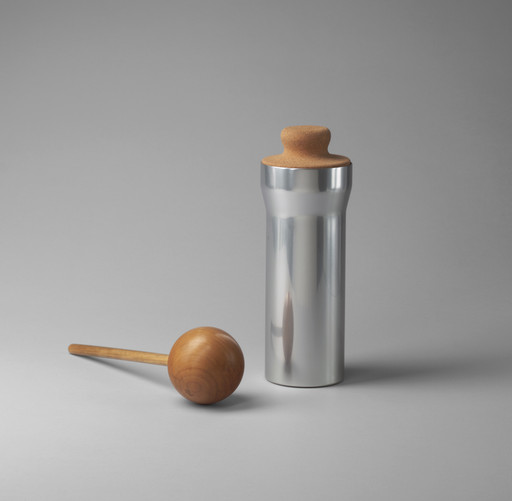
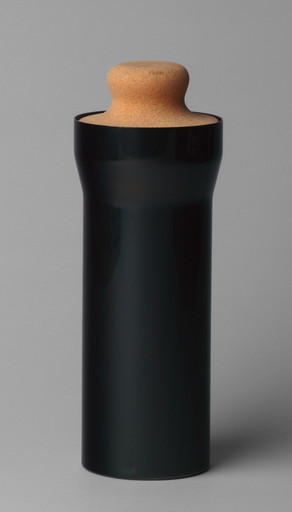
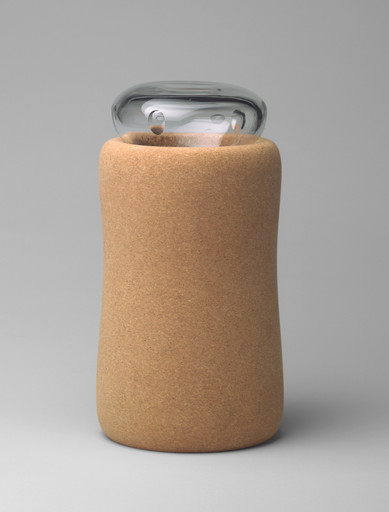
This unified series of kitchenwares by chemist and inventor Schlumbohm epitomizes the kitchen–as–laboratory concept—a hallmark of the interwar New Kitchen—as it continued beyond World War II. After immigrating to the United States from Germany in 1935, Schlumbohm created the famous Chemex coffeemaker, inspired in spirit by the Bauhaus school of design and in form by laboratory equipment such as the Erlenmeyer flask. A feature of James Bond's breakfast in From Russia with Love, this was the most successful design of the more than 300 he patented.
Counter Space: Design and the Modern Kitchen, September 15, 2010-March 14, 2011.
Explore more


From MoMA Design Store


Installation views
We have identified this work in the following photos from our exhibition history.
Licensing
Artwork or archival images
If you would like to reproduce an image of a work of art in MoMA's collection, or an image of a MoMA publication or archival material (including installation views, checklists, and press releases), please contact Art Resource (publication in North America) or Scala Archives (publication in all other geographic locations).
Audio and film clips
MoMA licenses archival audio and select out of copyright film clips from our film collection. At this time, MoMA produced video cannot be licensed by MoMA/Scala. All requests to license archival audio or out of copyright film clips should be addressed to Scala Archives at [email protected]. Motion picture film stills cannot be licensed by MoMA/Scala. For access to motion picture film stills for research purposes, please contact the Film Study Center at [email protected]. For more information about film loans and our Circulating Film and Video Library, please visit Circulating Film and Video Library.
Text from a publication or the archives
If you would like to reproduce text from a MoMA publication, please email [email protected]. If you would like to publish text from MoMA's archival materials, please fill out this permission form and send to [email protected].
Feedback
This record is a work in progress. If you have additional information or spotted an error, please fill out this feedback form.