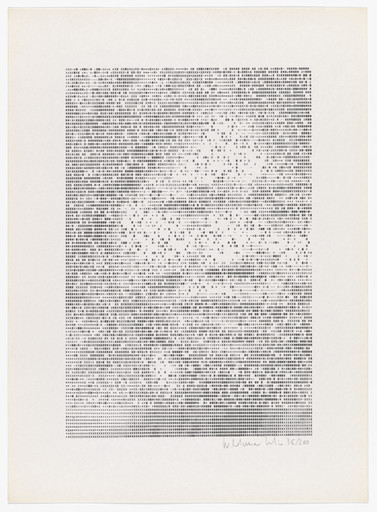
Gente Ampli2 is a digital alteration of a photograph documenting a protest in Praça da Sé, a public square in São Paulo. After pulling the source image from a local newspaper, Cordeiro subjected it to a process of manual digitization, using an orthogonal grid to divide the composition and then carefully assigning each square a value, ranging from zero to six, corresponding to the area’s tonality. Transcribing these values into symbols that produced different shades of gray, he then enlarged and reprinted the modified image using an IBM 360 computer at the State University of Campinas in Brazil, where he had founded the Arts Institute that year. Twenty years earlier, in 1952, Cordeiro had been a founding member and lead theoretician of Grupo Ruptura, an influential movement of artists that promoted geometric abstraction and Concrete art—expressions based on form, line, and color as opposed to illusionistic depictions of the natural world. Later on, as director of the university’s Center for Image Processing, Cordeiro was among the first artists to use computation as a means for art-making.
Part of a larger series of prints depicting popular gatherings, Gente Ampli2 dates from Brazil’s so-called Years of Lead (1968–74), the most severely repressive period of the military dictatorship that ruled Brazil for more than two decades. Through its analytical approach, the digital print restores the anonymity of the image’s subjects, preserving instead the collective identity of the critical mass, captured while exercising their democratic right to protest.
MoMA Highlights: 375 Works from The Museum of Modern Art, New York (New York: The Museum of Modern Art, 2019)
Explore more
Waldemar Cordeiro
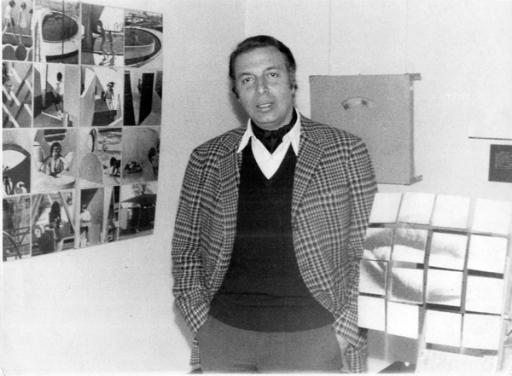
Brazilian, born Italy. 1925–1973 3 works onlineWhat is Concrete art? This is a question the charismatic artist and critic Waldemar Cordeiro spent his career answering. As a champion of the São Paulo–based artists adapting the principles of Constructivism in midcentury Brazil, Cordeiro wrote, painted, organized, and innovated around the possibilities of the term “concrete.
Learn more →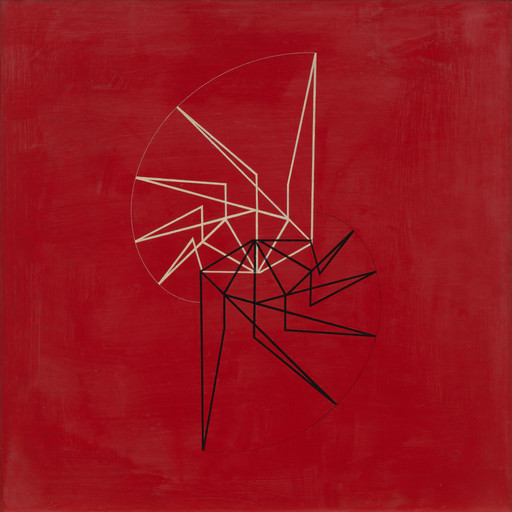

From MoMA Design Store


Installation views
We have identified this work in the following photos from our exhibition history.
Licensing
Artwork or archival images
If you would like to reproduce an image of a work of art in MoMA's collection, or an image of a MoMA publication or archival material (including installation views, checklists, and press releases), please contact Art Resource (publication in North America) or Scala Archives (publication in all other geographic locations).
Audio and film clips
MoMA licenses archival audio and select out of copyright film clips from our film collection. At this time, MoMA produced video cannot be licensed by MoMA/Scala. All requests to license archival audio or out of copyright film clips should be addressed to Scala Archives at [email protected]. Motion picture film stills cannot be licensed by MoMA/Scala. For access to motion picture film stills for research purposes, please contact the Film Study Center at [email protected]. For more information about film loans and our Circulating Film and Video Library, please visit Circulating Film and Video Library.
Text from a publication or the archives
If you would like to reproduce text from a MoMA publication, please email [email protected]. If you would like to publish text from MoMA's archival materials, please fill out this permission form and send to [email protected].
Feedback
This record is a work in progress. If you have additional information or spotted an error, please fill out this feedback form.