Camille Henrot’s extensive research across a range of disciplines like philosophy, anthropology, and history often shapes her work, including Grosse Fatigue. She made the video while in residence at the Smithsonian Institution in Washington, D.C., digging into its vast collections to pull together images of objects and specimens, like animal skeletons and carved figurines, with footage she shot in offices and collection storage. Henrot merges this with additional video clips and images she both made and found online.
Characterizing her structuring of Grosse Fatigue as “an experience of density itself,” she frames this material in layered pop-up windows that continually open and close against the changing background of a computer desktop. Brief pauses in the pacing stand out in Henrot’s otherwise rapid-fire sequencing. Sometimes, a woman’s hands appear in the frames, nails playfully manicured to match the colorful backgrounds. A spoken word-style voiceover, which interweaves stories of creation from across cultures, structures the visual cacophony. Henrot describes this mash-up of scientific discovery and religious myth-making as an “intuitive unfolding of knowledge,” a presentation meant to highlight our abundance of information, as well as its limits.
What Is Contemporary Art?. Coursera, 2019 [https://www.coursera.org/learn/contemporary-art/supplement/DwSt8/surveilling-seeing-scanning]
Explore more
Camille Henrot
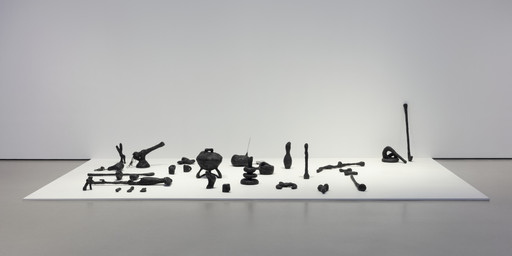
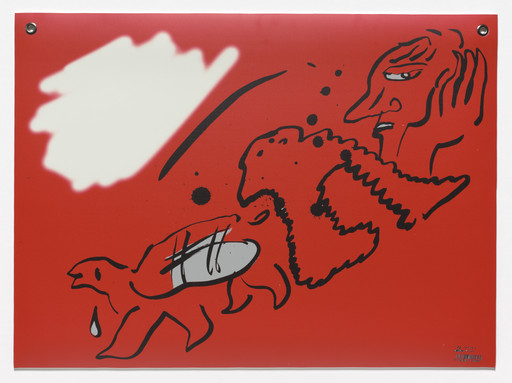
French, born 1978 5 works onlineIn her work, Camille Henrot has engaged subjects and inspirations as diverse as ethnographic film, the zoetrope (a pre-film animation device from the 19th century that produces the illusion of motion), telephone hotlines, and ikebana (the Japanese art of flower arranging).
Learn more →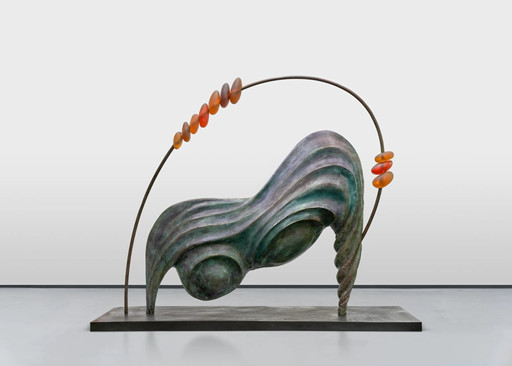






From MoMA Design Store


Installation views
We have identified this work in the following photos from our exhibition history.
Licensing
Artwork or archival images
If you would like to reproduce an image of a work of art in MoMA's collection, or an image of a MoMA publication or archival material (including installation views, checklists, and press releases), please contact Art Resource (publication in North America) or Scala Archives (publication in all other geographic locations).
Audio and film clips
MoMA licenses archival audio and select out of copyright film clips from our film collection. At this time, MoMA produced video cannot be licensed by MoMA/Scala. All requests to license archival audio or out of copyright film clips should be addressed to Scala Archives at [email protected]. Motion picture film stills cannot be licensed by MoMA/Scala. For access to motion picture film stills for research purposes, please contact the Film Study Center at [email protected]. For more information about film loans and our Circulating Film and Video Library, please visit Circulating Film and Video Library.
Text from a publication or the archives
If you would like to reproduce text from a MoMA publication, please email [email protected]. If you would like to publish text from MoMA's archival materials, please fill out this permission form and send to [email protected].
Feedback
This record is a work in progress. If you have additional information or spotted an error, please fill out this feedback form.