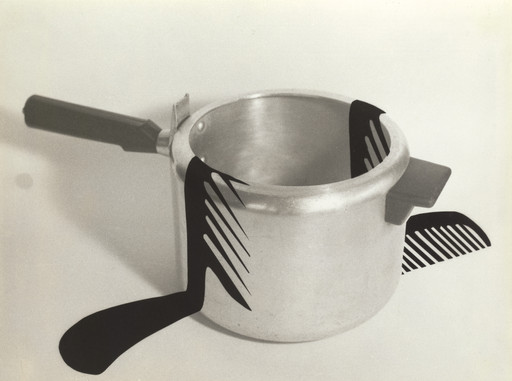
In the shadow of the Brazilian military dictatorship, Silveira pursued an elusive art, by necessity and by design. Absence and isolation, illusion and distortion were not only promising artistic strategies, but also richly meaningful metaphors in an era of severe political repression. Silveira made Enigmas by photographing an object and carefully drawing an opaque mask over it during the exposure process. In the resulting images, the masks produce the illusion of shadows, absent of visible volumes from which they were cast, that loom large over each object.
Around this time, shadow (and its corollaries absence, trace, and afterimage) became an essential subject for Silveira, and she sought new alternatives to the rigid authority of a singular perspective. The incongruous pairings of mundane household objects with shapes that are more difficult to classify (and that are alternately menacing and harmless) hint at her fascination with Marcel Duchamp's Readymades.... Silveira's Enigmas deftly synthesize her fascination with the ancient art of skiagraphia (shadow painting) and anamorphosis (the distortion of a singular perspective captured from oblique angles) that would become central to her practice.
Sarah Meister, Excerpt from "Enigmas: The Works of Regina Silveira", post: notes on modern & contemporary art around the glob. 2015.
Explore more



From MoMA Design Store


Installation views
We have identified this work in the following photos from our exhibition history.
Licensing
Artwork or archival images
If you would like to reproduce an image of a work of art in MoMA's collection, or an image of a MoMA publication or archival material (including installation views, checklists, and press releases), please contact Art Resource (publication in North America) or Scala Archives (publication in all other geographic locations).
Audio and film clips
MoMA licenses archival audio and select out of copyright film clips from our film collection. At this time, MoMA produced video cannot be licensed by MoMA/Scala. All requests to license archival audio or out of copyright film clips should be addressed to Scala Archives at [email protected]. Motion picture film stills cannot be licensed by MoMA/Scala. For access to motion picture film stills for research purposes, please contact the Film Study Center at [email protected]. For more information about film loans and our Circulating Film and Video Library, please visit Circulating Film and Video Library.
Text from a publication or the archives
If you would like to reproduce text from a MoMA publication, please email [email protected]. If you would like to publish text from MoMA's archival materials, please fill out this permission form and send to [email protected].
Feedback
This record is a work in progress. If you have additional information or spotted an error, please fill out this feedback form.