Edwards made The Lifted X in 1965, the year of the assassination of Malcolm X, the establishment of the Black Arts Movement, and the Watts Rebellion—six days of civic uprising in a predominantly Black neighborhood of Los Angeles, the city where Edwards lived and worked. The imposing sculpture, made from gnarled, welded steel balanced within and atop a steel armature, seems to have been forged from the turbulence of its time. Titled in remembrance of the slain civil rights activist, Edwards’s defiant work is both a memorial and a monument to the struggle for racial equality. “When important persons die, they rise,”
the artist has said.
2021
Publication excerpt from MoMA Highlights: 375 Works from The Museum of Modern Art, New York (New York: The Museum of Modern Art, 2019)
Edwards made The Lifted X in 1965, the year of the assassination of Malcolm X, the establishment of the Black Arts Movement, and the Watts Rebellion—six days of civic uprising in a predominantly black neighborhood of Los Angeles, the city where Edwards lived and worked. Titled upon completion in remembrance of the slain civil rights activist, the imposing sculpture, made from gnarled, welded steel balanced within and atop a rectangular steel armature, seems to have been born from the turbulence of its time.
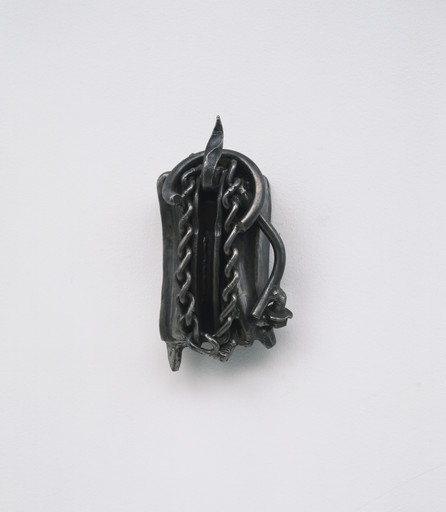
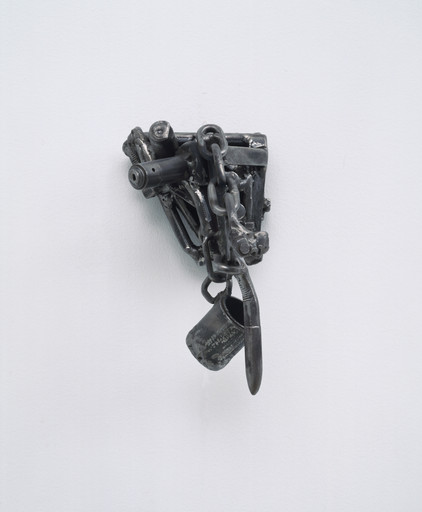
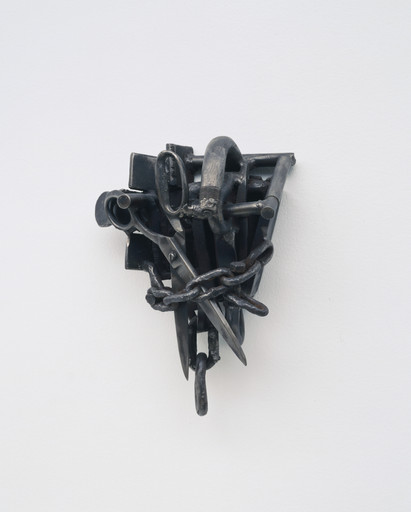
Edwards learned to weld in 1960, and in 1963 he began his ongoing Lynch Fragments series of small wall reliefs. Between two and three Lynch Fragments form the central body of The Lifted X. Unified in medium, the metal elements are not obviously parts of earlier works or other objects; in this way, Edwards’s sculptures sidestep the category of assemblage, though not entirely its technique. Completely abstract except for the unmistakable meat hook hanging in clear view, the sculpture evokes an instrument of torture. “When important persons die, they rise,” Edwards has said. According to the artist, in death Malcolm X became a martyr: assassination only expanded the significance of his words and actions. In this context, rather than a symbol of mourning or a torture device, The Lifted X is a triumphant object of defiance.
MoMA Highlights: 375 Works from The Museum of Modern Art, New York (New York: The Museum of Modern Art, 2019)
Explore more

Melvin Edwards
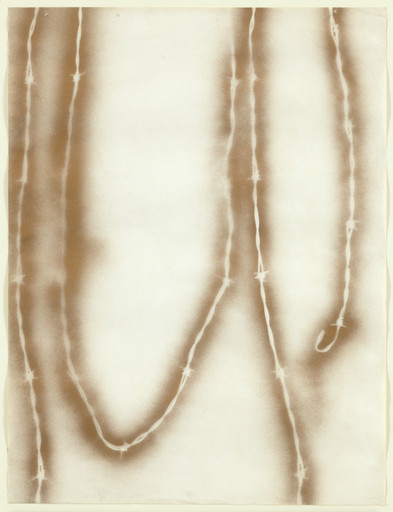
American, 1937–2026 11 works onlineMelvin Edwards once described his approach to sculpture in terms borrowed from the evolving technology of jazz records. Abstraction, for him, was an understanding of scale in relation to both the symbol and the concrete “in order to make variations on form and space, going through a lot of ideas.
Learn more →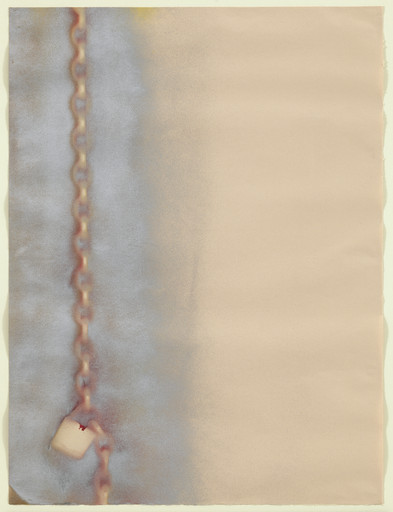
Audio
Audio from the playlist Collection 1950s–1970s
Articles and videos
From MoMA Design Store


Installation views
We have identified this work in the following photos from our exhibition history.
Licensing
Artwork or archival images
If you would like to reproduce an image of a work of art in MoMA's collection, or an image of a MoMA publication or archival material (including installation views, checklists, and press releases), please contact Art Resource (publication in North America) or Scala Archives (publication in all other geographic locations).
Audio and film clips
MoMA licenses archival audio and select out of copyright film clips from our film collection. At this time, MoMA produced video cannot be licensed by MoMA/Scala. All requests to license archival audio or out of copyright film clips should be addressed to Scala Archives at [email protected]. Motion picture film stills cannot be licensed by MoMA/Scala. For access to motion picture film stills for research purposes, please contact the Film Study Center at [email protected]. For more information about film loans and our Circulating Film and Video Library, please visit Circulating Film and Video Library.
Text from a publication or the archives
If you would like to reproduce text from a MoMA publication, please email [email protected]. If you would like to publish text from MoMA's archival materials, please fill out this permission form and send to [email protected].
Feedback
This record is a work in progress. If you have additional information or spotted an error, please fill out this feedback form.