Not on view
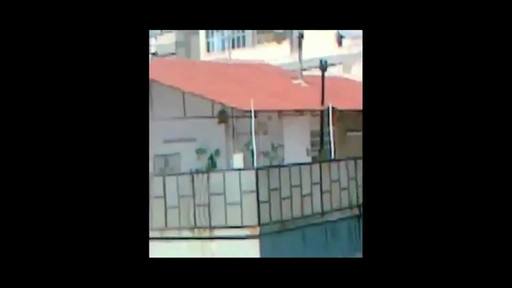
When protests against Syrian President Bashar al-Assad erupted in 2011, Rabih Mroué became interested in the cellphone videos people were posting online: “I found out that some of the activists were circulating instructions…on how to shoot a demonstration in a secure manner.” In response, he began The Pixelated Revolution, a multi-part project including a display of seven large-scale photographs titled, The Fall of a Hair: Blow Ups.
In each photograph, a man stands pointing a gun. Mroué pulled these images from cellphone videos at the moment when the gunmen and the protesters recording them made eye contact. The resulting stills resemble surveillance camera frames, but in this case the surveillance is mutual as both the gunmen and the protesters were watching each other. The consequences of being seen differ dramatically, however: for the protesters it often meant getting shot. Long interested in how death is presented in images of war, Mroué was prompted to make this work when a friend commented that the protesters were “shooting their own deaths”—a phrase evoking both firing guns and filming or photographing.
[What Is Contemporary Art?, online course, Coursera, 2019] (https://www.coursera.org/learn/contemporary-art/supplement/DwSt8/surveilling-seeing-scanning)
Explore more




From MoMA Design Store


Installation views
We have identified this work in the following photos from our exhibition history.
Licensing
Artwork or archival images
If you would like to reproduce an image of a work of art in MoMA's collection, or an image of a MoMA publication or archival material (including installation views, checklists, and press releases), please contact Art Resource (publication in North America) or Scala Archives (publication in all other geographic locations).
Audio and film clips
MoMA licenses archival audio and select out of copyright film clips from our film collection. At this time, MoMA produced video cannot be licensed by MoMA/Scala. All requests to license archival audio or out of copyright film clips should be addressed to Scala Archives at [email protected]. Motion picture film stills cannot be licensed by MoMA/Scala. For access to motion picture film stills for research purposes, please contact the Film Study Center at [email protected]. For more information about film loans and our Circulating Film and Video Library, please visit Circulating Film and Video Library.
Text from a publication or the archives
If you would like to reproduce text from a MoMA publication, please email [email protected]. If you would like to publish text from MoMA's archival materials, please fill out this permission form and send to [email protected].
Feedback
This record is a work in progress. If you have additional information or spotted an error, please fill out this feedback form.