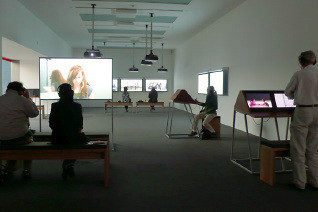
Four-channel video (color, sound; 60 min.), eighty-one 35mm color slides, and table
Not on view
At many historic sites in the United States, guides, officially called “historical interpreters,” create and lead tours for visitors. In The Interpreter Project, her first video work, Hayes “re-interprets” tours given at the historic houses of four prominent American women: Clara Barton, a nurse and humanitarian who was a founder of the American Red Cross in 1881 and its first president; Maggie Walker, a schoolteacher and businesswoman who became the first female African American bank president, in 1903; Mary McLeod Bethune, an educator and civil rights leader who founded the National Council of Negro Women in 1935 and served as a policy advisor to President Franklin Delano Roosevelt; Eleanor Roosevelt, a civil rights advocate and, as wife of President Roosevelt, First Lady of the United States from 1933 to 1945. Each of these four sites was the woman’s home as well as the location of much of her political and social service. They are the only US National Historic Sites specifically dedicated to women.
Repeating the texts of the tours given at these houses, Hayes makes evident their construction of a “feminized” historical narrative. This work marks Hayes’s departure from theatrical venues in favor of a public performative practice that focuses on the complex relationships between history, politics, and desire.
Performing Histories: Live Artworks Examining the Past, September 12, 2012–March 8, 2013.
Explore more


From MoMA Design Store


Installation views
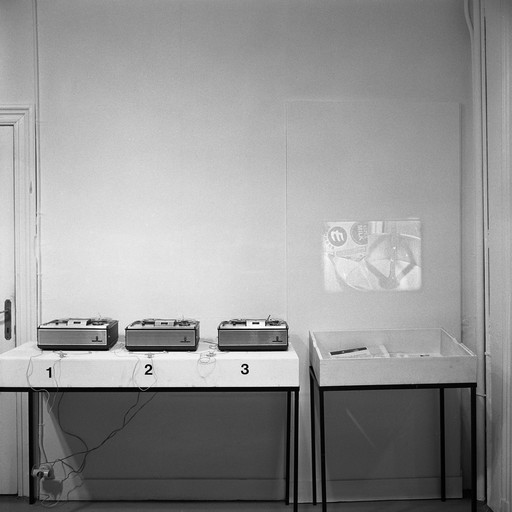
We have identified this work in the following photos from our exhibition history.
Licensing
Artwork or archival images
If you would like to reproduce an image of a work of art in MoMA's collection, or an image of a MoMA publication or archival material (including installation views, checklists, and press releases), please contact Art Resource (publication in North America) or Scala Archives (publication in all other geographic locations).
Audio and film clips
MoMA licenses archival audio and select out of copyright film clips from our film collection. At this time, MoMA produced video cannot be licensed by MoMA/Scala. All requests to license archival audio or out of copyright film clips should be addressed to Scala Archives at [email protected]. Motion picture film stills cannot be licensed by MoMA/Scala. For access to motion picture film stills for research purposes, please contact the Film Study Center at [email protected]. For more information about film loans and our Circulating Film and Video Library, please visit Circulating Film and Video Library.
Text from a publication or the archives
If you would like to reproduce text from a MoMA publication, please email [email protected]. If you would like to publish text from MoMA's archival materials, please fill out this permission form and send to [email protected].
Feedback
This record is a work in progress. If you have additional information or spotted an error, please fill out this feedback form.