Not on view
The Weeping Woman, I is an elaboration of one of the central figures in Picasso’s famous mural-size painting Guernica, executed some months earlier. Like the painting, the print was created in reaction to the bombing on April 26, 1937, of the defenseless town of Guernica during the Spanish Civil War. The image is an emblem of the artist’s homeland, torn apart by that conflict, and, more universally, of the horrors of war.
The portrait also reflects Picasso’s conflicted love life, appearing to conflate the features of two women with whom he was then involved. Dora Maar, known for her volatile temper, is represented by the glossy black hair, tapered fingernails, and tearful state, in which Picasso often portrayed her. Marie-Thérèse Walter is referenced in the distinctive nose and forehead, features the artist frequently depicted in the 1930s. The image is composed of bulbous, contorted, and distended shapes and a veritable battlefield of tangled lines, heightening the sense of explosive emotion. Picasso also capitalized on the potential of etching and drypoint to create sharply incised details, such as nail-like tears and scissor-like fingers, which reinforce the notion of pain being inflicted. He accorded great significance to this large etching, which he developed and reworked through seven independent stages, or states. This is the seventh and final one.
MoMA Highlights: 375 Works from The Museum of Modern Art, New York (New York: The Museum of Modern Art, 2019)
Gallery label from New to the Print Collection: Matisse to Bourgeois , June 13, 2012–January 7, 2013.
The Weeping Woman, I, a monumental 1937 etching in its seventh state, is one of Pablo Picasso’s greatest achievements in printmaking and perhaps in any medium. This is tied not only to its large size—unusual for an etching—but also to the fact that the artist strengthened the elaborate composition through seven separate stages, or states. An icon of catastrophic suffering, it reprises one of the central figures in Picasso's famous mural-size painting Guernica, made earlier the same year after the Basque town of Guernica, in northern Spain, was bombed at the behest of Nationalist forces in the Spanish Civil War. The image also refers to the Surrealist photographer Dora Maar, known for her glossy black hair and tapered fingernails, with whom Picasso had a tempestuous relationship.
New to the Print Collection: Matisse to Bourgeois, June 13, 2012–January 7, 2013.
Explore more
Pablo Picasso
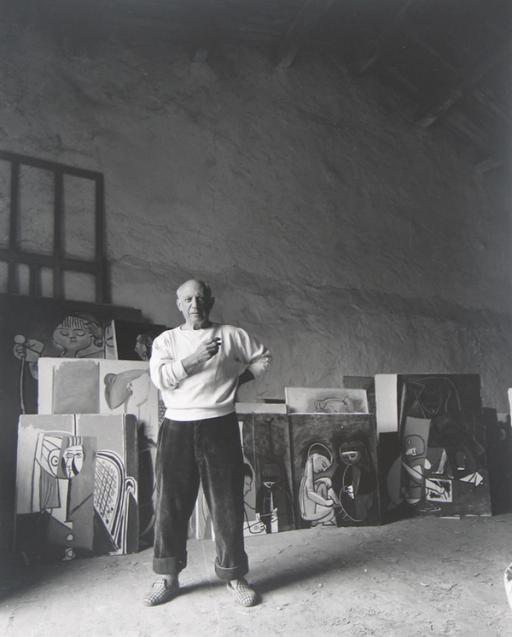
Spanish, 1881–1973 1257 works onlineWith these words, Picasso shed light on two central principles of his artistic production over nearly 80 years: his openness to a diverse range of styles, subject matters, and mediums, and his resistance to the notion that change in art necessarily corresponds to improvement or progress.
Learn more →
Intaglio
A general term for metal-plate printmaking techniques, including etching, drypoint, engraving, aquatint, and mezzotint. The word comes from the Italian intagliare, meaning “to incise” or “to carve.
Learn more →

From MoMA Design Store


Installation views
We have identified this work in the following photos from our exhibition history.
Licensing
Artwork or archival images
If you would like to reproduce an image of a work of art in MoMA's collection, or an image of a MoMA publication or archival material (including installation views, checklists, and press releases), please contact Art Resource (publication in North America) or Scala Archives (publication in all other geographic locations).
Audio and film clips
MoMA licenses archival audio and select out of copyright film clips from our film collection. At this time, MoMA produced video cannot be licensed by MoMA/Scala. All requests to license archival audio or out of copyright film clips should be addressed to Scala Archives at [email protected]. Motion picture film stills cannot be licensed by MoMA/Scala. For access to motion picture film stills for research purposes, please contact the Film Study Center at [email protected]. For more information about film loans and our Circulating Film and Video Library, please visit Circulating Film and Video Library.
Text from a publication or the archives
If you would like to reproduce text from a MoMA publication, please email [email protected]. If you would like to publish text from MoMA's archival materials, please fill out this permission form and send to [email protected].
Feedback
This record is a work in progress. If you have additional information or spotted an error, please fill out this feedback form.