8mm film transferred to16 mm film (black and white, silent)
Not on view
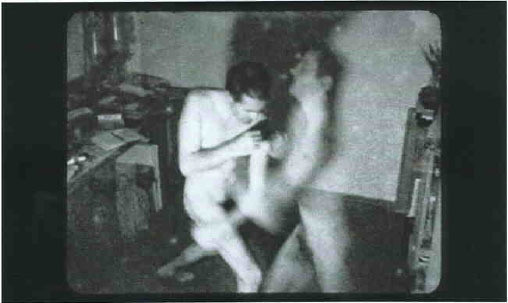
In the 1970s Grigorescu's practice was driven by resistance to a particular moment of political oppression in Romania, which saw the rise of the cult of the leader and of an increasingly powerful police state. The schizophrenic character of authority underlies Dialog cu Presedintele Ceausescu (Dialogue with President Ceausescu) In the film the artist plays two opposing roles, appearing alternatively as Romanian president Nicolae Ceausescu—wearing a mask of the leader's face—and as a common citizen who wants to ask Ceausescu questions and confront him about the decline of the people’s welfare. Grigorescu performed in the intimacy of his own apartment, under the scrutiny of the camera lens, enacting the trauma of political reality in communist society.
Transmissions: Art in Eastern Europe and Latin America, 1960–1980, September 5, 2015–January 3, 2016.
Gallery label from Performing Histories: Live Artworks Examining the Past , September 12, 2012–March 8, 2013.
One of the first Romanian Conceptual artists, Grigorescu has made significant contributions in exploring the relationship between performance and recorded image. Part of the Romanian “post-Actionist” movement in the 1970s, he has produced numerous films, photographs, and works on paper exploring his roles as an individual and an artist under a despotic political regime. Grigorescu made his work in a period of sociopolitical decline: in the late 1970s, Romania’s president, Nicolae Ceausescu—also Secretary General of the Romanian Communist Party—enforced policies that impoverished the nation, increased the authority of the police, and imposed a cult of personality. (In 1989 Ceausescu was overthrown and executed, the first revolution that was broadcast live on television.) Grigorescu used film to record intimate experiments that he staged secretly in his home, using his own body.
In Dialogue with Ceausescu, the artist carries on an imagined conversation with the Romanian president, also performed by himself. Again acting in double, opposing roles, Grigorescu wears everyday clothing, while Grigorescu-as-Ceausescu wears a suit, tie, and exaggerated mask. The film begins with the phrase, “If the people cannot rule, they should at least criticize!”
Performing Histories: Live Artworks Examining the Past, September 12, 2012–March 8, 2013.
Explore more
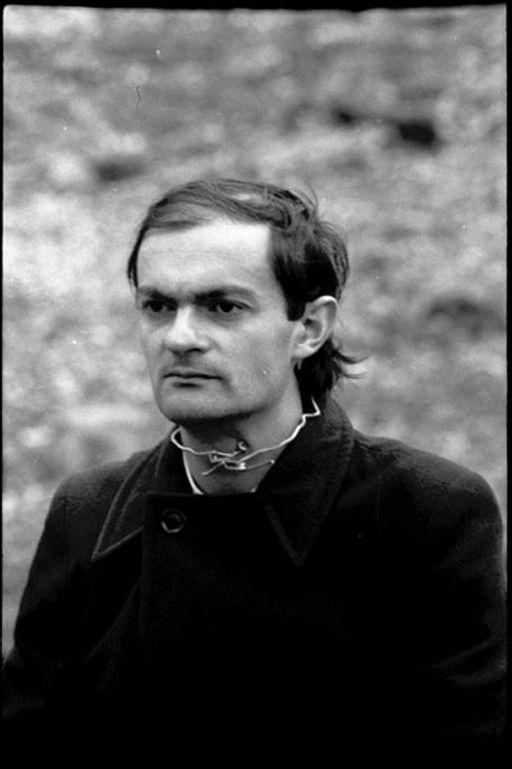
Ion Grigorescu
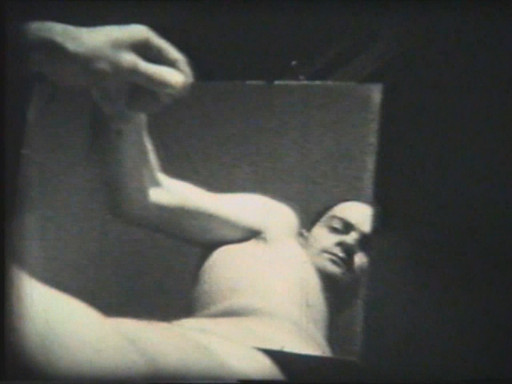
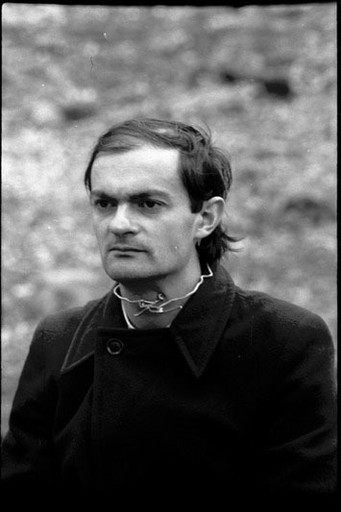
Romanian, born 1945 5 works onlineIon Grigorescu is a central figure in the Romanian neo-avant-garde. Born in 1945 in Bucharest, where he still lives and works, he had a childhood marked by the consecutive traumas of World War II, the Holocaust, and the rise of communism in Romania.
Learn more →


From MoMA Design Store


Licensing
Artwork or archival images
If you would like to reproduce an image of a work of art in MoMA's collection, or an image of a MoMA publication or archival material (including installation views, checklists, and press releases), please contact Art Resource (publication in North America) or Scala Archives (publication in all other geographic locations).
Audio and film clips
MoMA licenses archival audio and select out of copyright film clips from our film collection. At this time, MoMA produced video cannot be licensed by MoMA/Scala. All requests to license archival audio or out of copyright film clips should be addressed to Scala Archives at [email protected]. Motion picture film stills cannot be licensed by MoMA/Scala. For access to motion picture film stills for research purposes, please contact the Film Study Center at [email protected]. For more information about film loans and our Circulating Film and Video Library, please visit Circulating Film and Video Library.
Text from a publication or the archives
If you would like to reproduce text from a MoMA publication, please email [email protected]. If you would like to publish text from MoMA's archival materials, please fill out this permission form and send to [email protected].
Feedback
This record is a work in progress. If you have additional information or spotted an error, please fill out this feedback form.