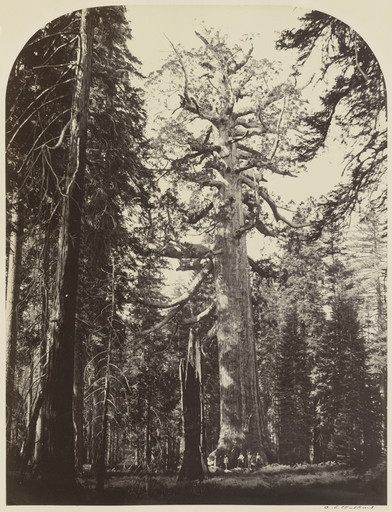
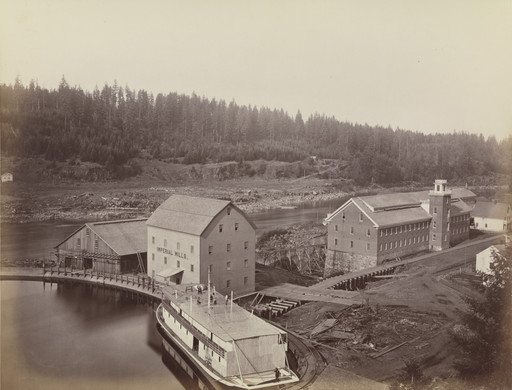
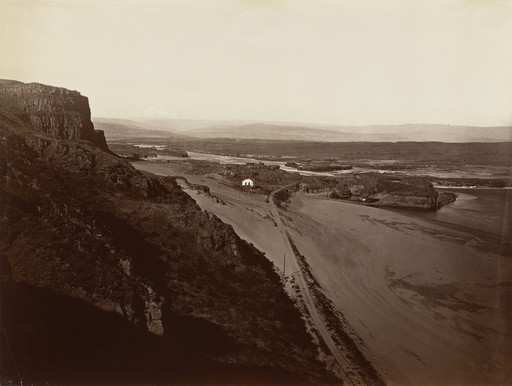
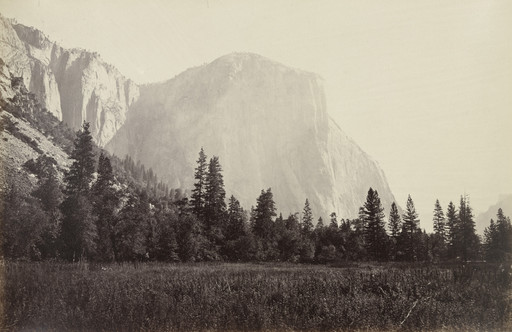
Carleton Watkins photographed the landscape of the American West. He often worked on commission and took this closely framed photograph of a crate full of peaches on assignment. Watkins was tasked with taking pictures of landholdings in Kern County, California, to attract prospective buyers to the region. Among the qualities he was asked to emphasize were the fertility of the land and its ready access to water, both of which are evoked in this photograph of plump peaches. To support this photograph’s function as evidence, Watkins affixed to its mount a certificate vouching for the authenticity of its content.
Publication excerpt from MoMA Highlights: 375 Works from The Museum of Modern Art, New York (New York: The Museum of Modern Art, 2019)
Watkins was a great artist but a terrible businessman. In 1875 he lost his San Francisco studio and his entire stock of negatives to creditors, and, as a result, he was actively soliciting commissions when he might otherwise have relied on income from printing existing negatives. One of Watkins’s best clients hired him to conduct a visual inventory of his vast property near Bakersfield, in Kern County, California, to entice people to buy land and settle there. Watkins obliged by exposing at least seven hundred 8-by-10-inch glass plate negatives, along with numerous even bigger “mammoth” plates, of which this is undeniably his finest.
On a printed label beneath the photograph are two statements: one by the property owner, attesting to the fertility of the land; another by the Kern County Board of Trade, certifying that the owner’s statement is true. Photography’s usefulness as evidence was established with its invention in 1839, and its fictive possibilities began to be exploited not long after that (thus the need for Kern County’s certificate).
Late George Cling Peaches distills space in a strikingly modern way, decades before such disturbances became commonplace; the void on the right-hand side of the image, created by two pairs of fuzzy fruit that don’t quite make contact, animates the eye’s path with the metaphorical potential of impenetrable depth.
MoMA Highlights: 375 Works from The Museum of Modern Art, New York (New York: The Museum of Modern Art, 2019)
Explore more

Albumen silver print
A photographic print that uses albumen, more commonly known as egg white, as a binder layer. To make the print, a glass-plate negative is placed in direct contact with the sensitized paper and exposed.
Learn more →
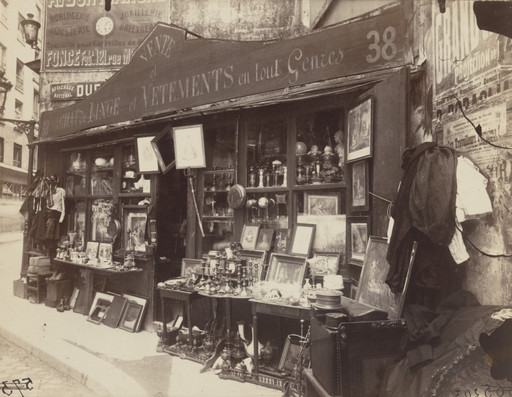
Vernacular photography
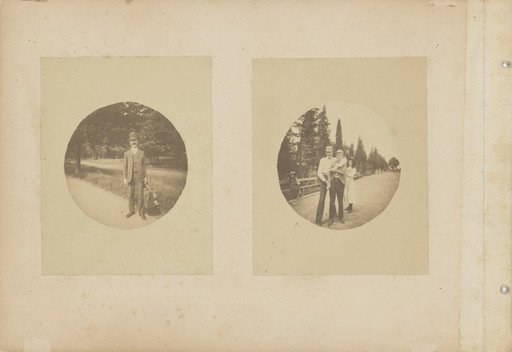
An umbrella term used to distinguish fine art photographs from those made for a huge range of purposes, including commercial, scientific, forensic, governmental, and personal.
Learn more →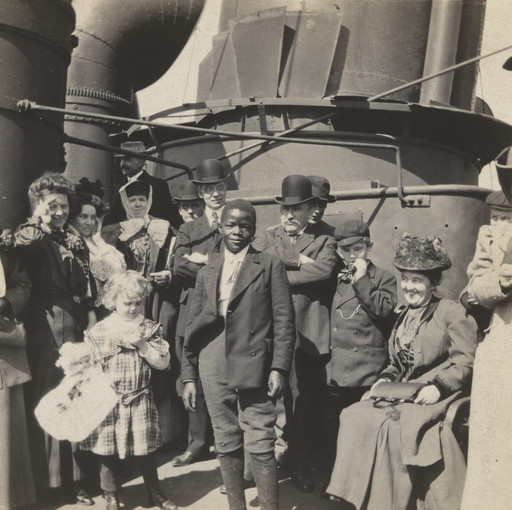
From MoMA Design Store


Installation views
We have identified this work in the following photos from our exhibition history.
Licensing
Artwork or archival images
If you would like to reproduce an image of a work of art in MoMA's collection, or an image of a MoMA publication or archival material (including installation views, checklists, and press releases), please contact Art Resource (publication in North America) or Scala Archives (publication in all other geographic locations).
Audio and film clips
MoMA licenses archival audio and select out of copyright film clips from our film collection. At this time, MoMA produced video cannot be licensed by MoMA/Scala. All requests to license archival audio or out of copyright film clips should be addressed to Scala Archives at [email protected]. Motion picture film stills cannot be licensed by MoMA/Scala. For access to motion picture film stills for research purposes, please contact the Film Study Center at [email protected]. For more information about film loans and our Circulating Film and Video Library, please visit Circulating Film and Video Library.
Text from a publication or the archives
If you would like to reproduce text from a MoMA publication, please email [email protected]. If you would like to publish text from MoMA's archival materials, please fill out this permission form and send to [email protected].
Feedback
This record is a work in progress. If you have additional information or spotted an error, please fill out this feedback form.