Not on view
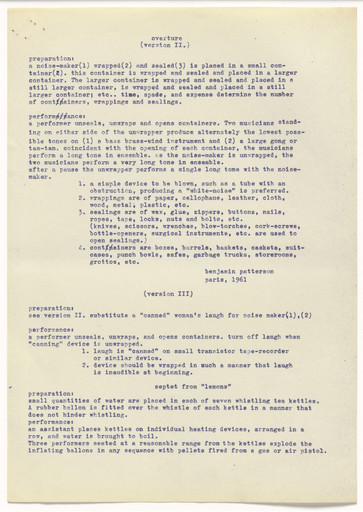
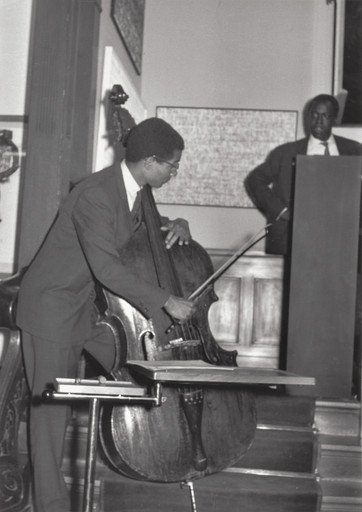
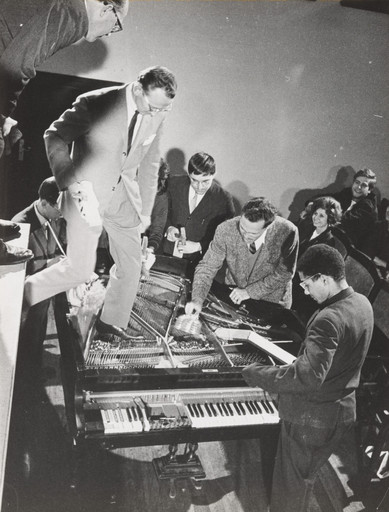
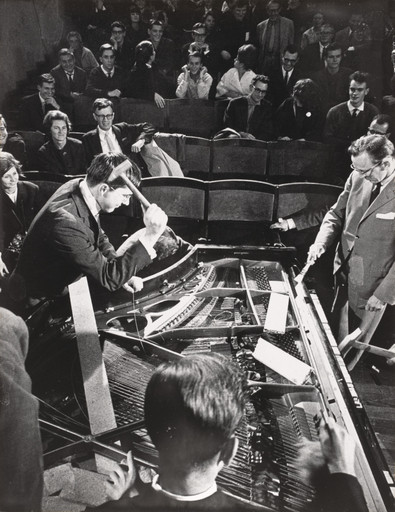
Clothespins, plastic butterflies, blowtorches, buttons, a red feather duster, a Japanese fan, a map of the world—these unexpected objects are invoked in Patterson’s whimsical scores for Overture and Variations for Double-Bass. Patterson, a composer and classically trained bassist, was denied employment with orchestras because of his race. In the 1960s he began traveling the world with the international Fluxus collective, becoming one of its key participants and its only African American member. Rejecting the conventions of Western musical notation and performance, Patterson created a form of communal creation in which participants interpreted and “composed” in the moment, rather than following a predetermined set of notes or instructions. The result was startlingly open-ended. Indeed, the score for Variations for Double-Bass denies the very existence of a score: “Pitches, dynamics, durations and number of sounds to be produced in any one variation in this composition are not notated. In the first performance by the composer a graphic score derived from ink blots was used as a guide; however, there are many other satisfactory solutions.” By prompting performers to elicit unconventional sounds from unconventional sources—such as whistling tea kettles and bursting balloons—Patterson created multisensory experiences that redefined both music and art.
Artist’s Choice: Grace Wales Bonner—Spirit Movers, November 18, 2023 – April 07, 2024
Explore more
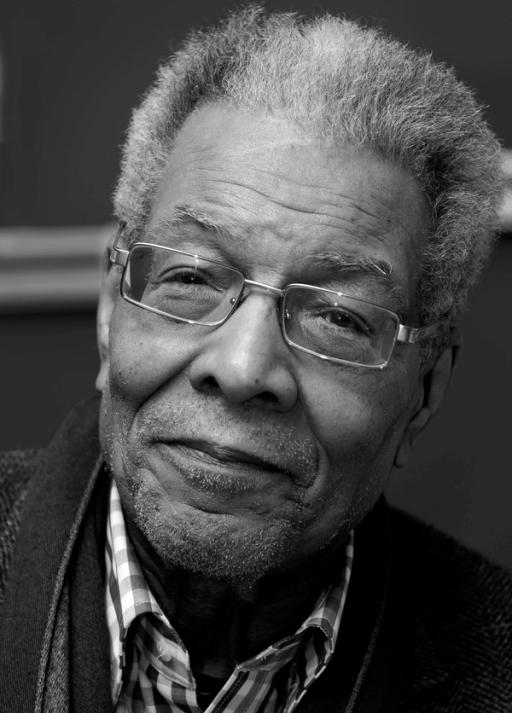
Benjamin Patterson
American, 1934–2016 54 works onlineOn December 22, 1960, during a stay in Cologne, Germany, Benjamin Patterson wrote a letter to his parents in Pittsburgh containing the score for his recent composition Paper Piece .
Learn more →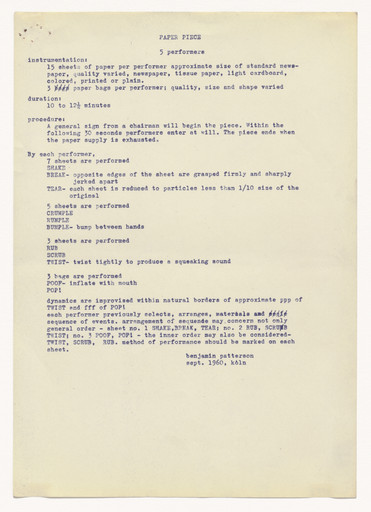

From MoMA Design Store


Licensing
Artwork or archival images
If you would like to reproduce an image of a work of art in MoMA's collection, or an image of a MoMA publication or archival material (including installation views, checklists, and press releases), please contact Art Resource (publication in North America) or Scala Archives (publication in all other geographic locations).
Audio and film clips
MoMA licenses archival audio and select out of copyright film clips from our film collection. At this time, MoMA produced video cannot be licensed by MoMA/Scala. All requests to license archival audio or out of copyright film clips should be addressed to Scala Archives at [email protected]. Motion picture film stills cannot be licensed by MoMA/Scala. For access to motion picture film stills for research purposes, please contact the Film Study Center at [email protected]. For more information about film loans and our Circulating Film and Video Library, please visit Circulating Film and Video Library.
Text from a publication or the archives
If you would like to reproduce text from a MoMA publication, please email [email protected]. If you would like to publish text from MoMA's archival materials, please fill out this permission form and send to [email protected].
Feedback
This record is a work in progress. If you have additional information or spotted an error, please fill out this feedback form.